

Commentary
Michael Young
{
  "authors": [
    "Michael Young"
  ],
  "type": "commentary",
  "blog": "Diwan",
  "centerAffiliationAll": "dc",
  "centers": [
    "Carnegie Endowment for International Peace",
    "Malcolm H. Kerr Carnegie Middle East Center"
  ],
  "collections": [
    "Inquiring Minds"
  ],
  "englishNewsletterAll": "menaTransitions",
  "nonEnglishNewsletterAll": "",
  "primaryCenter": "Malcolm H. Kerr Carnegie Middle East Center",
  "programAffiliation": "MEP",
  "programs": [
    "Middle East"
  ],
  "projects": [],
  "regions": [
    "Levant",
    "Iraq",
    "Middle East"
  ],
  "topics": [
    "Political Reform",
    "Civil Society"
  ]
}
Source: Getty
A regular survey of experts on matters relating to Middle Eastern and North African politics and security.
Renad Mansour | Research fellow in the Middle East and North Africa Program at Chatham House, the Royal Institute of International Affairs, London
The elections in Iraq this past summer were marked by the lowest voter turnout since the United States invaded the country in 2003. In the subsequent government formation process, the same cast of characters came together to divide power between themselves. This process has yet to benefit citizens. As such, many Iraqis remain disillusioned. They do not believe that the same political class working in the same political system can produce real change.
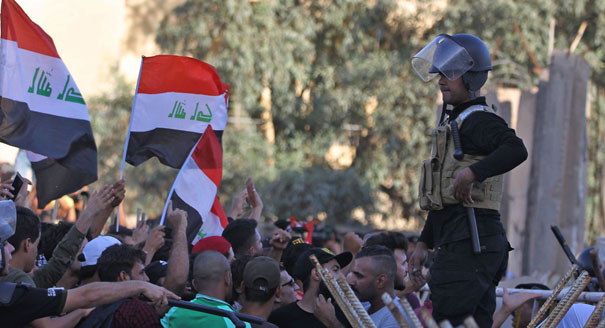
In Basra and the southern governorates, residents have again taken to the streets to demonstrate against a lack of electricity, water, and employment, which are felt particularly hard during the summer heat. Yet this protest movement, which has existed for several years, is not interested in changing a few leaders, but rather in changing the system, which is symbolized by the ethno-sectarian quota, or muhassasa, power-sharing model. The government formation process may, therefore, feature new officials to appease the protesters, but for most Iraqis the problem is the political class and system that has failed to govern for the past fifteen years. To many Iraqis, real change cannot come through the government formation process or the current institutions of the state. This underlines that the gap between the rulers and ruled will remain.
Martin Chulov | Middle East correspondent of The Guardian
Iraq has seen protests before, but nothing like the ones recently. For more than a month large parts of the country’s south and center have been in revolt against a sclerotic state whose feckless political class continues to deliver little. The latest parliamentary elections in early May have yet to yield even the hint of a government. Using the “legitimacy” of a political process, myriad interests are competing to carve up the spoils of a relatively wealthy postwar country, notwithstanding decades of war and insurgency.
Prime Minister Haidar al-‘Abadi has made concessions, pledged cash, and visited the scorching, often electricity-less south to hear demands, but has not won peoples’ trust. Services remain woeful, and fixing them requires the buy-in of a functioning state that a dysfunctional political system can only sometimes offer. It remains unclear whether any leadership candidate can soothe real grievances about staggering levels of corruption across all levels of governance.
After the last elections in 2010, the horse-trading to elect a government took nine months, and that was in better times. This time, a combustible street is holding its leaders to account away from the ballot box. It may eventually produce better roads and more hours of power. But it won’t deliver a government anytime soon.
Muhanad Seloom | Associate lecturer at the University of Exeter in the United Kingdom
There are three centers of governance in Iraq: The president, prime minister, and ministers who are locally classified as heading “sovereign” or “service” ministries. In this context, sovereign and service ministries mean powerful and less powerful ministries, respectively. The current protests will impact the nomination of the next prime minister and ministers of service ministries. To address the protestors’ demands, service ministries will most likely be led by technocrats, who can help provide basic services such as electricity, water, health services, planning, and transport. Sovereign ministries, such as foreign affairs, interior, oil, and defense, are unlikely to be staffed by technocrats. Instead, the political parties forming the next Iraqi government will insist on nominating senior party members to become sovereign ministers—meaning ministers who are selected through political patronage, not on merit. These partial reforms might, therefore, not entirely satisfy the protestors who are calling for real and tangible reforms.
Echoing the protests in Shi‘a-majority southern governorates and Baghdad, the Marja‘iyya, the Shi‘a community’s highest religious authority, issued a statement on July 27 calling on the political parties to form a government as soon as possible, led by a prime minister who must be “brave and firm against corruption.” Prime Minister Haidar al-‘Abadi has been criticized for not doing enough to fight corruption over the past four years. At the same time, his government’s violent clampdown on protesters has revealed a disconnect between the public and the political class. Consequently, ‘Abadi’s chances of securing a new term are, in light of the protestors’ demands, slim.
Harith Hasan | Non-resident senior fellow at the Carnegie Middle East Center in Beirut
So far, the protests in the southern governorates have suspended the government formation process, which was already stumbling due to widespread accusations of electoral fraud and the parliament’s decision to recount votes manually. Recently, a new factor has also emerged: Ayatollah ‘Ali Sistani’s explicit support for the protesters’ demands and his warning of a stronger reaction if the political class fails to quickly form a new government and take more serious measures to fight corruption and improve public services. This has put more pressure on the Shi‘a groups that have for a long time claimed to be following Sistani’s guidance. However, their ability to deliver remains in doubt for several reasons, including the likely resistance from Kurdish and Sunni parties to a non-partisan government that would deprive them of their shares in power.
Still, given Sistani’s position, and if protests continue and gain more momentum, the dominant factions might be forced to accept making concessions, such as forming a transitional government led by independents or a government of non-partisan technocrats. However, if the protests lose their momentum and wane, as happened in 2016, fundamental change is unlikely. In that case the dominant political parties will resume their business-as-usual approach, again apportioning state institutions and the spoils of the state among themselves, while publicly paying lip service to Sistani and claiming they are implementing his instructions. The protests have been strong enough to distract the political factions, yet not enough to force substantial change in their behavior. If the dominant factions do not regard the protests as a real and imminent threat, they will opt for temporary, cosmetic adjustments.

Editor, Diwan, Senior Editor, Malcolm H. Kerr Carnegie Middle East Center
Michael Young is the editor of Diwan and a senior editor at the Malcolm H. Kerr Carnegie Middle East Center.
Recent Work
Michael Young
Michael Young
Carnegie does not take institutional positions on public policy issues; the views represented herein are those of the author(s) and do not necessarily reflect the views of Carnegie, its staff, or its trustees.
As Iran defends its interests in the region and its regime’s survival, it may push Hezbollah into the abyss.
Michael Young
A recent offensive by Damascus and the Kurds’ abandonment by Arab allies have left a sense of betrayal.
Wladimir van Wilgenburg
The government’s gains in the northwest will have an echo nationally, but will they alter Israeli calculations?

Armenak Tokmajyan
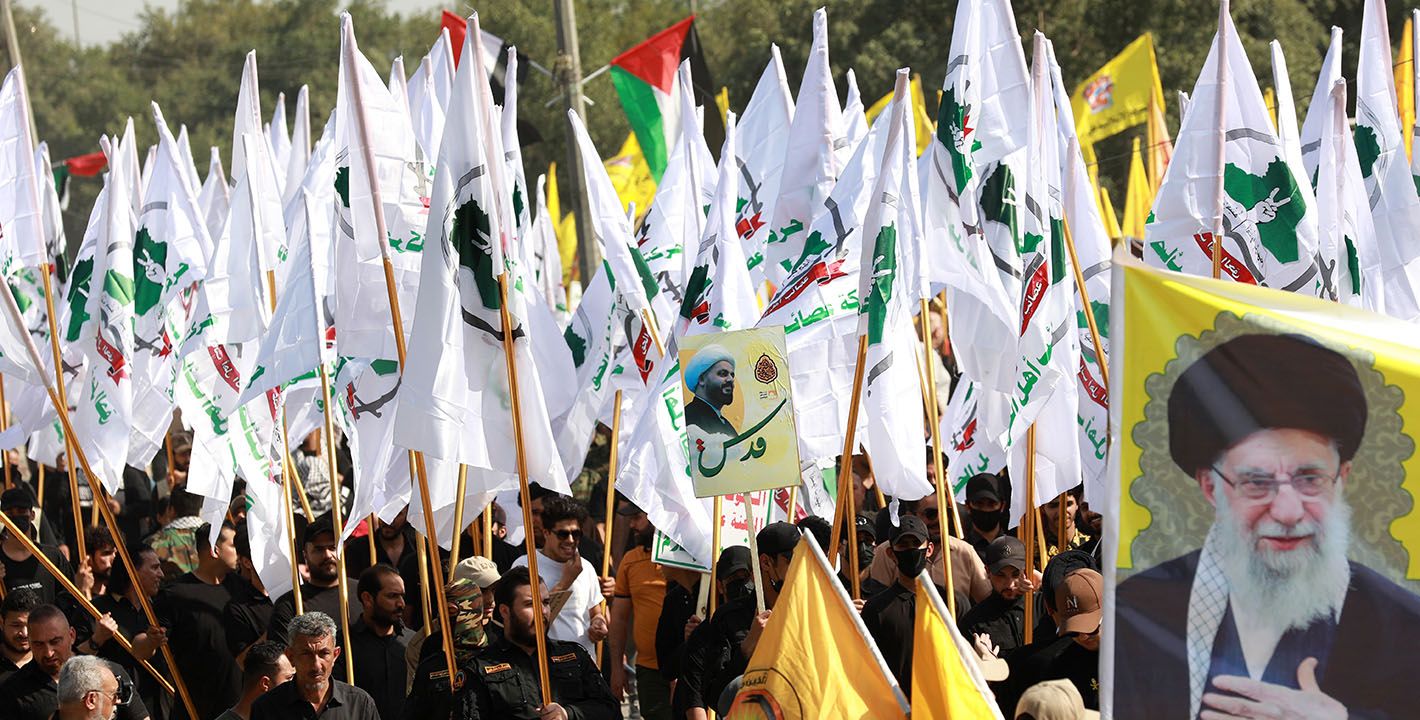
Beirut and Baghdad are both watching how the other seeks to give the state a monopoly of weapons.
Hasan Hamra

The country’s leadership is increasingly uneasy about multiple challenges from the Levant to the South Caucasus.
Armenak Tokmajyan