

Commentary
Baku may allow radical nationalists to publicly discuss “reunification” with Azeri Iranians, but the president and key officials prefer not to comment publicly on the protests in Iran.
Bashir Kitachaev
{
  "authors": [
    "Xue Gong"
  ],
  "type": "commentary",
  "centerAffiliationAll": "",
  "centers": [
    "Carnegie Endowment for International Peace",
    "Carnegie China"
  ],
  "collections": [
    "Carnegie China Commentaries"
  ],
  "englishNewsletterAll": "",
  "nonEnglishNewsletterAll": "",
  "primaryCenter": "Carnegie China",
  "programAffiliation": "",
  "programs": [],
  "projects": [],
  "regions": [
    "China",
    "Southeast Asia",
    "Russia",
    "India",
    "Brazil",
    "South Africa",
    "United States"
  ],
  "topics": [
    "Foreign Policy",
    "Global Governance",
    "Trade",
    "BRICS"
  ]
}
While China will remain a significant political and economic force in the Global South, its ambition to leverage the Global South as a counterbalance to the United States and the Global North is far from assured.
This publication is a product of Carnegie China. For more work by Carnegie China, click here.
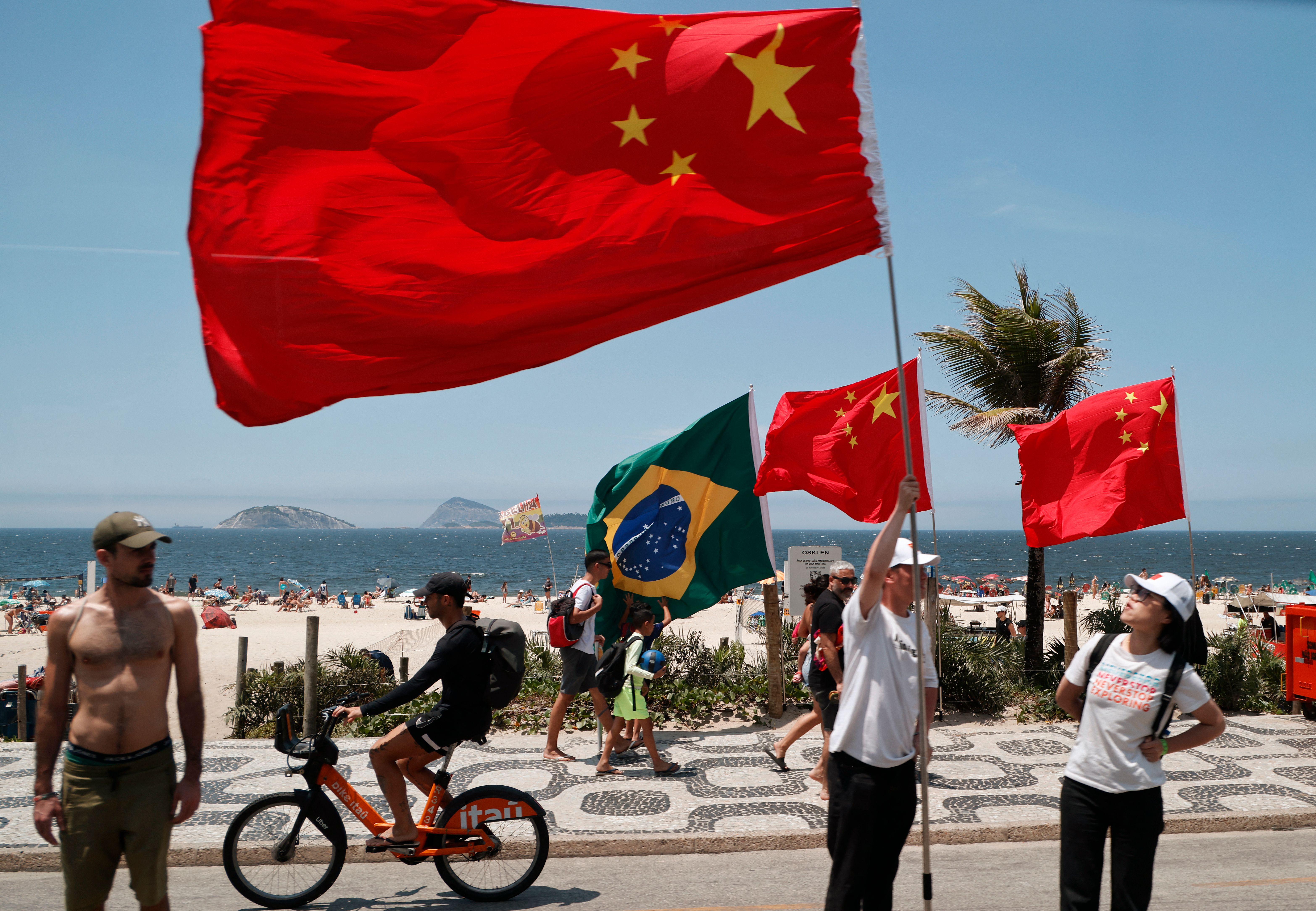
At the G20 Summit in Rio de Janeiro, Brazil, China unveiled eight initiatives to support the Global South, including advancing technology connectivity and cooperating on poverty reduction, food security, and climate change. China’s initiatives came as no surprise. As its tensions with the Global North intensify—particularly in areas of economic competition, technological rivalry, and security issues such as the Russia-Ukraine war—the Global South, with approximately 85 percent of the world’s population, assumes great significance in China’s foreign policy. Facing a weak domestic market, increasing trade restrictions from the West, and growing tensions with the United States, China seeks to mobilize support from the Global South to counterbalance the West in economic, security, and ideological challenges. However, China’s Global South policy is increasingly confronted by its limits in trade and investment and its self-deceiving security-nexus approach.
Historically, China has forged fifteen free trade agreements (FTAs) with Global South countries, among its twenty-one FTAs with foreign governments, to expand its economic influence in these countries and regions. To reduce reliance on Western economies, China has boosted trade and investments with economic unions, organizations, and regions like the African Union, ASEAN, the Middle East, and BRICS Plus. In 2023, China’s exports to ASEAN and BRICS Plus nations nearly matched its exports to the EU and the U.S. combined. At the latest G20 summit, President Xi Jinping announced the unilateral opening-up of the Chinese economy for the low-income countries that have established diplomatic relations with China. This announcement follows China’s recent commitment made in September 2024 to offer zero-tariff treatment on 100 percent of tariff lines. These measures aim to reinforce China’s image as a proponent of free trade and globalization for the Global South.
However, China’s trade and investment relationship with the Global South faces three key challenges: trade tensions with emerging markets, reduced capabilities in supporting infrastructure development, and a heavy reliance on Western capital for both China and the Global South.
First, China is facing a dilemma between bolstering consumption in its domestic economy over maintaining unbalanced trade relationships with nations from the Global South. Over the years, there’s been a growing realization among many Global South countries that the trade dynamics between China and themselves result in unfavorable trade imbalances. One of the major issues is China’s substantial state subsidies and unfair trade practices, which both Western countries and Global South countries criticize. Countries like India, Brazil, Thailand, and Chile are particularly struggling with the by-products of Chinese economic policies.
While China is steering its economy towards a high-tech and consumption-led model, its overcapacity in green energy such as electric vehicles (EVs) and solar panels will struggle to find alternative markets due to tariffs being imposed by rich countries in Europe and North America on Chinese products. As trade barriers rise in the developed world, many Global South markets will encounter a rapid influx of surplus Chinese goods, prompting emerging Global South countries like South Africa and Brazil to adopt anti-subsidy and anti-dumping measures to counteract Chinese products like steel, EVs, solar panels, and fiber optic cables. Therefore, China’s promise of delivering green and digital connectivity through billions of dollars in Silk Road Funds at the latest G20 Summit may risk straining its relationships with the Global South.
Second, China’s offerings may not easily align with the needs or capacity of low-income countries of the Global South. Many non-emerging Global South countries lack the infrastructure and consumption to support Chinese industries. While rising trade barriers from Western developed nations may push these countries toward China, their experiences with initiatives like the Belt and Road Initiative (BRI) have raised doubts due to issues with excessive debt, lack of transparent governance, and environmental impact. China’s overseas development finance has declined significantly, dropping from $90 billion in 2016 to less than $5 billion in 2021. This reflects a shift towards smaller-scale projects and China’s shrinking capabilities. Additionally, China’s status as a “developing country” in the World Trade Organization (WTO) is creating tensions with low-income nations. China has been accused of using Special and Differential Treatment to compete with other developing countries, contradicting its narrative of championing fairness in multilateralism.
Third, while China seeks to leverage the Global South to counter tensions with the Global North, it still relies on high-quality foreign direct investments (FDI) from the West to support its economic transition. Despite expanding trade and investments with the Global South, China’s dependence on Western markets remains strong.
Driven by President Xi Jinping’s aim to build a shared “community of humankind,” China connects the development and security of Global South countries to its own goals. Through initiatives like the Global Development, Security, and Civilization Initiatives, China promotes its “China wisdom” to address challenges, emphasizing the security-development nexus, where economic growth helps mitigate security concerns. For decades, China has hoped to inspire the Global South to adopt its model of modernization, demonstrating that developing countries can achieve stability and prosperity without relying on Western practices. Unlike Western financing, China’s approach is often seen as attractive for its ability to provide much-needed capital without conditionalities.
However, China’s development-security nexus is not a cure-all for the Global South. While economic growth can address some causes of instability, it doesn’t resolve political or security issues, especially in countries with ethnic, religious, or geopolitical tensions. In countries like Pakistan and Myanmar, Chinese investments have caused frictions with locals or become entangled in political strife, worsening instability. Additionally, China’s no-strings-attached and non-interventionist approaches have been criticized for supporting authoritarian models. India has refused to join the BRI and has accused China’s investments of undermining democratic principles of governance, like transparency. Even some African politicians, for example, have also accused China of undermining democracy in the region.
Moreover, China’s Global South policy, which often emphasizes shared historical experiences of colonization and subjugation, does not always resonate in Asia. Ongoing territorial disputes with countries like India over their shared border and with several Southeast Asian nations over the South China Sea complicate China’s narrative of harmonious South-South cooperation. These territorial disputes undermine China’s efforts to mitigate security tensions through economic development. In fact, China’s large-scale infrastructure projects in Southeast Asia and the Indian Ocean are often seen as enhancing China’s military and geopolitical influence, which results in further securitizing of China’s economic activities in the region. For instance, India cracked down on Chinese tech companies and has implemented a series of restrictions on China’s investments after the deadly Galwan Valley clash in June 2020.
While regional countries like Malaysia, Indonesia, Vietnam, and Thailand have become partner countries of the BRICS group, this alignment does not automatically translate into unified support for China in matters of security. It is emblematic of Global South countries’ institutional balancing behavior to diversify economic and political relations. To mitigate the potential risks of overreliance on China, they also actively engage with Global North-led institutions. For instance, Vietnam, despite its participation in BRICS, has strengthened its security and economic ties with the United States and its allies to counter China’s growing influence in the Indo-Pacific region.
Global South countries have been quite wary of being caught in the crossfire of great power competition. This is because historically, many of these countries have advocated for non-alignment—a principle that seeks to maintain autonomy and avoid entanglement in great power competition. Therefore, for decades, they have been exploring regional partnerships, multilateral agreements, and alternative trade routes to avoid being caught in great power competition. For instance, in 2020, amid trade tensions between the U.S. and China, leaders in Africa established the world’s largest free-trade zone: the African Continental Free Trade Area.
With Donald Trump returning to power in 2025, his “America First” policies, combined with new trade barriers and tariffs, could disrupt trade for Global South countries and challenge the WTO, placing a significant strain on Global South countries that rely on multilateralism. For instance, Trump threatened 100 percent tariff on BRICS countries for the blocs’ attempts to undercut the U.S. dollar on November 30.
While China’s rise could drive global governance reforms and challenge the Global North’s dominance, many countries remain cautious. This trend is exacerbated by at least two concerns: first, Global South countries are concerned about becoming overly dependent on China and fear that China’s increasing influence could replace one form of dominance with another.
Second, Global South countries are also cautious about how their economic ties with China could be perceived by the United States. Brazil reportedly declined China’s invitation to join the BRI, ahead of President Xi’s visit to the G20 Summit. Moreover, having close economic ties with China may invite increased scrutiny of Chinese contents in goods that are routed through third markets. For instance, Chinese companies have used Southeast Asia, Mexico, and other Global South countries to disguise the origin of their products, a practice known as “Southeast Asia-washing.” A second Trump administration will be more willing to apply stricter and tighter controls over trade and investments with other Global South countries. Therefore, countries in the Global South have increasingly realized the importance of diversifying their trade partners. Economic unions like ASEAN and MERCOSUR have turned to the European Union to gain access to balance their supply chain relationships.
In all, China’s Global South policy is increasingly challenged by its limits in trade and investment and its self-deceiving security-nexus approach. Despite these challenges, China’s Global South policy will remain central to its foreign policy, perhaps more so than ever before.
Carnegie does not take institutional positions on public policy issues; the views represented herein are those of the author(s) and do not necessarily reflect the views of Carnegie, its staff, or its trustees.
Baku may allow radical nationalists to publicly discuss “reunification” with Azeri Iranians, but the president and key officials prefer not to comment publicly on the protests in Iran.

Bashir Kitachaev

The country’s leadership is increasingly uneasy about multiple challenges from the Levant to the South Caucasus.

Armenak Tokmajyan
The U.S. is trying to force Lebanon and Syria to normalize with Israel, but neither country sees an advantage in this.

Michael Young
The countries of the region have engaged in sustained competition that has tested their capacities and limitations, while resisting domination by rivals. Can a more stable order emerge from this maelstrom, and what would it require?


Hamza Meddeb, Mohamed Ali Adraoui

The objective is to lock Hamas out of political life, but the net effect may be negative indeed.

Nathan J. Brown