

Commentary
Sergey Vakulenko
{
  "authors": [
    "Sergey Vakulenko"
  ],
  "type": "commentary",
  "blog": "Carnegie Politika",
  "centerAffiliationAll": "",
  "centers": [
    "Carnegie Endowment for International Peace",
    "Carnegie Russia Eurasia Center"
  ],
  "englishNewsletterAll": "",
  "nonEnglishNewsletterAll": "",
  "primaryCenter": "Carnegie Russia Eurasia Center",
  "programAffiliation": "",
  "programs": [],
  "projects": [],
  "regions": [
    "Russia",
    "Ukraine"
  ],
  "topics": [
    "Energy",
    "Military",
    "Foreign Policy",
    "Climate Change",
    "Security"
  ]
}
Source: Getty
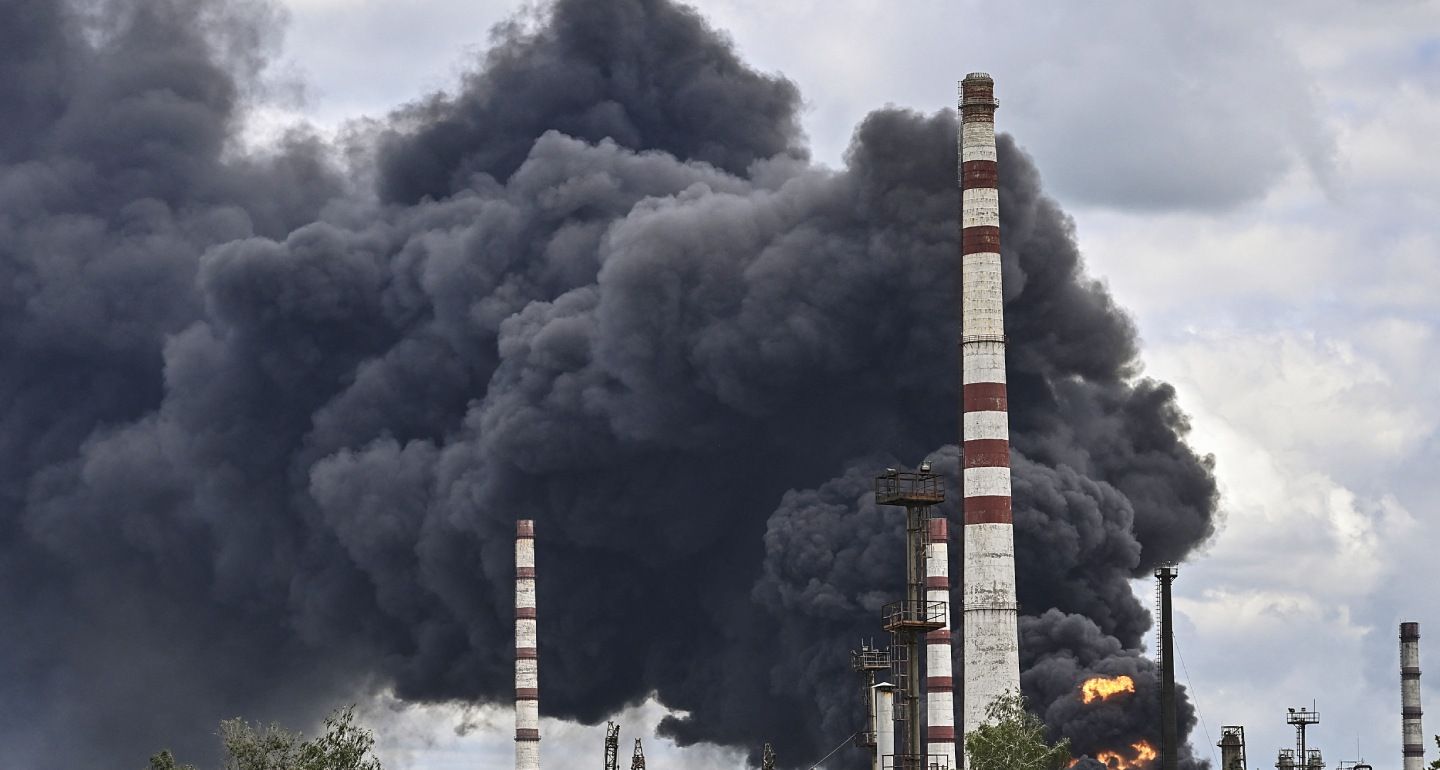
Kyiv’s unprecedented strike campaign on Russian oil refineries has inflicted serious—but likely not critical—damage on the country’s ability to produce fuel.
There has been a lot of speculation in recent days about how much damage Ukrainian drone attacks have done to Russia’s oil refineries, with some news outlets claiming Russia has lost 38 percent of its oil refining capacity. While this figure might have some formal basis in fact, the real state of affairs is far more complex.
On paper, Russia can refine 327 million tons of oil every year (or 6.5 million barrels per day). And the capacity of the 16 refineries that have been attacked by Ukrainian drones in August and September is 123 million tons a year—or 38 percent of the total. In other words, 38 percent is the upper limit of potential damage.
For Moscow, the current situation is far more serious than in the spring and summer of 2024 when Ukraine conducted a similar strike campaign. Now, Ukrainian drones can fly further, carry bigger payloads, and attack more frequently. Russia’s Volgograd refinery was hit twice in August and twice in September; the Novokuibyshev refinery has been struck three times (about one every three weeks); and the Ryazan, Saratov, and Salavat refineries have been hit twice each. Previously, Kyiv had only been able to target the Krasnodar and Rostov refineries with such regularity—because they are nearer the Ukraine border, and could be reached by light, low-cost drones.
There are three important questions that must be answered when attempting to assess the current level of damage to Russia’s oil refineries: were they working at full capacity before the attacks? Was the damage complete or partial? Has the damage been repaired or is it still hindering throughput?
While there is not enough publicly available information to provide exhaustive answers, we can draw some conclusions. During the 2024 campaign, most refineries kept operating—at least in part—after attacks, and had restored full output within weeks—and this is true today. The Volgograd refinery, for example, was able to fully repair the damage from attacks by multiple drones on August 13 and August 14, and had restored full operations by August 25.
The starting point for calculations can also be misleading. Russia’s refining capacity is not equal to output. Every year, Russia refines up to 270 million tons—so at least 22% of the country’s total capacity is always idle (there are various reasons for this, but one is that there is a lot of old equipment in place that just hasn’t been decommissioned). Russian domestic consumption of oil products is about 120 million tons a year, with the rest sent for export.
The exact surplus varies according to oil product, but is substantial in every case. For example, Russia produces 16 percent more gasoline than it requires for domestic consumption, and almost twice as much diesel. In addition, Russia’s production of naphtha could meet 60 percent of the country’s gasoline needs (with additives, naphtha can, if necessary, be made into Euro-3 gasoline).
It’s also important to remember that a reduction in primary refining capacity (for example, damage to an atmospheric distillation column) generally does not mean a proportional reduction of market-grade fuel output. Russian refineries tend to have surplus primary distilling capacity, and bottlenecks when it comes to secondary treatment and conversion units turning distillates into market-grade fuel. Therefore, the destruction of one of two identical atmospheric distillation columns in a refinery is more likely to lead to a 30 percent drop in gasoline production—not 50 percent as you might expect.
These details and nuances reveal themselves in statistics. According to Russian newspaper Kommersant, gasoline output has fallen 10%. Industry analysts, who might have access to non-public sources, estimate Russia is currently refining just under 5 million barrels a day (a 38% reduction in capacity would mean the figure was 4 million barrels per day).
In other words, Russia’s oil refineries are facing a lot of problems—but things are far from catastrophic. How the situation develops in the coming months depends on whether Ukraine is able to maintain the pace of its strike campaign, or even ramp up attacks. There are several ways the latter could happen: scope (the number of refineries being attacked), scale (the number of drones and the size of their payloads), or timing (how frequently they strike one target).
Russia’s oil refineries are a bit like a man who is being repeatedly punched. He will not die from one punch, or even half a dozen punches. But it becomes harder and harder for him to recover after each subsequent blow. Although no single punch is fatal, he could end up being beaten to death.
Russia’s ability to ward off Ukrainian attacks using air defense systems is a separate—albeit important—question. Here the attacker has the advantage: it’s far harder for Moscow to re-deploy air defenses than it is for Kyiv to simply re-direct its strikes to poorly-protected refineries. And if air defenses are spread too thin, some drones will get through. At the same time, refineries have started to erect anti-drone defenses, including netting and improvised coverings that protect vulnerable spots. For some, these sorts of defenses are comical—but they have proven themselves to be effective on the frontlines in Ukraine.
For the moment, it’s unclear who will come out on top in the battle over Russia’s oil refineries—only time will tell. While the 38 percent figure may be based on real data, it’s a long way from accurately reflecting the nuance of the present situation.

Senior Fellow, Carnegie Russia Eurasia Center
Sergey Vakulenko is a senior fellow at the Carnegie Russia Eurasia Center.
Recent Work
Sergey Vakulenko
Sergey Vakulenko
Carnegie does not take institutional positions on public policy issues; the views represented herein are those of the author(s) and do not necessarily reflect the views of Carnegie, its staff, or its trustees.

Sergei Kiriyenko used Russia’s parliamentary vote to further hone his strategy of corporate mobilization that is designed to maximize votes for United Russia.

Andrey Pertsev

The European far right might fail to steer EU policy in the direction Russia wants, but they will create enough chaos inside Europe to benefit the Kremlin.

Dimitar Bechev

Minsk clearly expected the dialogue with Washington to yield more results, in particular the lifting of EU sanctions and permission to export potash.

Artyom Shraibman

Russia’s ruling party would have benefited from Putin appearing as its distant patron, but as an active frontman imposing his views on the public, he has done nothing but harm both the party’s election campaign and the ruling system overall.
Andrey Pertsev

Depleted financial reserves and a shrinking tax base mean it is no longer possible to simultaneously deliver high defense spending, price stability, and economic growth.

Alexandra Prokopenko