

{
  "authors": [
    "Minxin Pei",
    "Tianjian Shi"
  ],
  "type": "event",
  "centerAffiliationAll": "dc",
  "centers": [
    "Carnegie Endowment for International Peace"
  ],
  "collections": [],
  "englishNewsletterAll": "asia",
  "nonEnglishNewsletterAll": "",
  "primaryCenter": "Carnegie Endowment for International Peace",
  "programAffiliation": "AP",
  "programs": [
    "Asia"
  ],
  "projects": [],
  "regions": [
    "South Asia",
    "East Asia",
    "Southeast Asia"
  ],
  "topics": [
    "Political Reform",
    "Democracy"
  ]
}
How Do Asian People Understand Democracy?
Wed, November 28th, 2007
Washington, D.C.
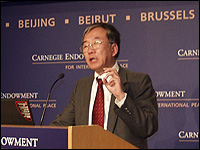
IMGXYZ820IMGZYXThe China Program at Carnegie Endowment held a breakfast session entitled “How Do Asian People Understand Democracy?” on November 28, 2007, where Dr. Tianjian Shi, Associate Professor of the Political Science Department at Duke University, presented result of the latest survey he conducted in Asia regarding Asian people’s perception of democracy. Director of China Program Minxin Pei moderated the event.
Shi’s survey, which entitled as the “Asia Barometer,” was inspired partially by former Prime Minister of Singapore Mr. Lee Kuan Yew, who claimed during the early 1990s that Western Liberalists’ belief of “end of the history” would not apply to Asia, because given the uniqueness of Asian culture and its significant influence over the political systems of most countries in the region, practices of liberal democracy among Asian governments would be very difficult. The main purpose of Shi’s survey was therefore to figure out whether there is a clash between liberal democratic values and Asian culture.
Based on data collected throughout Japan, Hong Kong, Taiwan, Mainland China, and other countries in Southeast Asia, Shi’s report produced several interesting results. According to the survey, citizens in Hong Kong and Taiwan commit much less to democracy than people in Mainland China do. In addition, many people from the mainland believe democracy would be suitable for their country, while fewer people in Hong Kong and Taiwan believe such suitability. More surprisingly, the survey reveals that people in Mainland China perceived the supply of democracy in their country as fairly high while people in Taiwan believe the supply of democracy on the island exceed their demand, i.e., their government has become “too democratic.”
Shi listed out two rational justifications for such interesting results. First of all, Chinese people who participated in this survey might be deterred from telling the truth lest punishment from the authoritarian regime if they did so. The second explanation appears to be more reasonable: Asian people might have a total different interpretation of liberal democratic values than people in the West do. Based on such hypothesis, Shi came up with two separate definitions of democracy: Procedural Democracy and Substantive Democracy. The former, which corresponds to Western democracy, determines the legitimacy of state governments based on democratic procedures such as election, lobbying, etc., while the latter believes definition of democracy mainly based on how well policies from the governments reflect interests of the public. Apparently, people in Asia associate themselves more with the Substantive Democracy.
In the end, Shi reached three conclusions from his survey. First, people in Asia embraces democracy in its principals, such as the freedom of belief. However, they have a totally different understanding than the West specifically on the implementation of democracy. Finally, regimes in Asia are highly capable of manipulate their people by modifying the definition of democracy whenever necessary.
Carnegie does not take institutional positions on public policy issues; the views represented herein are those of the author(s) and do not necessarily reflect the views of Carnegie, its staff, or its trustees.
Event Speakers
Former Adjunct Senior Associate, Asia Program
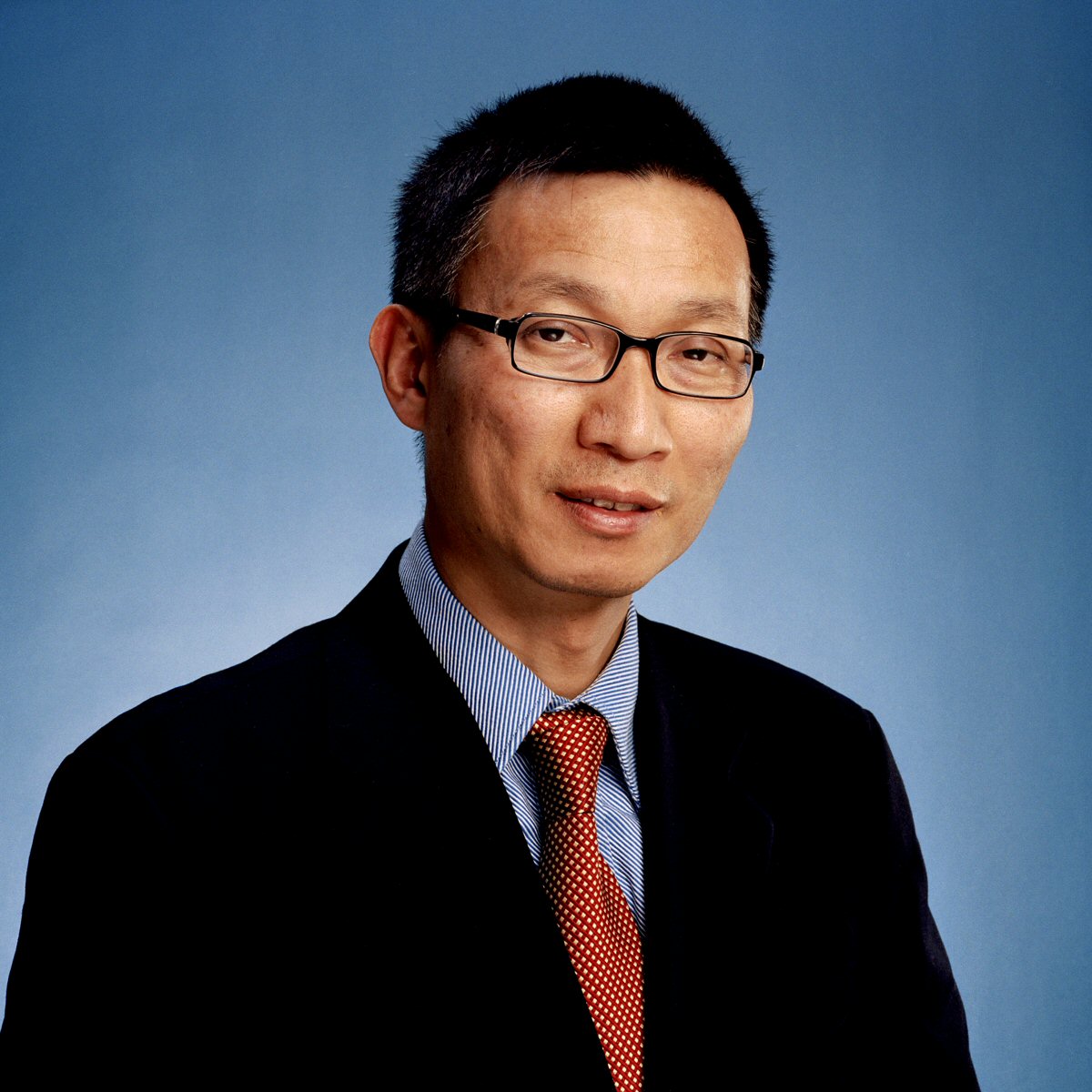
Pei is Tom and Margot Pritzker ‘72 Professor of Government and the director of the Keck Center for International and Strategic Studies at Claremont McKenna College.
Former Senior Associate, Beijing
Shi Tianjian is a specialist in Asian security issues and political participation.