

{
  "authors": [
    "Uday Bhaksar"
  ],
  "type": "event",
  "centerAffiliationAll": "dc",
  "centers": [
    "Carnegie Endowment for International Peace"
  ],
  "collections": [],
  "englishNewsletterAll": "ctw",
  "nonEnglishNewsletterAll": "",
  "primaryCenter": "Carnegie Endowment for International Peace",
  "programAffiliation": "SAP",
  "programs": [
    "South Asia"
  ],
  "projects": [],
  "regions": [
    "South Asia",
    "India"
  ],
  "topics": [
    "Nuclear Policy",
    "Nuclear Energy"
  ]
}
Ten Years After Pokhran II: Nuclear Stability in Southern Asia
Mon, May 12th, 2008
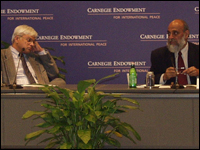
IMGXYZ898IMGZYX Reflecting on the ten year anniversary of India’s Pokhran II nuclear tests, retired Indian Cmde. Uday Bhaksar said that the tests have been good for security in India and in Asia. Speaking at Carnegie on May 12, Bhaksar noted that India’s tests, which followed Pakistan's, transformed those two nations’ programs from covert to nascent overt capabilities, a situation he said is better for stability.
Pokhran II also transformed India’s position with regard to China. From 1964 until May of 1998, China’s nuclear arsenal created a regional imbalance. Pokhran II created mutual deterrence between India and China, which prevented the emergence of a unipolar Asia, with a dominant China at the center.
Bhaksar acknowledged that Pokhran II infuriated President Bill Clinton, and the aftermath of the tests was the nadir of U.S.-India relations. But, Bhaksar said, from that low-point the two nations were able to rebuild the relationship on more stable ground. Pokhran II enabled the U.S. and India, seven years later, to negotiate the civilian nuclear deal, he said.
Many see the development of India’s nuclear arsenal as a failure of the nonproliferation agenda, noted Bhaksar, but he argued that India has behaved as a responsible nuclear power, and that the focus on the acquisition of nuclear weapons by states like India misses the real proliferation threats—individuals like A.Q. Khan and non-state actors. Bhaksar suggested elliminating the Nonproliferation Treaty (NPT) in favor of a modern agreement that addresses the challenges of the twenty-first century.
Carnegie does not take institutional positions on public policy issues; the views represented herein are those of the author(s) and do not necessarily reflect the views of Carnegie, its staff, or its trustees.
Event Speaker
Uday Bhaksar