

Paper
George Perkovich
{
  "authors": [
    "George Perkovich"
  ],
  "type": "legacyinthemedia",
  "centerAffiliationAll": "dc",
  "centers": [
    "Carnegie Endowment for International Peace",
    "Carnegie Russia Eurasia Center"
  ],
  "collections": [
    "U.S. Nuclear Policy"
  ],
  "englishNewsletterAll": "ctw",
  "nonEnglishNewsletterAll": "",
  "primaryCenter": "Carnegie Endowment for International Peace",
  "programAffiliation": "NPP",
  "programs": [
    "Nuclear Policy"
  ],
  "projects": [],
  "regions": [
    "North America",
    "United States"
  ],
  "topics": [
    "Nuclear Policy"
  ]
}
Source: Getty
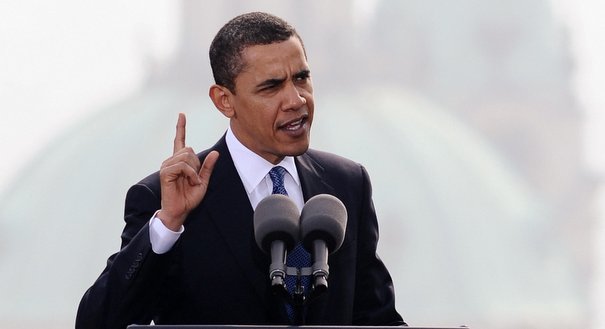
President Obama's vision of a world without nuclear weapons will require step-by-step progress on disarmament by nuclear-armed states, reciprocated by step-by-step progress toward strengthening the nonproliferation regime by non-nuclear-weapon states.
Source: The International Herald Tribune

More importantly, the range of states whose cooperation would be necessary to implement the Prague agenda either oppose it or have done little to help achieve it. Public opinion has not mobilized to make nuclear disarmament and nonproliferation a highly salient issue in any single country, including the United States. The result is a president ready to lead a long-term campaign to remove the existential threats posed by nuclear weapons, but as yet lacking sufficient followers to make it happen.
Proponents and critics have selectively interpreted or misinterpreted the vision Mr. Obama set out in Prague. Some on the left hope (and on the right fear) that he intends to pursue a treaty to ban nuclear weapons, or that he contemplates unilateral U.S. nuclear disarmament. Some believe that all of the obstacles to global disarmament will somehow fall out of the way now that the U.S. has an enlightened leader. Some charge that he will leave allies in Europe and Asia vulnerable to Russia, China, North Korea or Iran.
In reality, Mr. Obama had in mind neither the caricature of the left nor that of the right. As he said clearly in Prague, nuclear weapons probably could not be eliminated in his lifetime, and the United States would maintain a nuclear deterrent as long as other states possess or threaten to acquire these weapons. The Nuclear Posture Review released by the Pentagon on Tuesday clearly negates the idea of U.S. unilateral nuclear disarmament. So does the president’s increased budget to refurbish the aging infrastructure of nuclear weapons laboratories and material-handling facilities.
Rather, Mr. Obama posits the need for all states that now possess nuclear weapons or rely on extended nuclear deterrence to take the steps necessary to obviate their perceived need for these weapons. The Posture Review reaffirms America’s interest in a world without nuclear weapons and clearly reduces the role of nuclear weapons in U.S. security policy. It calls for high-level talks with Russia and China to promote the stability and cooperation that would lead to global reductions of nuclear weapons and cooperation in regional security-building. This is an inherently multilateral challenge. As Mr. Obama said, “all nations must come together to build a stronger, global regime.”
It is only realistic to think that the eventual elimination of all nuclear arsenals would proceed in a co-evolutionary process. Improvements in security relations among key states will facilitate arms control and disarmament steps, which in turn beget further improvements in security relations, and so on.
The new START accord helps improve U.S.-Russian relations, but differences in capabilities and doubts about intentions will make further steps harder. NATO states worry about Russian bullying and so-called “tactical nuclear weapons,” while Russia will cling to its nuclear weapons unless conventional military balances are readjusted and it is reassured about future U.S. missile defense capabilities.
The U.S. and China have only begun to explore how their strategic relations could be cooperative over the long-term. China, India, and Pakistan have not yet imagined the sorts of confidence-building and arms control processes that would be required to reverse their nuclear build ups. In the Middle East, Israel’s willingness to move toward nuclear disarmament would depend on achieving durable peace with its neighbors and verifiable guarantees that Iran and other regional states would not acquire nuclear weapons.
Countries without nuclear arms were in many ways the primary audience Mr. Obama sought to influence with the Prague speech. To some extent he succeeded. Newspapers around the world reflected wide support. The Nobel Committee was moved to award him its peace prize (which actually did not help his nuclear agenda at home or in Moscow).
But the leaders of Brazil, South Africa, Indonesia, Malaysia and other influential non-nuclear-weapon states have not embraced Mr. Obama’s logic that step-by-step progress on disarmament needs to be reciprocated by step-by-step progress in strengthening the nonproliferation regime. The Nuclear Posture Review strengthens the U.S. assurance to non-nuclear-weapon states that it “will not use or threaten to use nuclear weapons” against them. It is reasonable for such states to insist that the United States and other nuclear-armed countries must deliver more disarmament. Yet they could encourage this by communicating their intent to reciprocate with concrete measures to strengthen nonproliferation rules and enforcement in light of flaws exposed by the A.Q. Khan network and the actions of Iran and North Korea.
Two approaching events will indicate whether Mr. Obama has made progress with non-nuclear-weapon states. Next week he will be the host of a meeting of leaders from 40 states to enhance cooperation to prevent nuclear terrorism. In May, the parties to the nonproliferation treaty will gather in New York to review the accord. All the leaders attending will be asked to make commitments to guard nuclear material and prevent nuclear smuggling and terrorism. Will they follow up? Will they act to build the material-accounting and control systems necessary not only to prevent nuclear terrorism but also to enable verification of nuclear disarmament?
The nonproliferation review conference in May requires a consensus of the nearly 200 states in attendance in order to make new nonproliferation rules or to leverage compliance with current rules. In practice this makes the conference simply a barometer of moods and trends.
Will the consensus express strong enduring support for the nonproliferation regime, or instead a sense of hedging and recrimination? Will key states without nuclear weapons support universal adoption of the stronger International Atomic Energy Agency inspection protocols necessary to build everyone’s confidence that proliferation will not occur as nuclear energy technology spreads to new markets?
In word and deed Mr. Obama shows he would like to push harder to reduce nuclear dangers, which he knows cannot be accomplished with double standards and agreements that only benefit the United States. Without follow-on forces determined to widen the offensive he has opened, he risks being cut off and isolated. The most important question is whether those who support the president’s agenda will become more active or instead will turn away in passive resignation.

Japan Chair for a World Without Nuclear Weapons, Senior Fellow
George Perkovich is the Japan Chair for a World Without Nuclear Weapons and a senior fellow in the Carnegie Endowment for International Peace’s Nuclear Policy Program. He works primarily on nuclear deterrence, nonproliferation, and disarmament issues.
Recent Work
George Perkovich
George Perkovich
Carnegie does not take institutional positions on public policy issues; the views represented herein are those of the author(s) and do not necessarily reflect the views of Carnegie, its staff, or its trustees.

The new U.S.–Denmark–Greenland agreement will help Washington exert political, economic, and financial dominance under the guise of security. Yet, it acknowledged Copenhagen’s and Nuuk’s sovereignty on the island.

Marc Pierini

European Commission President Ursula von der Leyen is about to give her annual address on the state of the EU. Here’s what she won’t—but should—say.

Rym Momtaz

Radical-right parties are expected to do well in upcoming elections in four of the EU's biggest member states. If successful, they could prevent the union from addressing key challenges ahead.

Stefan Lehne

Canadian Prime Minister Mark Carney has twice inspired praise for standing up to U.S. President Donald Trump: at the 2026 World Economic Forum in Davos and on Canada-U.S. trade negotiations. Is Carney showing a third way better than the EU has in dealing with the Trump administration?
Rym Momtaz, ed.

European states control several Overseas Countries and Territories around the world that carry strategic, economic, and environmental weight. As great powers challenge the rules-based order, defending them is a geopolitical imperative for Europe.
Marc Pierini