{
  "authors": [
    "Nadim Hasbani"
  ],
  "type": "legacyinthemedia",
  "centerAffiliationAll": "",
  "centers": [
    "Carnegie Endowment for International Peace",
    "Malcolm H. Kerr Carnegie Middle East Center"
  ],
  "collections": [],
  "englishNewsletterAll": "",
  "nonEnglishNewsletterAll": "",
  "primaryCenter": "Carnegie Endowment for International Peace",
  "programAffiliation": "",
  "programs": [],
  "projects": [],
  "regions": [
    "Levant"
  ],
  "topics": [
    "Security"
  ]
}
Source: Getty
In The Media
Blame the Politicians, Not Lebanon's Army
In the last few years, the Lebanese Army has found itself in a relatively stable national context for the first time since the 1970s. The military should seize this moment to open dialogue channels with political leaders in order to persuade them to think and budget for long-term military development in Lebanon.
Link Copied
By Nadim Hasbani
Published on Oct 7, 2010
Source: THE DAILY STAR
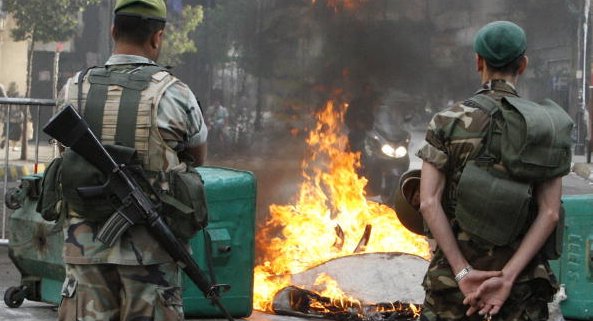
Blame the Politicians, Not Lebanon's ArmyStreet battles in Beirut’s Borj Abi Haidar neighborhood during August, as well as the border skirmish between Lebanese and Israeli forces that left three Lebanese and one Israeli dead, have highlighted the importance of the Lebanese Armed Forces in maintaining stability in the country.
However, while Lebanese politicians talk about strengthening the Lebanese Army, most of them do not really want a strong national army. A strong army would mean empowered state institutions that, in turn, would weaken feudal political leaders who have been in power for decades. Lebanon’s current weak state institutions allow politicians to offer their supporters services such as medical care, education and welfare support. Should the Lebanese ever decide that they are serious about strengthening the Lebanese Army, their first steps should include formulating a real defense strategy and increasing spending on military procurement.
After the Lebanese Civil War ended in 1991, Syria’s military played a central security role in the country and kept the Lebanese Army both nationally and internationally marginalized and away from international attention. Following the 2005 Syrian withdrawal, the Lebanese Army slowly began to rearm and equip itself as a fighting force. But with no domestic defense industry or real procurement budget, the army has had to largely rely on foreign donations.
The United States and other outsiders became increasingly aware of the Lebanese Army’s needs after it ousted an Al-Qaeda inspired group entrenched in the Palestinian refugee camp of Nahr al-Bared in 2007. An underequipped, undertrained army was sent into an urban fighting environment. Commanders managed the battle via regular cell phones, and soldiers had little ammunition, no real air support, and limited intelligence. The Lebanese Army won the battle after three months, but it cost the lives of 169 soldiers.
This confrontation showed the international community the potential value of the Lebanese Army and highlighted the importance of a strong state capable of curtailing the growth and infiltration of violent extremist groups in Lebanon. But because of the continued state of war between Lebanon and Israel, most Western countries donated insufficient, secondhand, or technologically outdated military equipment. Since 2006, Washington has provided more than $600 million worth of vehicles, spare parts for aging aircraft, howitzers, ammunition, light weapons, radios and training.
Substantial aid came also from the United Arab Emirates (Gazelle and Puma helicopters) and, to a much lesser extent, from Germany (coastal patrol boats), France (training), the United Kingdom (spare parts) and Belgium (armored transporters and ambulances). This support was much needed after decades of an undeclared international embargo on weapons to the Lebanese Army, but it was far from adequate in strengthening the military.
The army is often seen as a test case for institution building in Lebanon because it enjoys the support of the vast majority of Lebanese across the sectarian spectrum. But the lack of real political will is reflected, for example, in the national dialogue talks, held every few months since 2006 with the stated aim of formulating a national defense strategy. Participants have used the talks as a debating club, putting forth superficial proposals chiefly for public consumption and failing to make any real contributions toward formulating a defense strategy.
Another sign of the lack of seriousness with which Lebanese leaders approach the Lebanese Army lies in the absence of a realistic procurement budget. Out of a $1 billion annual defense budget, more than $800 million goes toward salaries (including hundreds of generals and close to a thousand colonels) and only $30 million per year is allocated to procurement, most of it spent on spare parts and logistics. In comparison, defense budgets for Jordan and Syria for 2009 were respectively $2.3 billion and $2 billion. According to a study by the Center for Strategic International Studies, between 2005 and 2008 Jordan spent $1.6 billion and Syria $5 billion on equipment orders.
In the latest talks on creating a procurement budget, the Defense Ministry announced in mid-August the establishment of a Central Bank account to which private citizens could donate money to support the army’s weapon procurements. But this idea was again a public relations exercise. Indeed, the account has not been opened yet because it should, by law, be opened by the Cabinet, which the ministry did not consult before its announcement. Moreover, even if the donations account were to open soon, no country can realistically plan its military procurement budget based on charitable donations.
With no real defense strategy or a serious procurement budget, the army is pushed into a domestic security mission for which it is not prepared. Should it play that role effectively, it would clash with the multitude of local politicians protecting rogue armed supporters. The fact that it cannot ensures a weak military institution to the advantage of the same old established political elites, most of whom are former Civil War warlords. This domestic role also comes at the expense of an external security role, in which the army would take over Hizbullah’s self-declared mission of protecting Lebanon against Israeli aggressions.
Real-world empowerment of the army would start by finding the right balance between foreign assistance and national spending in order to implement a comprehensive build-up and procurement plan. The army command has such a plan in hand, which would include infrastructure construction (barracks, airfield upgrades, and so on), operational main battle tanks, air-to-ground capable jetfighters (for air support against militias in scenarios similar to the army’s 2007 battle in Nahr al-Bared), short range anti-aircraft missiles, anti-tank missiles, transport and attack helicopters, naval landing craft, and other basic military development needs. The plan would cost more than $2 billion.
In the last few years, the Lebanese Army has found itself in a relatively stable national context for the first time since the 1970s, liberated from dominance by either Israel or Syria. The military should seize this moment to do what has not been done in post-independence Lebanon: open dialogue channels with political leaders in order to persuade them to think and budget for long-term military development in Lebanon.
Carnegie does not take institutional positions on public policy issues; the views represented herein are those of the author(s) and do not necessarily reflect the views of Carnegie, its staff, or its trustees.
Russia is testing the waters of NATO’s mutual defense clause. What do strikes in Romanian territorial waters mean for the alliance’s posture toward Moscow?
With its public finances in shambles, the far right polling at 35 percent ahead of the 2027 presidential election, and a growing protest movement, is France’s crisis a threat to the EU’s geopolitical awakening?
The new U.S.–Denmark–Greenland agreement will help Washington exert political, economic, and financial dominance under the guise of security. Yet, it acknowledged Copenhagen’s and Nuuk’s sovereignty on the island.
A summer of escalation in the Black Sea has hurt Ukraine economically and is exacerbating world food security. A truce is needed—as is a broader reframing of Europe’s Ukraine strategy.