

Commentary
Amr Hamzawy
{
  "authors": [
    "Amr Hamzawy"
  ],
  "type": "legacyinthemedia",
  "centerAffiliationAll": "",
  "centers": [
    "Carnegie Endowment for International Peace",
    "Malcolm H. Kerr Carnegie Middle East Center"
  ],
  "collections": [],
  "englishNewsletterAll": "",
  "nonEnglishNewsletterAll": "",
  "primaryCenter": "Carnegie Endowment for International Peace",
  "programAffiliation": "",
  "programs": [],
  "projects": [],
  "regions": [
    "Egypt"
  ],
  "topics": [
    "Political Reform"
  ]
}
Source: Getty
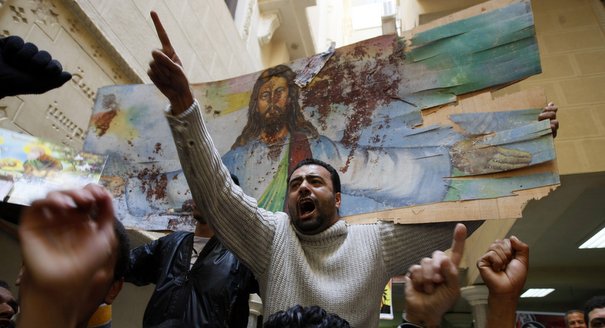
In the wake of increasing sectarian violence in Egypt, it is the responsibility of both the government and civil society to preserve diversity and tolerance and guarantee the political, legal, and religious rights of the nation’s Coptic population.
Source: Los Angeles Times

Terrorism exercises violence in societies that provide fertile ground for sectarian conflicts, as in Iraq, or likewise as it is being cultivated in Egypt today.
Egyptians must discard the deceptive displays they mechanically regurgitate each time blood is shed in crimes of sectarian violence. Championing national unity and flaunting it with kisses of priests by sheiks is baseless. Muslims who speak of their Christian brothers often do so incredulously.
Copts’ refusal to accept the condolences of government representatives to senior members of the All Saints Church is not an act to be feared. Rather, it is an explicit expression of a frustration gripping many Christians who are ruled by a government resigned to their discrimination. Public institutions fail to soberly consider the root causes of such vehemence, and are lax in their responsibility to provide them with protection.
It is true that with the absence of democracy, the regime oppresses Egyptians of every color and creed. All citizens, Muslims and Christians alike, are subject to political marginalization dependent upon on the whims of state bodies and influential people. Yet, in claiming that Muslims and Christians share the same fate, Muslim Egyptians are denying the fact of that Copts confront legal, religious, and political discrimination that is unique to them.
Some laws have been recently introduced with the goal of promoting equality regardless of religious affiliation. Despite these measures and other attempts by the authorities to shut down satellite channels accused of fomenting sectarianism, the government remains impotent to combat sectarianism.
Conversely, some are mistakenly shifting the blame solely onto the government for its failure to build a society free of sectarian tension, and where all citizens are created equal. Indeed, the government bears a share of the responsibility in perpetuating discrimination. All Egyptians, however, particularly the Muslim majority, have come to generally accept the idea of Copts as inferior and as second-class citizens.
In fact, discrimination is not only ignored, it is flourishing to the point of damaging the national fabric.
As the overwhelming majority, Muslims bear most of the responsibility to preserve the values of diversity, tolerance, equal treatment and coexistence. Yet the Muslim majority seems either unwilling or unable to assume this role. Positive signs do sometimes emerge, as when Muslims protected Coptic churches on Jan. 6, Christmas Eve, a week after the attacks at All Saints.
Amid Egypt’s increasing religiosity, however, broad segments of Egyptian Muslims have become overwhelmed by unfettered extremist discourse in the media. It should come as no surprise when Copts respond to such aggression with the equally exclusionary message, “Egypt is our country and Muslims are guests.”
Copts struggle against legal restrictions on the construction and maintenance of churches while Muslims are freely allowed to build mosques. Coptic representation in parliament -– only a handful of Copts were elected in November 2010 elections to the new 508-seat People’s Assembly -– is close to zero despite comprising an estimated 10% of the population. The president’s ruling National Democratic Party named only 10 Copts as candidates out of a total 800 running in the parliamentary race. The government and ruling party have come to accept Copts’ systemic marginalization.
Acts of sectarian violence are on a terrifying rise across Egypt. Those in power make arrests and reproduce the customary speeches. The regime focuses on foreign conspirators as the culprits, and extols national unity without introducing any real policy changes that affect the Christian population. Judicial bodies in Egypt are empowered to bring those guilty of violent crimes to justice, but the courts have often failed to render conclusive verdicts. Such outcomes offer the public the tragic impression that Christians and their places of worship are legitimate targets for hatred.
If they truly seek to rescue Egypt from sectarian violence and restore the humanity of their society, their treatment of Copts as second-class citizens must stop.
The regime must introduce political, legal and procedural changes to guarantee Copts’ security and religious freedoms, as well as to increase their representation in government. As part of a long-term society project, civil society organizations and liberal media must work to restore Egypt’s heritage of tolerance and secular citizenship.

Director, Middle East Program
Amr Hamzawy is a senior fellow and the director of the Carnegie Middle East Program. His research and writings focus on Egypt’s and other middle powers’ involvement in regional security in the Middle East, particularly through collective diplomacy and multilateral conflict resolution
Recent Work
Amr Hamzawy
Amr Hamzawy
Carnegie does not take institutional positions on public policy issues; the views represented herein are those of the author(s) and do not necessarily reflect the views of Carnegie, its staff, or its trustees.

As the EU confronts profound challenges, several leaders have called for fundamental reform to the union’s model—but only modest, superficial changes have resulted. What if Europe really could be reimagined from zero today: What should such a redesigned European order look like?

Richard Youngs, ed.

Preparing candidate countries for EU membership is no longer enough. As the enlargement process becomes a reality, the union must also prepare its own societies.

Iliriana Gjoni
Countries face several hurdles in joining the EU, including the final stage of ratifying their accession treaties. Procedural reforms and substantive adjustments could help move the process forward.

Stefan Lehne
Europe has an interest in supporting Armenian leader Nikol Pashinyan as he tries to make peace with neighbors and loosen ties with Russia. But it is depersonalized support in the long term, not quickfire flash, that will win the day.

Thomas de Waal
Montenegro and Albania are frontrunners for EU enlargement in the Western Balkans, but they can’t just sit back and wait. To meet their 2030 accession ambitions, they must make a strong positive case.

Dimitar Bechev, Iliriana Gjoni