

Commentary
The European Commissioner for Trade is headed to China. But after President Xi’s bridge-building visit to Washington, can a more isolated EU overcome Beijing’s stranglehold on critical raw materials? Who will blink first?
Rym Momtaz, ed.
{
  "authors": [
    "Bianka Speidl",
    "Hanga Horváth-Sántha"
  ],
  "type": "commentary",
  "blog": "Strategic Europe",
  "centerAffiliationAll": "",
  "centers": [
    "Carnegie Endowment for International Peace",
    "Carnegie Europe"
  ],
  "englishNewsletterAll": "",
  "nonEnglishNewsletterAll": "",
  "primaryCenter": "Carnegie Europe",
  "programAffiliation": "",
  "regions": [
    "Europe",
    "Syria",
    "Gulf",
    "Türkiye"
  ],
  "topics": [
    "EU",
    "Foreign Policy",
    "Political Reform",
    "Migration",
    "Trade"
  ]
}
Source: Getty
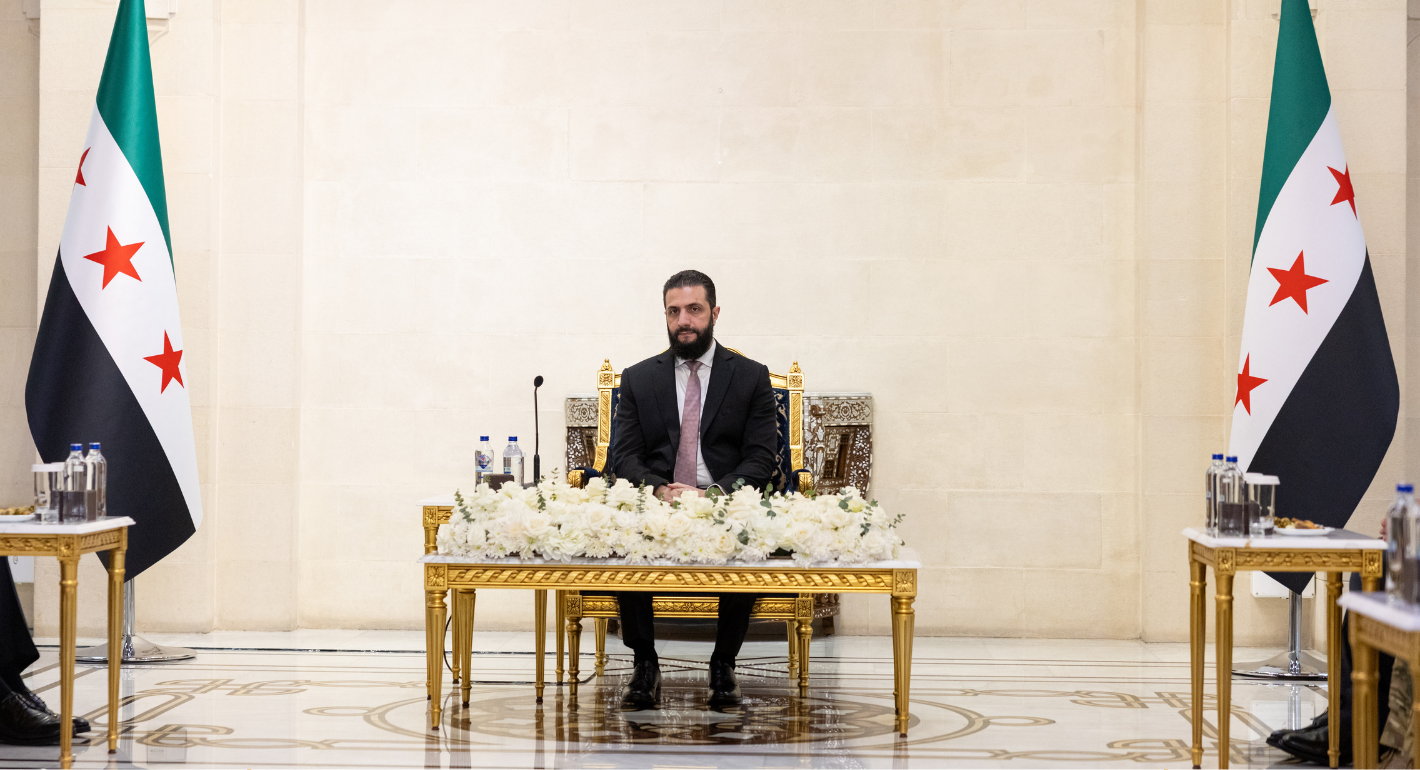
Europe’s interests in Syria extend beyond migration management, yet the EU trails behind other players in the country’s post-Assad reconstruction. To boost its influence in Damascus, the union must upgrade its commitment to ensuring regional stability.
In the great jockeying for influence in Syria that has followed the downfall of Bashar al-Assad’s regime, the Europeans are decidedly trailing behind. The United States is central by virtue of its extraterritorial might. Turkey and Qatar are reaping the rewards of their long-term military and political engagement with the new Syrian President Ahmed al-Sharaa. And Saudi Arabia was quick to make moves and leverage their financial and symbolic firepower.
The EU—despite geographic proximity, economic resources, and hosting over 1.3 million Syrian refugees—remains absent from the negotiations shaping the country’s institutional future.
It does not have to be this way, and it is not too late to get back into the mix. In fact, the union and some individual member states have more to offer in Syria, and more to leverage, than they currently have to show.
Europe’s normative strengths could provide genuine institutional value, despite the fact its investment capacity pales in significance when compared to other actors. But the condition is that such investments can only be operationalized through reconstruction engagement with an emphasis on property rights frameworks and social equity mechanisms.
After pledging nearly €2.5 billion ($3 billion) for the 2025–2026 period, the EU recently announced a new financial package of around €620 million ($735 million) for 2026–2027 covering humanitarian aid, early recovery, and bilateral support. But while this is substantial, it remains fragmented without strategic coordination. The EU’s own 2024 mid-term evaluation of the Neighborhood, Development, and International Cooperation Instrument—its primary €79.5 billion ($94.2 billion) development and cooperation framework otherwise known as Global Europe—found the financing and coordination approach “insufficiently flexible” and that the “Team Europe approach is falling short of expectations.”
During and after the 2015 refugee crisis, Europe welcomed many of Syria’s qualified and educated nationals. But some member states still see Syrian refugees as nothing but a burden to be unloaded as soon as possible. However, hasty returns would abandon “the economic, social, and cultural fruits” of integration trajectories serving neither European nor Syrian interests. Moreover, ground conditions reveal why deportation rhetoric ignores strategic realities. Fifty percent of the country’s infrastructure has been destroyed or severely damaged. Ninety percent of the population is below the poverty line. And beyond the physical destruction, insecurity and instability are still prevalent outside Damascus.
The challenges returning Syrians face illustrate precisely where European engagement could matter most. Property disputes after more than a decade of internal displacement and brutal war create immediate risks of renewed conflict. Economic collapse and contested property rights create the conditions for social inequalities that threaten Syria’s transition.
This is where Europe’s comparative advantage lies. European involvement in establishing property registries, legal aid systems, and returnee protection mechanisms would not only advance its leverage but also provide critical stabilization infrastructure to make the country’s transition more viable in the long term. Effective engagement is possible only through cooperation with the Syrian government, by offering substantial reconstruction resources conditioned on EU-monitored institution building.
Without resolving three institutional prerequisites—coordination mechanisms, the concentration of financial commitment, and operational oversight—Europe cannot translate these opportunities into strategic influence. And it will continue suffering from a competitive disadvantage compared with Turkey’s integrated military-economic strategy or concentrated Gulf resources.
Turkey is effectively cashing in on the military and political support it provided the current Syrian President Ahmed al-Sharaa and his group Hayat Tahrir al-Sham when they were still an opposition group fighting against the now-deposed dictator Bashar al Assad. Having moved swiftly and decisively after the regime’s fall, Ankara is now helping to shape the security and energy landscapes of Syria’s reconstruction.
Gulf states, even without Turkey’s long-term commitment, have also effectively wielded their influence. Saudi Arabia and Qatar are tying reconstruction pledges to governance benchmarks and rule-of-law reforms designed to protect their investments. These institutional frameworks will shape Syria’s trajectory for decades, and have a substantial impact on Europe’s Southern flank.
The European Commission should appoint a senior Syria coordinator, tasked with aligning fragmented responses across EU development funds, diplomatic services, and the European Investment Bank. A dedicated Syria reconstruction working group with mandatory member state participation would prevent contradictory policies that undermine credibility.
A dedicated €2–3 billion ($2.4–3.6 billion) reconstruction budget should be ring-fenced within existing development funding, making the union’s commitment clear and sending a political signal that Europe takes Syria seriously. Decisionmaking for funding releases should be streamlined: While overall strategy requires consensus, quarterly implementation decisions based on monitoring reports could proceed with qualified majority voting, accelerating responses while preserving member state control over the strategic direction.
Finally, the Europeans should condition reconstruction funding on the Syrian government’s agreement to joint oversight committees covering property registries, returnee protection, and infrastructure implementation. These committees could be co-chaired by Syrian and EU representatives with independent third-party participation. The Syrian government would provide operational data, the EU would verify through independent spot-checks, and third-party auditors would certify whether benchmarks are met. And only after certification would the European Investment Bank release funds from escrow accounts. This creates enforceable conditionality.
Europe’s geopolitical interests in Syria—regional stability, energy security, counterterrorism cooperation, and Mediterranean order—extend far beyond migration management.
A stabilized Syria extracted from Iranian proxy networks would fundamentally reshape the Mediterranean’s security architecture. The collapse of the Assad-Iran supply corridor to Hezbollah and Hamas, and positioning Syria as a counterterrorism partner makes Damascus a pivot point for regional order that directly affects European security.
Syria’s potential integration into regional energy networks—including the potential development of the Qatar–Turkey gas pipeline route through the country—would directly affect European energy security. Beyond energy, Syria offers a critical land trade corridor connecting Gulf markets to Europe through Jordan and Turkey. Post-Assad reconstruction, estimated at €182 billion ($216 billion), represents major economic opportunities for European companies, if Europe can position itself competitively.
Yet structural dysfunction prevents the EU from translating these interests and substantial financial commitments into strategic influence. The question is not whether reforms solve all problems, but whether Europe can overcome coordination failures before competitive marginalization becomes irreversible. The moment for institutional reform is now.
Bianka Speidl is a Marie Curie research fellow and honorary senior lecturer in the Institute of Arab and Islamic Studies at the University of Exeter.
Hanga Horváth-Sántha is a senior lecturer in international law at the Károli Gáspár Reformed University.
Subscribe to Strategic Europe, delivered every Tuesday and Thursday!

Bianka Speidl
Marie Curie Research Fellow, University of Exeter
Bianka Speidl is Marie Curie Research Fellow and Honorary Senior Lecturer
Institute of Arab and Islamic Studies at the University of Exeter.
Hanga Horváth-Sántha
Senior Lecturer, Károli Gáspár Reformed University
Hanga Horváth-Sántha is senior lecturer in International Law at the Károli Gáspár Reformed University.
Carnegie does not take institutional positions on public policy issues; the views represented herein are those of the author(s) and do not necessarily reflect the views of Carnegie, its staff, or its trustees.

The European Commissioner for Trade is headed to China. But after President Xi’s bridge-building visit to Washington, can a more isolated EU overcome Beijing’s stranglehold on critical raw materials? Who will blink first?

Rym Momtaz, ed.

The domestic impacts of how long it is taking to end the war in Ukraine have pushed the French electorate to the political extremes and compromised the country’s diplomatic capacity.
Rym Momtaz

Before the next wave of EU enlargement takes place, the union needs to grapple with thorny questions of how power is distributed among its members.


Emil Sondaj Hansen, Ditte Brasso Sørensen

A summer of escalation in the Black Sea has hurt Ukraine economically and is exacerbating world food security. A truce is needed—as is a broader reframing of Europe’s Ukraine strategy.

Thomas de Waal

Are Germany’s economic, industrial, and political struggles becoming a liability for the EU’s ability to rise to the geopolitical moment?
Rym Momtaz, ed.