

Article
A notable degree of participative democracy has firmly arrived in Europe. But to have more far-reaching impact, democratic deliberation needs to move into a radically new phase.
Richard Youngs
{
  "authors": [
    "Amr Hamzawy",
    "Marina Ottaway"
  ],
  "type": "other",
  "centerAffiliationAll": "dc",
  "centers": [
    "Carnegie Endowment for International Peace",
    "Malcolm H. Kerr Carnegie Middle East Center"
  ],
  "collections": [
    "Arab Awakening"
  ],
  "englishNewsletterAll": "menaTransitions",
  "nonEnglishNewsletterAll": "",
  "primaryCenter": "Carnegie Endowment for International Peace",
  "programAffiliation": "MEP",
  "programs": [
    "Middle East"
  ],
  "projects": [],
  "regions": [
    "Middle East",
    "North Africa",
    "Egypt",
    "Algeria",
    "Morocco",
    "Tunisia",
    "Gulf",
    "Levant",
    "Maghreb"
  ],
  "topics": [
    "Political Reform"
  ]
}
Source: Getty
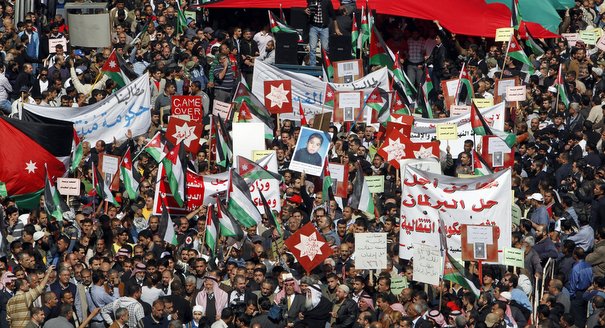
The uprising that started in Tunisia in late 2010 was not a completely new development, but rather a more dramatic example of the unrest common across the region, particularly in Egypt, Morocco, Algeria, and Jordan.
Over the past decade, the Arab world has seen an increase in protests, strikes, demonstrations, and other forms of social protest. The uprising that started in Tunisia in late 2010 was not a completely new development, but rather a more dramatic example of the unrest common across the region, particularly in Egypt, Morocco, Algeria, and Jordan.
But the protest movements in the region have severe limitations. The various organizations involved—labor groups, youth organizations, bloggers, political parties, and Islamist movements—have different constituencies, demands, and organizational styles. Indeed, in some countries there has been, until recently, a deliberate decision not to coordinate and particularly to keep socioeconomic and political demands separate. This helps incumbent authoritarian and semi-authoritarian regimes stay in power despite the high levels of discontent in many countries.
Despite the absence of large cohesive movements, Arab regimes are right to worry about the possibility of an uprising in their countries. The underlying conditions of difficult social and economic conditions coupled with political repression, lack of political freedoms, and corruption exist everywhere. Publics in Arab countries are also right in feeling inspired by events in Tunisia and in believing that they can force change. Ultimately, however, change depends not on Tunisia’s example, but on the ability of protesters to coordinate their efforts and link socioeconomic with political demands and on the governments’ response, plus the imponderable catalyst.

Director, Middle East Program
Amr Hamzawy is a senior fellow and the director of the Carnegie Middle East Program. His research and writings focus on Egypt’s and other middle powers’ involvement in regional security in the Middle East, particularly through collective diplomacy and multilateral conflict resolution

Former Senior Associate, Middle East Program
Before joining the Endowment, Ottaway carried out research in Africa and in the Middle East for many years and taught at the University of Addis Ababa, the University of Zambia, the American University in Cairo, and the University of the Witwatersrand in South Africa.
Carnegie does not take institutional positions on public policy issues; the views represented herein are those of the author(s) and do not necessarily reflect the views of Carnegie, its staff, or its trustees.

A notable degree of participative democracy has firmly arrived in Europe. But to have more far-reaching impact, democratic deliberation needs to move into a radically new phase.

Richard Youngs

Before the next wave of EU enlargement takes place, the union needs to grapple with thorny questions of how power is distributed among its members.


Emil Sondaj Hansen, Ditte Brasso Sørensen

The aftermath of the Ceuta crisis shows Europe has drawn the wrong lessons. Rather than doubling down on failed migration policies, the EU needs to address the underlying roots of such episodes.
Richard Youngs

As the EU confronts profound challenges, several leaders have called for fundamental reform to the union’s model—but only modest, superficial changes have resulted. What if Europe really could be reimagined from zero today: What should such a redesigned European order look like?
Richard Youngs, ed.

When the U.S.-Iran memorandum of understanding was announced, the UK, France, Germany, and Italy declared their readiness to help demine the Strait of Hormuz and lift nuclear sanctions on Tehran. But does Europe need new tools to recover a diplomatic role?

Rym Momtaz, ed.