

In The Media
John Judis
{
  "authors": [
    "John Judis"
  ],
  "type": "legacyinthemedia",
  "centerAffiliationAll": "",
  "centers": [
    "Carnegie Endowment for International Peace"
  ],
  "collections": [],
  "englishNewsletterAll": "",
  "nonEnglishNewsletterAll": "",
  "primaryCenter": "Carnegie Endowment for International Peace",
  "programAffiliation": "",
  "programs": [],
  "projects": [],
  "regions": [
    "North America",
    "United States"
  ],
  "topics": [
    "Political Reform"
  ]
}
Source: Getty
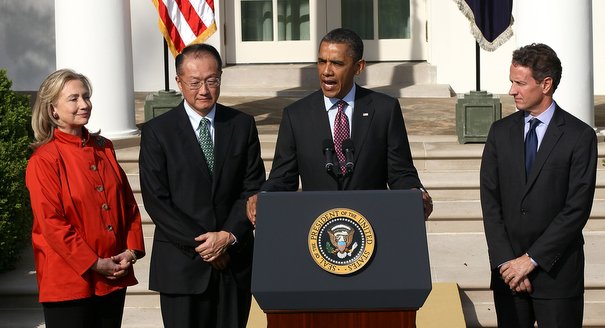
Secretary of the Treasury Timothy Geithner's focus on cutting the deficit risks worsening America's economic crisis.
Source: New Republic

But now I learn, in an excellent profile by Washington Post reporter Zachary Goldfarb, that Geithner is also behind the Obama administration’s unseemly obsession with reducing the debt and deficits—even if that should throw a few people out of work, prolong the Great Recession well into this decade, and pitch American politics to the right. (And, oh yes, increase the deficit and debt itself, because if the U.S. remains in a slump, that will cut into tax revenues and widen the deficit, whatever spending cuts Geithner and the Republicans should recommend.)
According to Goldfarb, Geithner gained the “upper hand” early last year in an administration debate about whether to propose a second stimulus program to Congress. While Lawrence Summers and Christina Romer argued for focusing on bringing down unemployment, Geithner called for focusing on reducing government debt. Of Geithner, Austan Goolsbee, who recently announced he is leaving his post as Chair of the Council of Economic Advisors to return to the University of Chicago Business School, says: “From the earliest moments of the administration and even before, he clearly had a big focus on long-term deficit reduction and making clear, not just to the markets but for the entire economy, that the government is living within its means.”
Of course, Presidents have gotten bad advice from their Treasury Secretaries before. In June 1937, while the United States was still in the midst of the Great Depression, but was enjoying a very modest rebound, Franklin Roosevelt’s Secretary of the Treasury Henry Morgenthau, Jr. recommended that he cut spending. Morgenthau acknowledged that while “the patient might scream a bit when he was taken off narcotics,” the time had come “to strip off the bandages, throw away the crutches,” and let the economy see if “it could stand on its own feet.” Roosevelt followed Morgenthau’s advice, and the economy plunged back into recession, the unemployment rate shot up, and Republicans and conservative Southern Democrats were able to attack the “Roosevelt recession.”
When the stock market tanked in March, 1938, Roosevelt began to have second thoughts. Morgenthau warned him that abandoning the attempt to balance the budget would harm business confidence. But Roosevelt decided not to listen to Morgenthau. He pressed ahead with new relief legislation and, by the next year, the economy was again showing modest signs of growth. Will Obama continue to listen to Geithner? I certainly hope not. I used to blame the administration’s timid and self-defeating fiscal policy on Republican intransigence, but as Goldfarb’s profile shows, Obama and his Treasury Secretary deserve a good part of the blame for what is becoming Obama’s “Great Recession.”

Former Visiting Scholar
As a visiting scholar at Carnegie, Judis wrote The Folly of Empire: What George W. Bush Could Learn from Theodore Roosevelt and Woodrow Wilson.
Recent Work
John Judis
John Judis
Carnegie does not take institutional positions on public policy issues; the views represented herein are those of the author(s) and do not necessarily reflect the views of Carnegie, its staff, or its trustees.

European Commission President Ursula von der Leyen is about to give her annual address on the state of the EU. Here’s what she won’t—but should—say.

Rym Momtaz

Radical-right parties are expected to do well in upcoming elections in four of the EU's biggest member states. If successful, they could prevent the union from addressing key challenges ahead.

Stefan Lehne

Canadian Prime Minister Mark Carney has twice inspired praise for standing up to U.S. President Donald Trump: at the 2026 World Economic Forum in Davos and on Canada-U.S. trade negotiations. Is Carney showing a third way better than the EU has in dealing with the Trump administration?
Rym Momtaz, ed.

European states control several Overseas Countries and Territories around the world that carry strategic, economic, and environmental weight. As great powers challenge the rules-based order, defending them is a geopolitical imperative for Europe.

Marc Pierini

In supporting Europe’s far-right, MAGA and Russia both want the same thing: a weaker EU. Europe must defend itself without abandoning the openness these forces exploit.

Armida van Rij