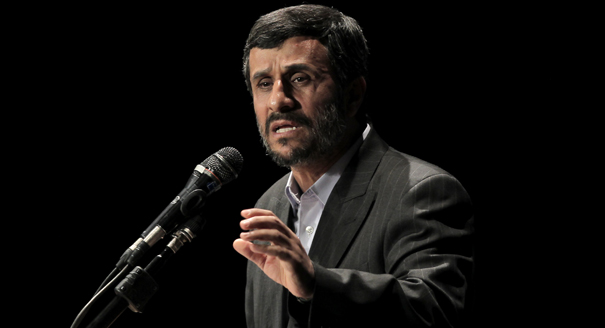
By accentuating the country’s internal rifts and breaking previously sacred taboos, Ahmadinejad has become an unlikely, unwitting ally of Iran’s democracy movement.
The Rise and Fall of Iran’s AhmadinejadWhile Iranian President Mahmoud Ahmadinejad’s demagoguery and Holocaust revisionism on the world stage have earned him alarmist comparisons to Adolf Hitler, his recent, ignoble fall from grace reveals the Iranian president for what he really is: the dispensable sword of Iran’s supreme leader, Ayatollah Ali Khamenei.
The marriage of Khamenei and Ahmadinejad should be understood in the context of Iran’s internal rivalries. Since the death in 1989 of the revolution’s father, Ayatollah Ruhollah Khomeini — whose austere nature and anti-Americanism set the tenor for Iran’s post-monarchic order — Tehran’s political elite has been broadly divided into two schools.
Reformists and pragmatists argued that ensuring the Islamic Republic’s survival required easing political and social restrictions and prioritizing economic expediency over ideology. Hard-liners, led by Khamenei, believed that compromising on revolutionary ideals could unravel the system, just as perestroika did the Soviet Union.
Given the youthful Iranian public’s desire for change, Khamenei seemed to have lost the war of ideas by the early 2000s.
No one anticipated that his saving grace would arrive in the person of Mahmoud Ahmadinejad, the hitherto unknown mayor of Tehran.
Ahmadinejad’s pious populism resonated among Iran’s working classes, and his revolutionary zeal and willingness to attack Khamenei’s adversaries endeared him to the supreme leader, whose backing of Ahmadinejad in the 2005 presidential election proved decisive. The balance of power between the two was exhibited during Ahmadinejad’s inauguration, when the new president prostrated himself before Khamenei and kissed his hand.
Under the supreme leader’s approving gaze, Ahmadinejad’s first term as president was spent bludgeoning Khamenei’s domestic opponents, taking a hard line on the nuclear issue and taunting the United States. Ahmadinejad’s newfound fame abroad, however, confused his true position at home.
What Khamenei failed to realize was that Ahmadinejad and his cohorts had greater ambitions than simply being his minions.
They spoke of their direct connection to the hidden imam — Shiite Islam’s Messiah equivalent — in an attempt to render the clergy obsolete. In “private” meetings — which were bugged by intelligence forces loyal to Khamenei — Ahmadinejad’s closest adviser, Rahim Mashaei, spoke openly of designs to supplant the clergy. The last straw came earlier this year, when Ahmadinejad tried to take over the Ministry of Intelligence, whose vast files on the financial and moral corruption of Iran’s political elite are powerful tools of political persuasion and blackmail.
The supreme leader was publicly nonchalant about Ahmadinejad’s insubordination; privately, however, he unleashed jackals that had long been salivating for the president’s comeuppance. The powerful Revolutionary Guards — who helped engineer Ahmadinejad’s contested 2009 reelection — swiftly declared their devotion to Khamenei, and several of the president’s advisers were arrested.
One former Guard and current member of parliament, Mohammad Karamirad, sent Ahmadinejad a message last week in the form of a macabre Persian proverb: “If [Khamenei] asks us to bring him a hat, we know what to bring him,” i.e., the head of the person wearing the hat.
In addition to proving the primacy of Iran’s supreme leader, the rise and fall of Ahmadinejad exemplifies the contempt that Tehran’s ruling cartel has for the intelligence of its citizenry.
Ahmadinejad’s tainted reelection — which spurred millions to take to the streets — was hailed by Khamenei as a “divine assessment” and the people’s will. Two years later, Ahmadinejad and his cronies are accused by former supporters of being “deviant Zionist agents” and “possessed by the devil.”
Khamenei’s desire to project a unified front to the world is likely to keep Ahmadinejad in office until his term expires in 2013. Khamenei seeks to wield power without accountability; this requires a president who has accountability without power. A disgraced Ahmadinejad can conveniently absorb blame for the country’s endemic economic, political and social disaffection.
For Washington, the best outcome of Iran’s conservative fratricide is only that the fight continues. Authoritarian collapses tend to have three prerequisites: grass-roots protests, fissures among the elite and a regime’s loss of will to use sustained brutality to retain power. While Iran has the first two, the regime remains quite willing to rule by terror.
And while the regime has been weakened, Iran’s opposition is unlikely to deliver democracy anytime soon. In contrast to Arab opposition movements that lack clear leadership but have a common goal — to bring down their respective regimes — the beleaguered, revolution-weary Iranian opposition has symbolic leadership — Mir Hossein Mousavi and Mehdi Karroubi, both of whom are under house arrest — but lacks a clear consensus on its goals.
Instead of waiting in vain for the regime’s will to soften or for the opposition to reconfigure, the United States can aid the cause of democracy and open society in Iran by focusing on tearing down the information and communication barriers the regime has erected. Technological aid and infrastructure for better Internet and satellite communications would allow Iran’s democracy activists to stay connected with one another and show the outside world what’s happening in their country.
By accentuating the country’s internal rifts and breaking previously sacred taboos — such as challenging the supreme leader — Ahmadinejad has become an unlikely, unwitting ally of Iran’s democracy movement. Once thought to be leading the Islamic Republic’s rise, he is more likely to be remembered by historians as the man who hastened its decay.
Karim Sadjadpour is a senior fellow at the Carnegie Endowment for International Peace, where he focuses on Iran and U.S. foreign policy toward the Middle East.
Carnegie does not take institutional positions on public policy issues; the views represented herein are those of the author(s) and do not necessarily reflect the views of Carnegie, its staff, or its trustees.
A notable degree of participative democracy has firmly arrived in Europe. But to have more far-reaching impact, democratic deliberation needs to move into a radically new phase.
As the EU confronts profound challenges, several leaders have called for fundamental reform to the union’s model—but only modest, superficial changes have resulted. What if Europe really could be reimagined from zero today: What should such a redesigned European order look like?
When the U.S.-Iran memorandum of understanding was announced, the UK, France, Germany, and Italy declared their readiness to help demine the Strait of Hormuz and lift nuclear sanctions on Tehran. But does Europe need new tools to recover a diplomatic role?
The EU’s new migration policy is not suited to today’s realities. With climate change increasingly becoming a driver of displacement, Europe needs to rethink its deterrence-focused approach.