

Commentary
Nikolay Petrov
{
  "authors": [
    "Nikolay Petrov"
  ],
  "type": "legacyinthemedia",
  "centerAffiliationAll": "",
  "centers": [
    "Carnegie Endowment for International Peace",
    "Carnegie Russia Eurasia Center"
  ],
  "collections": [],
  "englishNewsletterAll": "",
  "nonEnglishNewsletterAll": "",
  "primaryCenter": "Carnegie Russia Eurasia Center",
  "programAffiliation": "",
  "programs": [],
  "projects": [],
  "regions": [],
  "topics": []
}
Source: Getty
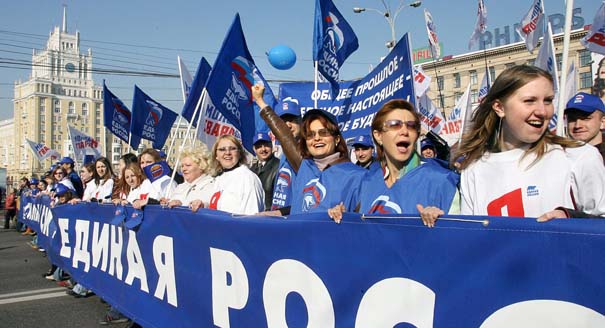
In response to United Russia’s declining popularity, the Kremlin is trying to dump all of the party’s political dead weight and pushing more support to its remaining assets, rather than forming a coalition with its junior political partners.
Source: The Moscow Times

After meeting with his supporters at the Digital October conference center, he met with the Federation Council leadership, spoke at Moscow State University, teamed up with Prime Minister Vladimir Putin to hold a video conference with United Russia campaign headquarters in the regions and, finally, spoke with Interior Ministry officials at a retreat in Tver.
But Medvedev was not very convincing in his new role as the outgoing president and the top gun on United Russia’s party list. His meeting at Moscow State University stood out not only because of how poorly it was staged, but also because it was conducted in such a stuffy, bureaucratic style — something that was in sharp contrast to Medvedev’s image as a liberal reformer and tech-savvy blogger.
The key element is not Medvedev’s apparent shift in style, but in the tactics the authorities have adopted to respond to the party of power’s declining popularity.
Rather than strengthening the party by forming a coalition with one or more of its junior political partners, the new strategy consists of dumping all of the party’s political dead weight and pumping more hot air into its remaining assets.
The All-Russia People’s Front is Putin’s contribution to the effort, while Medvedev is bringing his latest idea — “big government” — into play.
Characteristically, six months after its creation, the People’s Front remains only a shallow veneer to United Russia. The front has no organizational structure, relying entirely on the infrastructure of Putin’s network of loyal bureaucrats in the regions.
In recent weeks, Kremlin spin doctors and party functionaries have begun altering their predictions for United Russia’s showing in the upcoming elections. Previous claims that the party would retain its constitutional majority in the State Duma are increasingly replaced by predictions of holding onto a simple majority only.
This prediction is supported by results of the latest VTsIOM poll in early October indicating that United Russia might retain its absolute majority in the Duma but lose up to one-fourth of its mandates to the three minority parties. That would mean a new configuration of power based not so much on United Russia as it would be on “the people” — meaning a grouping of influential individuals and major corporations hand-picked by the authorities.
Former Scholar-in-Residence, Society and Regions Program, Moscow Center
Nikolay Petrov was the chair of the Carnegie Moscow Center’s Society and Regions Program. Until 2006, he also worked at the Institute of Geography at the Russian Academy of Sciences, where he started to work in 1982.
Recent Work
Nikolay Petrov
Nikolay Petrov
Carnegie does not take institutional positions on public policy issues; the views represented herein are those of the author(s) and do not necessarily reflect the views of Carnegie, its staff, or its trustees.