

Article
- +1
Toby Dalton, Mark Hibbs, Nicole Grajewski, …
{
  "authors": [
    "Mark Hibbs"
  ],
  "type": "questionAnswer",
  "centerAffiliationAll": "dc",
  "centers": [
    "Carnegie Endowment for International Peace",
    "Carnegie Europe",
    "Carnegie Russia Eurasia Center"
  ],
  "collections": [],
  "englishNewsletterAll": "ctw",
  "nonEnglishNewsletterAll": "",
  "primaryCenter": "Carnegie Endowment for International Peace",
  "programAffiliation": "NPP",
  "programs": [
    "Nuclear Policy"
  ],
  "projects": [
    "Eurasia in Transition"
  ],
  "regions": [
    "Middle East",
    "Iran"
  ],
  "topics": [
    "Nuclear Policy"
  ]
}
Source: Getty
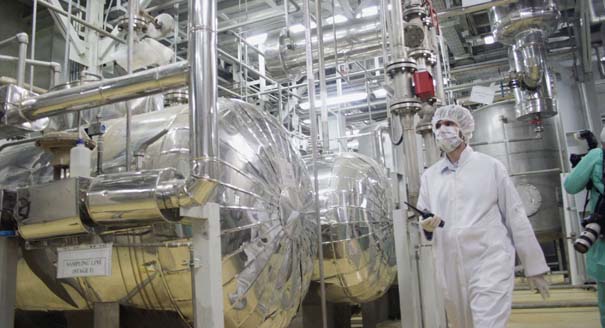
In the coming months, Washington will need to walk a fine line to maintain pressure on Iran while trying to prevent the nuclear crisis from escalating out of control.
The board of governors of the International Atomic Energy Agency (IAEA) admonished Iran by a large majority last week and urged Tehran to resolve outstanding issues over its nuclear program. But the board stopped short of calling for harsher sanctions firmly opposed by both China and Russia. The resolution came ten days after the release of a new IAEA report documenting that Iran has carried out activities relevant to the development of nuclear weapons.
In a Q&A, Mark Hibbs says that Iran is unlikely to cooperate with the IAEA in any significant way to address the questions raised in the IAEA’s report. In the coming months, Washington will need to walk a fine line to maintain pressure on Iran while trying to prevent the crisis from escalating out of control. The United States may see Russia’s commitment to diplomacy as a potential opportunity. This will depend on forthcoming talks among Russia, Iran, and other countries on a roadmap for a diplomatic resolution to the crisis.
The fact that Britain, China, France, Russia, and the United States all sponsored the resolution on Iran made it virtually certain that it would pass with overwhelming support in the IAEA’s 35-member board. And that’s exactly what happened. Two states—Cuba and Ecuador—objected and one state—Indonesia—abstained, but the rest voted in favor.
For the United States and other Western countries, this approach marked a return to something like consensus decision-making in the board. As proliferation issues in recent years increasingly polarized board members along North-South lines, Western states began taking non-consensus decisions, breaking with the tradition established over the last half century.
In June, for example, the board passed a Western-sponsored resolution condemning Syria, but it was opposed by China and Russia. The resolution brought Syria’s noncompliance with IAEA safeguards to the attention of the UN Security Council, but China and Russia were against imposing sanctions on Syria.
Since the middle of this year, a few Western states, notably Britain and France, aimed to pass an IAEA resolution that could lead to further sanctions against Iran. But by early October it was clear to the Western group that China and Russia would oppose such a resolution. Western states had also encouraged Yukiya Amano, the IAEA’s director general, to report to the board the information the IAEA had compiled suggesting that Iran’s nuclear program included activities to support the development of nuclear weapons. When Amano submitted that report earlier this month, China and Russia firmly objected to it.
Western states aiming to pass a resolution on Iran based on the report therefore had to make a choice: accept a weak resolution that everyone would agree to or take the risk that a tougher text would be opposed by China and Russia, demonstrating that two of the five Security Council veto powers didn’t agree on the significance of the IAEA’s weapons-related findings. Opposition from China and Russia to a resolution would have also been likely to trigger "no" votes by many developing and non-aligned countries on the board.
Not directly. If Iran chooses to dangle carrots in front of the IAEA and then doesn’t actually cooperate, Tehran has a chance to avoid tougher actions. One Western diplomat quipped after the IAEA meeting that under Amano’s predecessor, Mohamed ElBaradei, “the language of IAEA reports on Iran was weak and our resolutions were tough. This time it’s the other way around.”
China and Russia negotiated hard over language in the resolution to ensure it affirmed “continued support for a diplomatic solution” to the Iran crisis and underscored Iran’s right to the peaceful use of nuclear energy—a right some Western leaders have asserted Iran has forfeited. Significantly, the resolution does not specifically call on Iran to address Amano’s weapons-related findings, it does not threaten Iran with additional sanctions, nor does it set a deadline for Iran to address questions raised by the IAEA.
Indirectly, there will be more pressure on Iran. The near-unanimous support for the IAEA resolution is one reason. Separately, threats made by Israeli officials this month will be leveraged by the Security Council’s permanent members to try to convince Iran that it is in its best interest to agree to a negotiated solution.

Nonresident Senior Fellow, Nuclear Policy Program
Hibbs is a Germany-based nonresident senior fellow in Carnegie’s Nuclear Policy Program. His areas of expertise are nuclear verification and safeguards, multilateral nuclear trade policy, international nuclear cooperation, and nonproliferation arrangements.
Recent Work


Toby Dalton, Mark Hibbs, Nicole Grajewski, …
Mark Hibbs
Carnegie does not take institutional positions on public policy issues; the views represented herein are those of the author(s) and do not necessarily reflect the views of Carnegie, its staff, or its trustees.

When the U.S.-Iran memorandum of understanding was announced, the UK, France, Germany, and Italy declared their readiness to help demine the Strait of Hormuz and lift nuclear sanctions on Tehran. But does Europe need new tools to recover a diplomatic role?

Rym Momtaz, ed.

The EU’s new migration policy is not suited to today’s realities. With climate change increasingly becoming a driver of displacement, Europe needs to rethink its deterrence-focused approach.

Shana Tabak
Europe seems to have accepted its sidelining in the Middle East. The EU must reassert its support for the international rules-based order and step up engagement.
Rym Momtaz

Amid uncertainty caused by the Iran war, the global drive for nonproliferation has stalled. With Europe diplomatically marginalized and countries reassessing their nuclear options, efforts to curb the spread of nuclear weapons risk becoming irrelevant.

Jane Darby Menton
The U.S.-Iran war has crossed a dangerous threshold: water infrastructure in the Gulf is now a target. Ecological statecraft is no longer peripheral to security, it's part of its foundations.


Olivia Lazard, Ali Bin Shahid