

Paper
Matthew Rojansky
{
  "authors": [
    "Matthew Rojansky"
  ],
  "type": "legacyinthemedia",
  "centerAffiliationAll": "dc",
  "centers": [
    "Carnegie Endowment for International Peace",
    "Malcolm H. Kerr Carnegie Middle East Center",
    "Carnegie Russia Eurasia Center"
  ],
  "collections": [
    "Arab Awakening"
  ],
  "englishNewsletterAll": "ctw",
  "nonEnglishNewsletterAll": "",
  "primaryCenter": "Carnegie Endowment for International Peace",
  "programAffiliation": "russia",
  "programs": [
    "Russia and Eurasia"
  ],
  "projects": [
    "Eurasia in Transition"
  ],
  "regions": [
    "North America",
    "United States",
    "Caucasus",
    "Egypt",
    "Gulf",
    "Levant",
    "Maghreb"
  ],
  "topics": [
    "Political Reform",
    "Foreign Policy"
  ]
}
Source: Getty
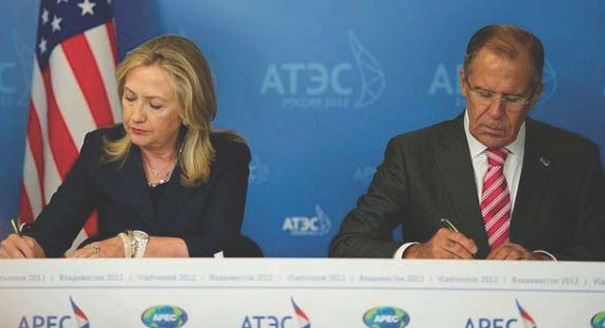
Despite high-profile disagreements on Syria and the broader changes brought in the wake of the Arab Spring, the United States and Russia continue to share similar interests in the region.
Source: World Politics Review

Finger-wagging aside, Russia’s main message during the so-called Arab Spring has not been about the United States. Rather, it has been about the Middle Eastern societies undergoing intense political change. And herein lies perhaps the biggest fundamental difference between Washington and Moscow in the “new” Middle East: whether the changes sweeping the region should be eagerly supported or warily monitored. Moscow’s experience as a patron of various regional strongmen and militant groups during the Cold War and afterward has taught Russian policymakers to approach political transitions with extreme caution, all the more so when they involve nationalist or Islamist ideologies and heavily armed private militias. From its own history, too, Russia has reason to trust the maxim that revolutions devour their children and are not especially kind to meddling foreigners.
To read the rest of the article, follow this link to the website of the World Politics Review:
http://www.worldpoliticsreview.com/articles/12343/for-u-s-russia-interests-trump-rhetoric-in-middle-east

Former Deputy Director, Russia and Eurasia Program
Rojansky, formerly executive director of the Partnership for a Secure America, is an expert on U.S. and Russian national security and nuclear-weapon policies.
Recent Work
Matthew Rojansky
Matthew Rojansky
Carnegie does not take institutional positions on public policy issues; the views represented herein are those of the author(s) and do not necessarily reflect the views of Carnegie, its staff, or its trustees.

Are Germany’s economic, industrial, and political struggles becoming a liability for the EU’s ability to rise to the geopolitical moment?

Rym Momtaz, ed.

European Commission President Ursula von der Leyen is about to give her annual address on the state of the EU. Here’s what she won’t—but should—say.
Rym Momtaz

Radical-right parties are expected to do well in upcoming elections in four of the EU's biggest member states. If successful, they could prevent the union from addressing key challenges ahead.

Stefan Lehne

The aftermath of the Ceuta crisis shows Europe has drawn the wrong lessons. Rather than doubling down on failed migration policies, the EU needs to address the underlying roots of such episodes.

Richard Youngs

Canadian Prime Minister Mark Carney has twice inspired praise for standing up to U.S. President Donald Trump: at the 2026 World Economic Forum in Davos and on Canada-U.S. trade negotiations. Is Carney showing a third way better than the EU has in dealing with the Trump administration?
Rym Momtaz, ed.