

Commentary
Rym Momtaz, ed.
{
  "authors": [
    "Rym Momtaz"
  ],
  "type": "commentary",
  "blog": "Strategic Europe",
  "centerAffiliationAll": "",
  "centers": [
    "Carnegie Europe",
    "Carnegie Endowment for International Peace"
  ],
  "englishNewsletterAll": "",
  "nonEnglishNewsletterAll": "",
  "primaryCenter": "Carnegie Europe",
  "programAffiliation": "",
  "regions": [
    "Europe",
    "France",
    "Germany"
  ],
  "topics": [
    "Foreign Policy",
    "EU",
    "Defense"
  ]
}
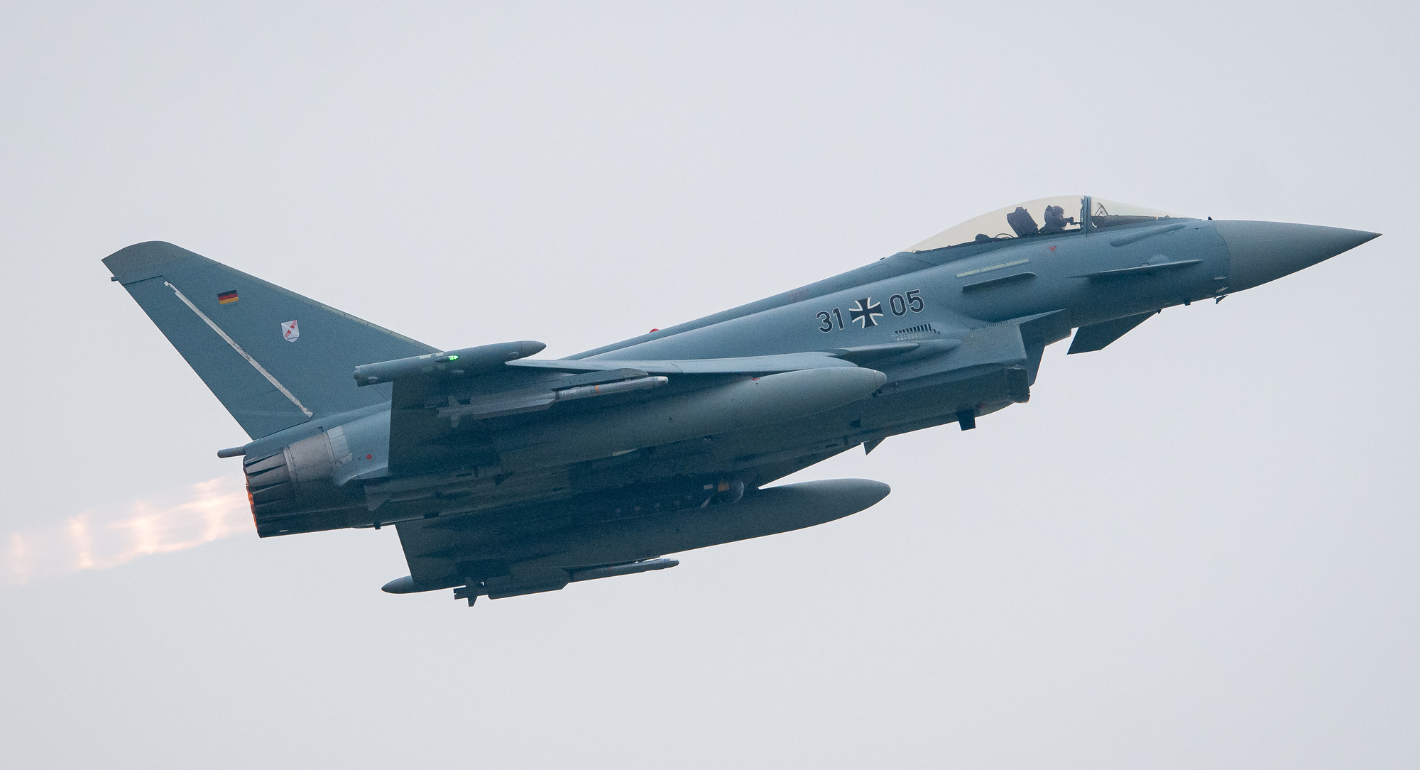
Source: Getty
France and Germany’s failure to agree on the Future Combat Air System (FCAS) raises questions about European defense. Amid industrial rivalries and competing strategic cultures, what does the future of European military industrial projects look like?
Postdoctoral Fellow, Université Grenoble Alpes
The issue isn’t pan-European defense cooperation, but the persistent failure of French and German strategic interests to align. Even after six decades of one of the world’s most institutionalized bilateral relationships, under relentless geopolitical pressure and with compelling economic incentives to unite, France and Germany still pursue divergent security strategies.
The Future Combat Air System (FCAS), together with the Main Ground Combat System (MGCS) were launched in 2017 as symmetrical, twinned Franco-German initiatives to increase European strategic autonomy. The idea was to transcend national rivalries by ensuring equal representation per project for each country and its industries. Germany would lead MGCS, centered on a tank; France would spearhead FCAS, built around a fighter jet. What followed, however, was a steady unraveling of these carefully constructed equilibria, as well as endless squabbles over specifications and workshare that have left France more exposed than Germany.
It is intriguing that a German chancellor contemplates seeking shelter under France’s nuclear deterrent while simultaneously distancing himself from FCAS, a project partly intended to secure the future of France’s force de frappe.
European defense projects will flourish when underpinned by compatible, clear-eyed strategic visions. Then, military requirements and industrial interests can be reconciled not just on paper, but in practice.
Director of the Security Studies Center, Institut Français des Relations Internationales
Defense cooperation tends to stumble over three obstacles: out-of-sync procurement cycles (one is in a hurry to procure while the other is not), divergence over country-specific requirements, and most of all the distribution of workshare and benefits to local industry.
In the case of FCAS, all these three items are now there. Germany’s purchase of U.S. F-35 combat aircraft unsynced the cycles: The Luftwaffe now has a fifth generation fighter for the next two decades. Meanwhile, German Chancellor Friedrich Merz’s comment on Germany’s lack of need for a nuclear- and aircraft carrier-capable aircraft (two French requirements that were known from the outset in 2017) mostly serves as an excuse to kill the beast.
The heart of the problem has been the workshare and benefits to local industry: While French manufacturer Dassault has the industrial know-how to build the plane, France does not have the resource to pay for it. Germany has the money and can work with others—European but also U.S. players—to plug the holes in industrial competency.
What the failure of the program highlights is less the difficulties of European defense cooperation than the Franco-German industrial rivalry, and the opposition of two models: while Germany prioritizes its own needs with off-the-shelf technology, France’s siloed model wants to keep all the industrial know-how but cannot finance it.
Head of the International Security Research Division, German Institute for International and Security Affairs (SWP)
The potential collapse of Franco-German cooperation on the FCAS is politically significant. It would be the final demonstration of the well-known problems plaguing many big European flagship projects.
European armament cooperation cannot deliver as long as there are disagreements on essential military requirements. The potential benefits of scale and efficiency will not be reaped if workshares are driven by political considerations.
But to argue that the end of FCAS would be the death knell of European ambitions for defense industrial cooperation would be a great exaggeration. Europe’s defense ecosystem is broader, more diversified, and more resilient than any single flagship program.
Rather, the end of FCAS may reinforce a recent pattern of European cooperation. Increasingly, EU member states join different smaller coalitions to procure and produce military systems together. Common operational requirements and pragmatism seem to be guiding principles of these coalitions of the willing. The German European Sky Shield Initiative is a case in point, as well as the Common Armored Vehicle Program, in which seven countries procure armored vehicles at scale. France, too, has successful cooperation with Italy on FREMM frigates. These initiatives are likely to increase the scale of production even if they fall short of greater inclusivity.
Director of the Center for Security, Diplomacy, and Strategy, Vrije Universiteit Brussel
If FCAS collapses, it will not kill Europe’s defense industry. But it would confirm something more uncomfortable: Europe still struggles to reconcile industrial integration with power politics.
At one level, the problem is industrial. For French manufacturer Dassault, control over system architecture is a key source of its—and France’s—comparative advantage. Sharing that edge with Airbus was always going to be difficult. For a firm whose business model prioritizes exports over European integration, the incentives to compromise are limited given Europe has yet to offer a credible, aggregated home market.
At another level, this is about leadership. As Germany rearms and edges toward becoming Europe’s preeminent military power, Berlin has fewer incentives to play second fiddle in a flagship program. The Franco-German defense-industrial bargain is being renegotiated in real time.
But the deepest fault line is arguably strategic. France is comfortable with the use of military power: It is a nuclear power and prioritizes strategic autonomy. Germany sees force as a last-resort tool and retains a strong transatlantic reflex. These differences translate into distinct military and industrial requirements.
And yet the structural pressures for convergence are powerful: Without greater cooperation and scale, Europeans will struggle to remain globally competitive.
Director General, Hellenic Foundation for European and Foreign Policy (ELIAMEP)
Yes, the European defense industry can survive the demise of FCAS—but only if the crisis is understood as symptomatic of deeper structural shortcomings rather than as an isolated program failure. What the FCAS impasse reveals, above all, is the fragility of Europe’s defense cooperation architecture. Multinational armament projects remain politically driven yet insufficiently institutionalized, exposed to shifts in national priorities, industrial competition, and strategic culture divergences.
What continues to be clear—and problematic—is that defense planning at EU level is still embryonic. While significant progress has been made through instruments such as the European Defense Fund and coordinated annual reviews, these mechanisms do not yet amount to a fully-fledged common defense planning system.
The Franco-German divergence illustrates this gap clearly: France conceives next-generation air power within a framework of strategic autonomy and expeditionary capability, including nuclear considerations, whereas Germany’s approach still appears to be firmly embedded in NATO structures.
The European defense industrial base, however, is broader and more adaptable than any single flagship program. Rising defense expenditure, increased political urgency, and EU-level financing instruments provide resilience. If the lessons of FCAS translate into more robust governance models and deeper political alignment, the industry may well survive and the EU as a defense player will mature.
Professor of Political Science, Swedish Defense University
For Europe, over the long term, the likely collapse of FCAS is a blessing in disguise. No doubt it will take time to tidy up the legal, financial, and political mess that the project is expected to leave behind. But a definitive breakup of this massive, €100 billion ($117 billion) fighter jet deal might very well be the best thing that can happen to Europe’s arms industry.
Up until now, this industry has only partially adjusted to new technical, operational, and geopolitical realities. In the aftermath of the collapse of this ambitious project, European arms manufacturers will be incentivized to innovate and absorb novel technological developments in the air domain. They will have to create solutions that enhance European self-reliance. And forge closer relationships with emerging small and medium-sized companies rather than rely on traditional ties between (primarily Western) European national champions sustaining legacy systems.
U.S. manufacturers such as Lockheed Martin, Raytheon Technologies, and Boeing will clearly benefit from a collapsed deal in the short run, by receiving a greater share of European defense expenditures.
In the long run, however, major U.S. corporations will have to get used to their increasingly competitive European counterparts no longer deferring to American leadership in high-tech segments of the global arms industry, associated with large profit margins.
Research Fellow in the Defense and Military Analysis Program, International Institute for Strategic Studies
The European defense industry is not the result of bilateral cooperation and, as such, it will survive a potential German withdrawal from the FCAS project.
Another question is if the failure of a bilateral cooperation between the two major EU spenders in defense can impact future joint development of major military capabilities, or if it might prompt a stronger push to pursue national developments of new capabilities. On this, there is no black or white answer. But a potential end to the FCAS project cannot be seen, automatically, as ending other collaborative projects. For instance Paris and Berlin cooperate on other areas too, such as on the Joint Early Warning for a European Lookout (JEWEL) initiative that also involves other European actors and is supported by EU funds.
Examples of cooperation such as Tornado aircrafts, Eurofighter jets, but also FREMM frigates suggest that big, joint industrial projects are possible. And if the goal is to have a European industry that is able to supply capabilities across the whole spectrum and to have national inventories that are less dependent on U.S. equipment, there is not much room for manoeuvre for single national defense industries. To develop future cutting-edge military equipment cooperation is needed.
Head of the Defense and Statecraft Program at the Center for Security, Diplomacy and Strategy, Vrije Universiteit Brussel
Europe’s next-generation fighter plane has not even taken off, and it looks as though it will be grounded indefinitely. The drama surrounding FCAS does not bode well for Franco-German defense industrial cooperation.
Germany has long sought to use the FCAS project to develop its own national aeronautics industry and skills base, which is why Dassault—among other reasons—has been reluctant to share technology so freely with partners.
The FCAS project reflects deep-seated divergent defense industrial interests, which are not easy to overcome. Could this cautionary case stand in the way of European joint capability projects? Perhaps. Yet, the key is to get the partner coalitions right and to iron out political expectations from the start.
Joint projects will likely go ahead at the EU level, but they may not always be centered on Franco-German cooperation. There is a need to study the FCAS project and to better understand why it has fallen apart, to ensure that mistakes are not repeated. If the failure of FCAS leads to greater dependencies on non-European weapons systems in the future, then this hardly bodes well for more European sovereignty in defense.
Lecturer in European Politics and History, King’s College London
The possible collapse of the FCAS would not mark the death of European ambitions to build globally powerful defense industries. On one level, it would just mark another episode in a long and familiar story.
FCAS joins a long list of ambitious European programs that stumbled over industrial rivalries and competing strategic cultures. But it also sits alongside projects such as Franco-Italian FREMM frigates or the MBDA missile alliance that continue to prosper. Since 1957, such European defense cooperation has always advanced unevenly.
What is different today is scale and intensity. European defense industries are seeing unprecedented attention and investment. The EU and the UK are pouring immense resources into rearmament, while firms are consolidating, expanding, and positioning themselves for long-term dominance.
Bringing together powerful corporate players such as Airbus and Dassault means a process of transformation that will have to navigate entrenched corporate, political, and military interests. Some projects will collapse under that strain.
But this turbulence signals transformation rather than decline. Europe is entering a messy period of consolidation that will determine which companies and states shape Europe's defense ecosystem for the rest of the century. The key question is therefore which players around the EU emerge stronger and which become mere historical footnotes.
Senior Analyst on strategic armaments, Fondation pour la Recherche Stratégique
“The French need a nuclear-capable and carrier-capable aircraft in the next generation. The Bundeswehr doesn’t need that for now.” This statement by German Chancellor Friedrich Merz surprised many in France, as it suggested that the German side of the Franco-German-Spanish project had suddenly realized—nine years after its launch—that the FCAS must form a crucial element in the air leg of France’s nuclear deterrent.
Yet Berlin has repeatedly expressed interest in recent months in France’s nuclear deterrent as a potential supplement to a partial or complete withdrawal of the United States from Europe.
Had the program succeeded in producing a common combat aircraft, Germany could have acquired a latent capability to carry French nuclear weapons, similar to how several European nations carry American B61-12 bombs on their U.S.-made F-35s. This would have symbolized a highly significant step toward European strategic autonomy from the United States, not only industrially but also operationally, including in nuclear deterrence.
The failure of the FCAS thus deals a severe blow to the vision of a sovereign Europe in security and defense.

Editor in Chief, Strategic Europe
Rym Momtaz is the editor in chief of Carnegie Europe’s blog Strategic Europe. A multiple Emmy award-winning journalist-turned-analyst, she specializes in Europe and the Middle East and the interplay between those two spaces.
Recent Work
Rym Momtaz, ed.
Rym Momtaz

While the EU and European governments are embracing the much-lauded middle-power moment, this entails three difficult conundrums.

Richard Youngs

Much has been said of the changes Brussels is trying to make to the EU enlargement process. Here’s why gradual integration might—or might not—be the answer.

Dimitar Bechev

The European Commissioner for Trade is headed to China. But after President Xi’s bridge-building visit to Washington, can a more isolated EU overcome Beijing’s stranglehold on critical raw materials? Who will blink first?
Rym Momtaz, ed.

The domestic impacts of how long it is taking to end the war in Ukraine have pushed the French electorate to the political extremes and compromised the country’s diplomatic capacity.
Rym Momtaz

Before the next wave of EU enlargement takes place, the union needs to grapple with thorny questions of how power is distributed among its members.


Emil Sondaj Hansen, Ditte Brasso Sørensen