

Commentary
Maria Lipman
{
  "authors": [
    "Maria Lipman"
  ],
  "type": "commentary",
  "centerAffiliationAll": "",
  "centers": [
    "Carnegie Endowment for International Peace",
    "Carnegie Russia Eurasia Center"
  ],
  "collections": [],
  "englishNewsletterAll": "",
  "nonEnglishNewsletterAll": "",
  "primaryCenter": "Carnegie Russia Eurasia Center",
  "programAffiliation": "",
  "programs": [],
  "projects": [],
  "regions": [],
  "topics": []
}
Source: Getty
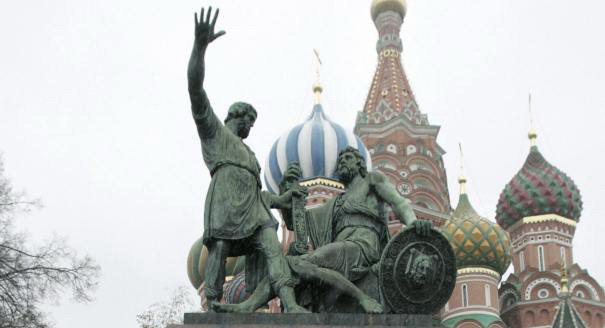
The meaning of the June 12 holiday remains murky and the nation’s leadership is evasive on what we are actually celebrating. No wonder that less than half of the Russians polled in 2012 knew even the name of Russia’s major national holiday.
In the list of major national holidays worldwide “Independence Day” is the most common: Of the more than two hundred nations listed over half celebrate “independence” as the biggest annual civic event. Other celebrated causes include “liberation,” “constitution,” “unification,” “republic,” “revolution,” and a few others. Monarchies celebrate coronations of a royalty’s birthday. There are a few exotic examples, such as Greenland that celebrates the “Longest Day.”
Russia falls in a category of just five nations that celebrate their own names; the other four are Australia, Bermuda, Canada, and Portugal. Australia remembers the arrival of the First Fleet to the Sydney Cove in late 18th century (and the proclamation of British sovereignty); Canada commemorates its “birthday:” the day when several colonies were united into a single country (also within the British Empire). On the Day of Portugal, the Portuguese commemorate the day when their greatest poet Luis de Camoes died. Bermuda Day is the first day when local residents go to sea and Bermuda shorts can be worn as a business attire (though these days, the national dress code has been reportedly eased, and shorts can be worn at any time). As can be seen, though the narratives that lie beneath their major national holidays are very diverse, they are simple and clear in each of the four countries.
The USSR also had a fairly clear narrative about the origins of the Soviet statehood: November 7 celebrated the Bolshevik revolution and the triumph of the new regime over the old one. This victory had its main hero, Vladimir Lenin, a universally revered, even saintly, figure.
The post-Communist Russia has nothing like this clarity regarding its national heroes, the origins of its statehood or the holiday associated with it. Originally introduced by President Boris Yeltsin, the Day of Adoption of the Declaration of State Sovereignty of the Russian Federation marked the vote for Russia’s sovereignty held on June 12, 1990, by the legislature of the Russian Federation, then still a constituent part of the USSR. The “sovereignty” of 1990 implied a liberation of democratic Russia from the Soviet Communism that eventually led to the collapse of the Soviet empire. The events associated with the disintegration of the USSR, however, are very broadly seen in Russia as a negative development. Putin famously referred to the collapse of the USSR as “the greatest geopolitical catastrophe of the 20th century;” since the early days of his first presidency he consistently distanced himself from Yeltsin’s rule. Moreover, in Putin’s Russia “sovereignty” has nothing to do with liberation from communism—instead it implies Russia’s defensive posture vis-a-vis the West. So it was natural that the mention of the 1990 event was removed and the old name of the holiday was replaced by “Russia Day” which has nothing concrete about it. But while the new name sounds much better than the old, which was far too long and clumsy, the meaning of the holiday remains murky and the nation’s leadership is evasive on what we are actually celebrating. Nor is there a nationally shared narrative on the origins of Russia’s statehood.
During his presidency Dmitry Medvedev, at least on one occasion, referred to Russia as being “only twenty years old” apparently, counting from the establishment of the post-Communist Russia. Shortly thereafter, however, he announced that 2012 would mark 1150 years of the Russian statehood. In December 2012, Putin called for a return of “the simple truth that Russia did not begin in 1917, or even in 1991, but rather, that we have a common, continuous history spanning over one thousand years.” Putin’s rhetoric emphasizes his desire to establish Russia’s historical continuity, but, at the same time, to avoid a discussion of the causes and the meaning of the Soviet Union’s collapse. No wonder that less than half of the Russians polled in 2012 knew even the name of Russia’s major national holiday.
Former Scholar in Residence, Society and Regions Program, Editor in Chief, Pro et Contra, Moscow Center
Lipman was the editor in chief of the Pro et Contra journal, published by the Carnegie Moscow Center. She was also the expert of the Carnegie Moscow Center’s Society and Regions Program.
Recent Work
Maria Lipman
Maria Lipman
Carnegie does not take institutional positions on public policy issues; the views represented herein are those of the author(s) and do not necessarily reflect the views of Carnegie, its staff, or its trustees.