

Commentary
Nathan J. Brown
{
  "authors": [
    "Nathan J. Brown"
  ],
  "type": "legacyinthemedia",
  "centerAffiliationAll": "dc",
  "centers": [
    "Carnegie Endowment for International Peace",
    "Malcolm H. Kerr Carnegie Middle East Center"
  ],
  "collections": [
    "Arab Awakening"
  ],
  "englishNewsletterAll": "menaTransitions",
  "nonEnglishNewsletterAll": "",
  "primaryCenter": "Carnegie Endowment for International Peace",
  "programAffiliation": "MEP",
  "programs": [
    "Middle East"
  ],
  "projects": [],
  "regions": [
    "North Africa",
    "Egypt"
  ],
  "topics": [
    "Political Reform",
    "Civil Society",
    "Religion"
  ]
}
Source: Getty
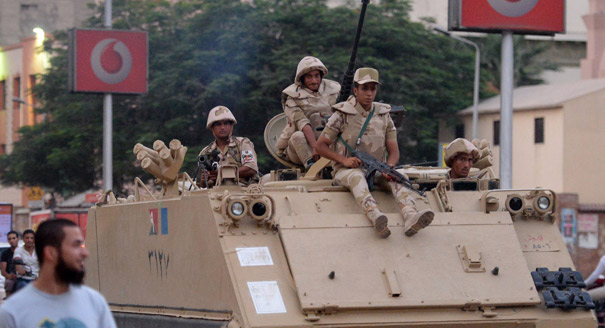
It would be wise for those who are now victorious in Egypt to remember that the issue is not only what the Brotherhood learns from the ousting of President Morsi; the issue is also what Islamists are taught.
Source: New Republic
The final, desperate hours of Mohamed Morsi, the Egyptian president ousted by the military on Wednesday, were in one sense merciful, but also pathetic. After a brief feint that called to mind the image of Salvadore Allende picking up a gun to defend his presidency, Morsi resorted instead to a series of increasingly desperate verbal signals, including ineffectual crises about his own legitimacy and attempts to grasp expired offers of compromise. The result made him seem less like a martyr than a property owner waving his deed at a wrecking-ball operator who has already destroyed his home.
Waving that deed—or, less metaphorically, attempting to fall back on constitutional text and electoral legitimacy—would have much to persuade a neutral observer if any such creature still exists. Yes, it is true that the Brotherhood did well in elections; that it was not able to govern fully but still saddled with responsibility for Egypt’s insurmountable problems; that important state actors never accepted its authority; that its opposition was unified only by a desire to make the Brotherhood fail; and that Egypt’s rumor mill transformed preposterous rumor into established fact with breathtaking speed.But it is also undeniable that Morsi and the Brotherhood made almost every conceivable mistake—including some (such as reaching too quickly for political power or failing to build coalitions with others) that they had vowed they knew enough to avoid. They alienated potential allies, ignored rising discontent, focused more on consolidating their rule than on using what tools they did have, used rhetoric that was tone deaf at best and threatening at worst. Had they hired a consultant from the Nixon White House, they would have done a more credible job, at least by being efficient.
The Morsi presidency is without a doubt one of the most colossal failures in the Brotherhood’s history. What lesson will the movement learn from it, if any?
In studying Islamist movements over the last decade, I generally found that the most rewarding time to speak to leaders was about a year or so after an election. During the heat of the political battle, they made decisions like most politicians do (on the fly, often overreacting to yesterday’s headlines) and spoke like most politicians do (providing glib spin than reflective analysis). But at calmer moments, they spoke less like politicians and more openly. And there was a reason why: The movements prided themselves (justifiably) on an ability to learn.
Egypt’s Muslim Brotherhood and its sister organizations represent the most successful non-governmental organizations in Arab history. No other movements have been able to sustain, reinvent, and replicate themselves over so much time and space. And there are two secrets to that success: a tight-knit organizational structure that rewards loyalty and the ability to adjust and adapt.
And those two features led to the experiment with political Islam that is now in such grave crisis. The organizational tightness of the Brotherhood made it more able than any other potential opposition force to organize for campaigns: In many countries, they were the only political party worthy of the name (even in places where they were banned from calling themselves a party). And their adaptability allowed them to take advantages of the cracks and openings that appeared in Arab authoritarian orders over the past few decades.
When the uprisings of 2011 occurred, the Egyptian Brotherhood had become sufficiently adept at the political game that it hit the ground running far faster than any possible competitor. And the organization had also evolved over the past couple decades to place politics at the center of its agenda. Founded as a general reform movement that carried out charity, self-improvement, education, mutual assistance, preaching, and politics, the Brotherhood had become a primarily political creature.
But just as its political project seemed poised to realize full success, it suddenly and ignominiously collapsed. The immediate reaction among its members will be to complain that the Brotherhood was cheated. And in a sense it was, but complaint will not substitute for reflection forever. What will be the movement’s more studied reaction? In a conversation two months ago with a Brotherhood leader Amr Darrag, I made a bold prediction that in ten years, the organization will regret having sought the Egyptian presidency in 2012. He politely disagreed. In retrospect we were both wrong: The regret will likely set in over the next several months.
And what will this reflective organization regret?
From the vantage point of this week's events, I see three answers.
The Brotherhood made bad decisions. Those arguing for such a path will have quite a smorgasbord at their disposal. But what they will likely focus on was the process in 2011 and 2012 in which the organization went from wishing to be a leading political actor to being the dominant party. They did so, I am convinced, not as part of a well thought-out strategy but because they reacted to various events—perceived slights, unexpected opportunities, and confusing signals. I saw the evolution of the Brotherhood’s thinking in a series of meetings with Brotherhood leader (and reputed chief strategist) Khairat al-Shatir in the year after the uprising. In March 2011, he spoke of governing as something that might be in the Brotherhood’s future after he had retired; by the following January he was beginning to edge toward his own presidential bid (one that he was forced to cede to his colleague Mohamed Morsi when al-Shatir’s conviction under the old regime led to his disqualification).
Those who favor this answer might wish to return to the political game but play it a bit more cautiously and judiciously. It will be a long road back, however, since the Morsi presidency will leave a residue of profound distrust and even hatred toward the organization in large parts of the society that had merely been skeptical before.
As some within the Brotherhood have nervously felt, the organization did not make these mistakes by accident. The tight-knit organization built for resilience under authoritarianism made for an inward-looking, even paranoid movement when it tried to refashion itself as a governing party. In fact, the organization was led by figures (Morsi himself, al-Shatir, and Brotherhood General Guide Muhammad Badi‘) who were themselves pure creatures of the organization, but the best of them tended to be fairly inexperienced at dealing with the world outside of it.
This diagnosis might lead to the Brotherhood leaving the political game to the political party it spawned, the Freedom and Justice Party. It might even lead the movement to decide to free its members to join any party they like, a position favored by a small number of young activists back in 2011. Either path would be extremely difficult for the current leadership—raised on hierarchy, coordination, and discipline—to follow.
The problem lay in the choice of a political strategy. The Brotherhood’s mistake in such a view would be that it thought it could win and govern. But the experience of the Islamist FIS in Algeria in the early 1990s (where the military intervened to prevent an Islamist victory), Hamas in Palestine in 2006 (where a coalition of international and domestic actors sabotaged the Islamists’ ability to rule) has now been joined by that of Egypt’s Brotherhood.
This diagnosis may be seem very persuasive in the long term, but it could lead in very diverse directions—to the movement abandoning political work; to individuals abandoning the Brotherhood; or to the Brotherhood determining that it will play politics but no longer by peaceful rules.
Which lesson will the Brotherhood learn, and how will it apply them? The organization first needs some time to think, and it is not yet clear how the disparate coalition that has destroyed the Morsi presidency will react to the Brotherhood’s continued role. In this respect, it would be wise for those who are now victorious in Egypt to remember that the issue is not only what the Brotherhood learns; the issue is also what Islamists are taught.

Nonresident Senior Fellow, Middle East Program
Nathan J. Brown, a professor of political science and international affairs at George Washington University, is a distinguished scholar and author of nine books on Arab politics and governance, as well as editor of five books.
Recent Work
Nathan J. Brown
Nathan J. Brown
Carnegie does not take institutional positions on public policy issues; the views represented herein are those of the author(s) and do not necessarily reflect the views of Carnegie, its staff, or its trustees.

In supporting Europe’s far-right, MAGA and Russia both want the same thing: a weaker EU. Europe must defend itself without abandoning the openness these forces exploit.

Armida van Rij

As the EU confronts profound challenges, several leaders have called for fundamental reform to the union’s model—but only modest, superficial changes have resulted. What if Europe really could be reimagined from zero today: What should such a redesigned European order look like?

Richard Youngs, ed.

The EU’s new migration policy is not suited to today’s realities. With climate change increasingly becoming a driver of displacement, Europe needs to rethink its deterrence-focused approach.

Shana Tabak
The battle over free speech has taken center stage since U.S. Vice President JD Vance accused Europe of censorship. From travel bans to social media regulation, especially around the Israel-Palestine conflict, are liberal democratic governments weaponizing free speech?

Rym Momtaz, ed.

Preparing candidate countries for EU membership is no longer enough. As the enlargement process becomes a reality, the union must also prepare its own societies.

Iliriana Gjoni