

Commentary
Thomas de Waal
{
  "authors": [
    "Thomas de Waal"
  ],
  "type": "commentary",
  "centerAffiliationAll": "",
  "centers": [
    "Carnegie Endowment for International Peace",
    "Carnegie Europe",
    "Carnegie Russia Eurasia Center"
  ],
  "collections": [],
  "englishNewsletterAll": "",
  "nonEnglishNewsletterAll": "",
  "primaryCenter": "Carnegie Europe",
  "programAffiliation": "",
  "programs": [],
  "projects": [],
  "regions": [],
  "topics": []
}
Source: Getty
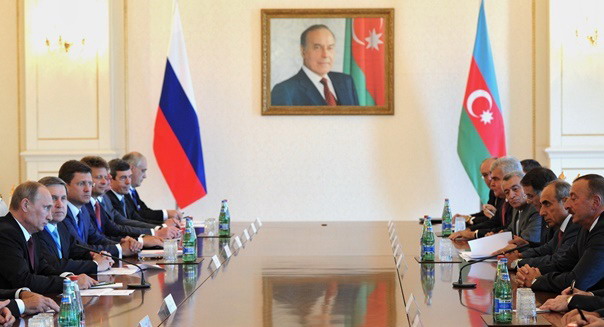
Vladimir Putin’s one-day visit to Baku on August 13 was fertile ground for Kremlinological speculation. The formal part of the negotiations revealed very little. It is more productive to focus on who was not in Baku and what was not said.
Vladimir Putin’s one-day visit to Baku on August 13 was fertile ground for Kremlinological speculation.
Despite professions of friendship and love by both sides and President Aliev’s declaration that “We have very similar positions on all issues,” the formal part of the negotiations, unsurprisingly, revealed very little.
So it is more productive to focus on who was not in Baku and what was not said.
There was no mention of the Gabala radar station, which the Russians were forced to abandon last year. The very fact of the Putin visit meant that Russia considered that episode closed. Putin uttered only a one-line reference to resolution of the Karabakh conflict, which for a while was the Number One foreign policy initiative of his predecessor, Dmitry Medvedev—making it obvious once again that this is an issue that does not especially interest him.
Conspicuously missing from Putin’s large delegation was the head of Gazprom, Alexey Miller. Instead it was Igor Sechin, head of Rosneft, who signed a grandiose cooperation agreement with the Azerbaijani state oil company, SOCAR. Rosneft has been seeking a piece of the Absheron gas field and the Russians must have left disappointed that they got no more than a generally worded cooperation agreement.
A few other important words did not get uttered in the meetings.
One was “America.” The very fact of a Russian head of state arriving in Baku with half a dozen ministers in tow reminded the Azerbaijanis where they should put their priorities. A second was “Armenia.” One reason for the visit, with all its talk of Azerbaijani-Russian military cooperation, was to make the Armenians nervous and think more seriously about joining Putin’s Customs Union. (One prominent face in the Russian delegation was the head of Russia’s defense export company Rosoboronexport, Anatoly Isaykin. Aliev said publicly that military cooperation with Russia is worth four billion dollars.)
A third missing word that hung over the whole visit was “elections.” Aliev runs for a third presidential term on October 9. This time the normally incompetent Azerbaijani opposition has nominated someone of real stature, well-known film maker Rustam Ibragimbekov, to be its unity candidate. However, in order to compete, Ibragimbekov must renounce the Russian part of his dual citizenship, a procedure which has handed the Russian authorities a de facto veto on his participation in the poll. Nothing had to be said on this—both sides knew what the other wanted.

Senior Fellow, Carnegie Europe
Thomas de Waal is a senior fellow at Carnegie Europe, specializing in Eastern Europe and the Caucasus.
Recent Work
Thomas de Waal
Thomas de Waal
Carnegie does not take institutional positions on public policy issues; the views represented herein are those of the author(s) and do not necessarily reflect the views of Carnegie, its staff, or its trustees.