

Article
- +1
Toby Dalton, Mark Hibbs, Nicole Grajewski, …
{
  "authors": [
    "Mark Hibbs"
  ],
  "type": "legacyinthemedia",
  "centerAffiliationAll": "dc",
  "centers": [
    "Carnegie Endowment for International Peace"
  ],
  "collections": [
    "U.S. Nuclear Policy"
  ],
  "englishNewsletterAll": "ctw",
  "nonEnglishNewsletterAll": "",
  "primaryCenter": "Carnegie Endowment for International Peace",
  "programAffiliation": "NPP",
  "programs": [
    "Nuclear Policy"
  ],
  "projects": [],
  "regions": [
    "North America",
    "United States",
    "East Asia",
    "China"
  ],
  "topics": [
    "Nuclear Policy",
    "Nuclear Energy"
  ]
}
Source: Getty
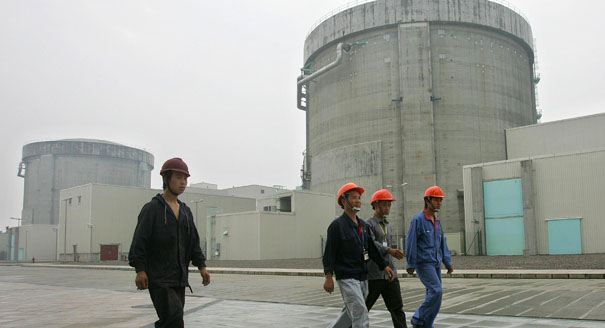
China has a far greater global presence today than when it negotiated its first nuclear agreement with the U.S. three decades ago. The new agreement must reflect these realities in order to best serve U.S. security interests.
Source: Hill
President Obama recently approved an agreement for bilateral nuclear cooperation with China, which would replace an agreement from 1985 that will expire in December. The new agreement will be sent to Congress for consideration at a time when the future direction of America’s relations with China has become uncertain.
Tension has risen between the two countries, most directly following from Beijing’s assertiveness vis-à-vis its Pacific neighbors, but there is also a nuclear energy component: Last May the U.S. Department of Justice accused Chinese military personnel of hacking into computers at Westinghouse Electric Company and stealing data related to its nuclear business in China.China has a far greater global presence today than when it negotiated its first nuclear agreement with the U.S. three decades ago. The new agreement must reflect these realities in order to best serve U.S. security interests.
Lawmakers in weeks ahead are likely to express two main concerns about continued nuclear trade with China: First, that Beijing might exploit the agreement to use U.S.-obligated plutonium in future nuclear weapons; and second, that the agreement won’t protect U.S. firms’ intellectual property.
Let’s look at both issues.
A major change from the old agreement is that China henceforth would be granted advance consent to reprocess spent fuel used in reactors built by Westinghouse in China and then use the separated plutonium in subsequent civil nuclear operations. Does this relaxed control on nuclear material mean that U.S.-obligated plutonium could end up in Chinese nuclear weapons?
No. China since 1964 is a nuclear weapons state with inventories of military-grade plutonium and uranium that were produced in dedicated Chinese military reactors and reprocessing plants. It is extremely unlikely that China would violate a bilateral accord with the United States to divert U.S.-obligated civilian nuclear materials to produce future nuclear weapons.
If China elects to reprocess U.S.-obligated fuel under the new agreement, reprocessing must take place in an installation subject to or eligible for International Atomic Energy Agency (IAEA) safeguards. (The existing agreement included no provision for IAEA monitoring of any U.S.-obligated nuclear material in China.) China will also provide assurances that all U.S.-obligated nuclear material remains in China’s civilian nuclear fuel cycle and will not be diverted into nuclear weapons. The assurances should include provision of technical data permitting the U.S. to track the material’s whereabouts, as well as visits by U.S. personnel at Chinese installations where the fuel is located to assure that it is physically protected. U.S.-obligated nuclear material may be used only in designated Chinese reactors that may be subject to IAEA safeguards.
The U.S. and China will negotiate a so-called administrative arrangement to track U.S.-obligated nuclear material in China. U.S. tracking will provide greater assurances that it will be used peacefully and is safe and secure. The U.S. tracks material used by most cooperating countries—for example the European Union, Korea, and Russia—but such tracking was not included in the 1985 agreement with China.
China has a small plant to reprocess its civil nuclear power fuel. It is not under IAEA safeguards. Should China in future want to reprocess U.S.-obligated fuel there, or in a much larger plant that China might build with French assistance, that facility must be under IAEA safeguards or eligible for IAEA safeguards.
In sum, there is nothing in the agreement concerning U.S.-obligated nuclear material in China that would inadvertently increase Chinese nuclear threats to U.S. security.
The new agreement does not address and undoubtedly will not prevent Chinese hacking attacks against U.S. firms. Cybercrime should be dealt with separately by the U.S. and China. But the new nuclear agreement will address concerns that technology provided by U.S. firms to China’s peaceful nuclear program could be diverted for military use.
Technology transfers from the U.S. to foreign nuclear programs are normally not covered by bilateral cooperation agreements but instead by Part 810 of the Federal Regulations. These require an approval process including vetting of intended Chinese recipients. Because of U.S. concerns about protecting intellectual property and preventing unauthorized retransfers, know-how transfers to China will be made subject to the new cooperation agreement, meaning that if know-how is abused, that would expressly violate the agreement. The agreement will incentivize Chinese compliance because it provides for advance authorizations to specific Chinese entities that are transparent. The agreement will also provide for training of U.S. and Chinese firms to protect intellectual property.
During the last half-century, the United States has been increasingly challenged to negotiate favorable nuclear cooperation agreements because the terms of nuclear trade are shifting away from the U.S. and toward other countries. The decline in America’s nuclear energy leverage mirrors the continued shrinkage of American nuclear industry and technology rights. This trend will continue, so the U.S. must more carefully than ever weigh the benefits of nuclear cooperation against the risks.
In the case of China, benefits include providing a legal framework for nuclear trade with a country whose commitment to global nuclear arrangements and norms is relatively recent, whose future role in the nuclear power industry will be considerable, and which remains the largest and most important foreign market for U.S. nuclear industry. Risks include diversion of nuclear wares to a state which is a potential adversary and is less transparent than most of America’s nuclear trade partners. The new agreement contains specific provisions with these risks in mind.

Nonresident Senior Fellow, Nuclear Policy Program
Hibbs is a Germany-based nonresident senior fellow in Carnegie’s Nuclear Policy Program. His areas of expertise are nuclear verification and safeguards, multilateral nuclear trade policy, international nuclear cooperation, and nonproliferation arrangements.
Recent Work


Toby Dalton, Mark Hibbs, Nicole Grajewski, …
Mark Hibbs
Carnegie does not take institutional positions on public policy issues; the views represented herein are those of the author(s) and do not necessarily reflect the views of Carnegie, its staff, or its trustees.

European Commission President Ursula von der Leyen is about to give her annual address on the state of the EU. Here’s what she won’t—but should—say.

Rym Momtaz

Radical-right parties are expected to do well in upcoming elections in four of the EU's biggest member states. If successful, they could prevent the union from addressing key challenges ahead.

Stefan Lehne

Canadian Prime Minister Mark Carney has twice inspired praise for standing up to U.S. President Donald Trump: at the 2026 World Economic Forum in Davos and on Canada-U.S. trade negotiations. Is Carney showing a third way better than the EU has in dealing with the Trump administration?
Rym Momtaz, ed.

European states control several Overseas Countries and Territories around the world that carry strategic, economic, and environmental weight. As great powers challenge the rules-based order, defending them is a geopolitical imperative for Europe.

Marc Pierini

In supporting Europe’s far-right, MAGA and Russia both want the same thing: a weaker EU. Europe must defend itself without abandoning the openness these forces exploit.

Armida van Rij