

Paper
Ariel (Eli) Levite, Toby Dalton
{
  "authors": [
    "Ariel (Eli) Levite"
  ],
  "type": "legacyinthemedia",
  "centerAffiliationAll": "dc",
  "centers": [
    "Carnegie Endowment for International Peace",
    "Malcolm H. Kerr Carnegie Middle East Center"
  ],
  "collections": [
    "Iranian Proliferation",
    "U.S. Nuclear Policy"
  ],
  "englishNewsletterAll": "ctw",
  "nonEnglishNewsletterAll": "",
  "primaryCenter": "Carnegie Endowment for International Peace",
  "programAffiliation": "NPP",
  "programs": [
    "Nuclear Policy"
  ],
  "projects": [],
  "regions": [
    "North America",
    "United States",
    "Middle East",
    "Iran"
  ],
  "topics": [
    "Political Reform",
    "Nuclear Policy",
    "Arms Control"
  ]
}
Source: Getty
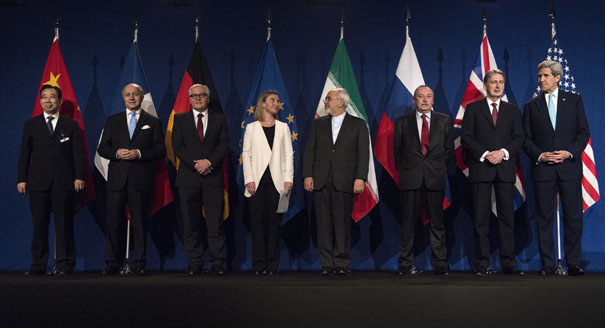
If the parties’ opening positions are used as benchmarks, the parameters of the Joint Comprehensive Plan of Action favor Iran. If the deal is seen through the lenses of their strategic objectives, the picture is far more nuanced.
Source: Norwegian Institute of International Affairs
The ink has barely dried on the recent “Parameters” for a “Joint Comprehensive Plan of Action” (JCPOA), which itself is merely another interim step en route to a fully-fledged comprehensive agreement that may or may not be reached by the end of June and which, furthermore, even if concluded could (certainly if judged in light of the previous agreements with Iran) significantly deviate from its current composition. Already, predictably conflicting narratives between Iran and the US have emerged on what was agreed upon in Lausanne, raising serious questions whether the parameters of the deal as described will survive the ongoing negotiations. Under these circumstances it is challenging to provide a definitive assessment of the agreement in hand.
Nevertheless, how does it look? In our judgment a great deal depends on one’s vantage point. If one is persuaded that the agreement averted imminent Iranian nuclearization and that such prospect would have inevitably unleashed war with Iran, then almost any deal seems preferable. If on the other hand you believe that Iran was not about to resume its pre-2003 Manhattan -type nuclear weapons program and war was a remote prospect, then time need not have been of the essence for the P-5, which in turn casts the achieved outcome in much less favorable light the outcome achieved.This article was published in full in the Norwegian Institute of International Affairs.

Senior Fellow, Nuclear Policy Program, Technology and International Affairs Program
Levite was the principal deputy director general for policy at the Israeli Atomic Energy Commission from 2002 to 2007.
Recent Work

Ariel (Eli) Levite, Toby Dalton
Ariel (Eli) Levite, Toby Dalton
Carnegie does not take institutional positions on public policy issues; the views represented herein are those of the author(s) and do not necessarily reflect the views of Carnegie, its staff, or its trustees.

The EU can impose sanctions but struggles to enforce them without the United States. With Washington increasingly disinterested in backing European interests, the bloc must now fend for itself.


Nicu Popescu, Tiago Antunes

Ahead of a tough winter for Ukraine, Donald Trump’s swing back toward Russia bodes ill. But instead of panicking, Kyiv’s European allies are focusing on action.

Rym Momtaz

While the EU and European governments are embracing the much-lauded middle-power moment, this entails three difficult conundrums.

Richard Youngs

Europe is facing rising populism internally as well as external pressures from Russia, China, Turkey, and the United States.

Dimitar Bechev

A notable degree of participative democracy has firmly arrived in Europe. But to have more far-reaching impact, democratic deliberation needs to move into a radically new phase.
Richard Youngs