

Paper
James M. Acton, Ankit Panda
{
  "authors": [
    "James M. Acton"
  ],
  "type": "legacyinthemedia",
  "centerAffiliationAll": "dc",
  "centers": [
    "Carnegie Endowment for International Peace",
    "Malcolm H. Kerr Carnegie Middle East Center"
  ],
  "collections": [
    "Iranian Proliferation",
    "U.S. Nuclear Policy"
  ],
  "englishNewsletterAll": "ctw",
  "nonEnglishNewsletterAll": "",
  "primaryCenter": "Carnegie Endowment for International Peace",
  "programAffiliation": "NPP",
  "programs": [
    "Nuclear Policy"
  ],
  "projects": [],
  "regions": [
    "North America",
    "United States",
    "Middle East",
    "Iran"
  ],
  "topics": [
    "Political Reform",
    "Nuclear Policy"
  ]
}
Source: Getty
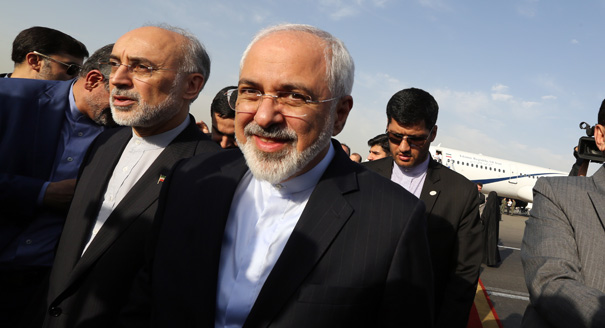
The recent nuclear deal between Iran, the United States, China, Russia, France, Germany, and the United Kingdom is better than existing alternatives.
Source: CNBC
Carnegie’s James Acton talked to CNBC about why Tuesday’s nuclear deal with Iran is better than existing alternatives. Acton argued that the agreement has very stringent limits on Iran’s nuclear activities lasting between ten and twenty-five years, as well as some very stringent verification provisions to detect cheating.
“It’s not a perfect deal, but the result I believe is better than any of the reasonably achievable alternatives at this point,” Acton said.
Acton added that it would be very hard to undo the deal and that that is “a good thing.” Responding to criticisms of the deal, Acton pointed out that the Soviet Union lied and yet the United States successfully did arms control with the USSR.
“This idea that the Iran deal is somehow based on trusting Iran is simply wrong. There are stringent verification provisions associated with this deal,” Acton said.

Jessica T. Mathews Chair, Co-director, Nuclear Policy Program
Acton holds the Jessica T. Mathews Chair and is co-director of the Nuclear Policy Program at the Carnegie Endowment for International Peace.
Recent Work

James M. Acton, Ankit Panda
James M. Acton
Carnegie does not take institutional positions on public policy issues; the views represented herein are those of the author(s) and do not necessarily reflect the views of Carnegie, its staff, or its trustees.

European states control several Overseas Countries and Territories around the world that carry strategic, economic, and environmental weight. As great powers challenge the rules-based order, defending them is a geopolitical imperative for Europe.

Marc Pierini

In supporting Europe’s far-right, MAGA and Russia both want the same thing: a weaker EU. Europe must defend itself without abandoning the openness these forces exploit.

Armida van Rij

As we close out another season of Strategic Europe, it is worth taking stock of the deep shifts underway.

Rym Momtaz

The hybrid warfare landscape is evolving rapidly, leaving policymakers without clear strategies. To better inform their work in addressing emerging challenges, governments must dig deeper into the underlying dynamics at play.


Raluca Csernatoni, Alicia Wanless

Trump is distracted and Ukraine wants Europe to step up. The continent’s leaders must find their voice and assert it in talks with Russia.

Alissa de Carbonnel