

Paper
Christopher S. Chivvis, Rohan Mukherjee, Milan Vaishnav
{
  "authors": [
    "Milan Vaishnav"
  ],
  "type": "legacyinthemedia",
  "centerAffiliationAll": "dc",
  "centers": [
    "Carnegie Endowment for International Peace"
  ],
  "collections": [],
  "englishNewsletterAll": "ctw",
  "nonEnglishNewsletterAll": "",
  "primaryCenter": "Carnegie Endowment for International Peace",
  "programAffiliation": "SAP",
  "programs": [
    "South Asia"
  ],
  "projects": [],
  "regions": [
    "South Asia",
    "India"
  ],
  "topics": [
    "Political Reform"
  ]
}
Source: Getty
In the short run, the Bihar loss damages Modi’s prestige, complicates politics, and makes parliament more of an obstacle. Its broader impact, however, should not be overstated over the longer term.
Source: BBC
The contest in this electorally critical heartland state pitted Mr Modi's National Democratic Alliance (NDA) coalition against the "Mahagatbandhan", or the "grand alliance" of anti-BJP parties.
This included a number of regional heavyweights, as well as the Indian National Congress.
In the coming days, India's opinion pages and news channels will dissect the reasons for the BJP's electoral defeat and scrutinise the way in which two longtime rivals -incumbent chief minister Nitish Kumar of the JD(U) and former chief minister Laloo Prasad Yadav of the RJD - so skillfully buried the hatchet in pursuit of political survival.
Beyond political theatre however, the Bihar outcome has implications for Mr Modi and his reform agenda.
In the short run, Bihar is a significant setback for Mr Modi in three ways: it damages his prestige, complicates politics both inside and outside the ruling alliance, and makes parliament more of an obstacle. Over the longer term, however, one should not overstate the broader impact on Mr Modi's economic reform plans.
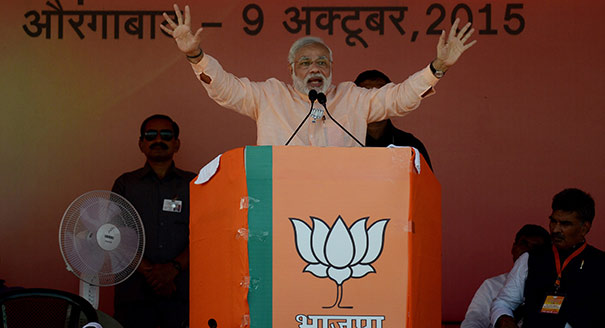
The Bihar loss damages the prime minister's standing because the BJP, hoping to exploit the prime minister's unparalleled popularity across India, made him the explicit face of the campaign.
This formula had delivered results for the BJP in a string of recent state polls. In Bihar, though, Mr Modi was pitted against a popular chief minister, Nitish Kumar, who also preaches the gospel of development and suffered no clear anti-incumbency sentiment.
As a result, the strategy of relying on the "Modi magic" - in the absence of a credible local face - fell flat.
Decisive defeats in successive state elections in Delhi and Bihar have resoundingly punctured the halo of invincibility that has surrounded Mr Modi and his trusted lieutenant, BJP president Amit Shah.
This loss of prestige, in turn, creates space for disgruntled voices within the party who are either underwhelmed by Mr Modi's governance or demoralised by Mr Modi and Mr Shah's iron grip on the party apparatus. The humbling rout in Bihar will give fresh oxygen to BJP dissenters. Beyond the ruling alliance, the election has two further political implications.
First, it elevates the profile of Nitish Kumar - set to begin his fourth stint as chief minister - making him an opposition leader to reckon with on a national level.
Even though Mr Yadav's RJD will end up as the single largest party in terms of seats, it is Mr Kumar who will be crowned victor and lead the state government.
Second, the election validates a much-debated hypothesis: that parties opposed to the BJP can counteract the Modi wave if they opportunistically band together.
In the 2014 general election, many regional parties - including those in Bihar - fought elections on their own, fracturing the anti-BJP vote. Parties in states like Assam, Uttar Pradesh and West Bengal will sit up and take note in anticipation of upcoming state elections.
Third, the BJP loss ensures that parliament will become an even greater obstacle to Mr Modi's legislative agenda on at least two counts.
The Bihar drubbing increases the likelihood that the national opposition will use its newfound mandate to block important bills in parliament's winter session. Expect the opposition to point to the BJP's use of Hindu-majority rhetoric on the campaign trail - Amit Shah famously warned Bihari voters that Pakistanis would set off firecrackers if the BJP loses - as evidence of its eroding legitimacy.
More importantly, the BJP's failure to win Bihar also makes its quest for a majority in parliament's upper house (Rajya Sabha), whose composition is determined by the various state assemblies, an ever-distant dream. Without majorities in both houses, Mr Modi's legislative agenda will continue to face headwinds.
Damage to the Modi brand, growing dissent within the party, and dimming hopes for a co-operative parliament will surely sting in the near term.
Over the long haul, however, it is not obvious that this election by itself will change Mr Modi's plans for economic reform.
The prime minister's priorities to date make it abundantly clear that he is plotting no dramatic rupture with the past; he is committed to an incremental programme of economic change. India's democratic system and important divides within his own alliance, provide enough checks and balances to mean that he is is unlikely to deviate from this course.
Wherever possible, the Modi regime will circumvent a divided parliament, deploying executive action and pushing reforms that can be adopted by India's states, where a divided national parliament poses no obstacle. In short, don't expect Mr Modi to dwell on Bihar for too long.
In India, another state election is always around the corner.
This article was originally published in the Indian Express.

Director and Senior Fellow, South Asia Program
Milan Vaishnav is a senior fellow and director of the South Asia Program and the host of the Grand Tamasha podcast at the Carnegie Endowment for International Peace. His primary research focus is the political economy of India, and he examines issues such as corruption and governance, state capacity, federalism, and electoral behavior. He also conducts research on the Indian diaspora.
Recent Work


Christopher S. Chivvis, Rohan Mukherjee, Milan Vaishnav



Sophia Besch, Eric Ciaramella, Steve Feldstein, …
Carnegie does not take institutional positions on public policy issues; the views represented herein are those of the author(s) and do not necessarily reflect the views of Carnegie, its staff, or its trustees.

As the EU confronts profound challenges, several leaders have called for fundamental reform to the union’s model—but only modest, superficial changes have resulted. What if Europe really could be reimagined from zero today: What should such a redesigned European order look like?

Richard Youngs, ed.

Preparing candidate countries for EU membership is no longer enough. As the enlargement process becomes a reality, the union must also prepare its own societies.

Iliriana Gjoni
Countries face several hurdles in joining the EU, including the final stage of ratifying their accession treaties. Procedural reforms and substantive adjustments could help move the process forward.

Stefan Lehne
Europe has an interest in supporting Armenian leader Nikol Pashinyan as he tries to make peace with neighbors and loosen ties with Russia. But it is depersonalized support in the long term, not quickfire flash, that will win the day.

Thomas de Waal

Montenegro and Albania are frontrunners for EU enlargement in the Western Balkans, but they can’t just sit back and wait. To meet their 2030 accession ambitions, they must make a strong positive case.

Dimitar Bechev, Iliriana Gjoni