

Research
- +4
Milan Vaishnav, Rahul Verma, Rukmini S., …
{
  "authors": [
    "Christophe Jaffrelot"
  ],
  "type": "legacyinthemedia",
  "centerAffiliationAll": "dc",
  "centers": [
    "Carnegie Endowment for International Peace"
  ],
  "collections": [],
  "englishNewsletterAll": "ctw",
  "nonEnglishNewsletterAll": "",
  "primaryCenter": "Carnegie Endowment for International Peace",
  "programAffiliation": "SAP",
  "programs": [
    "South Asia"
  ],
  "projects": [],
  "regions": [
    "South Asia",
    "India",
    "Pakistan"
  ],
  "topics": [
    "Security",
    "Military"
  ]
}
Source: Getty
Does Masood Azhar’s “protective custody” reflect a new policy at the top of the Pakistan army?
Source: Indian Express
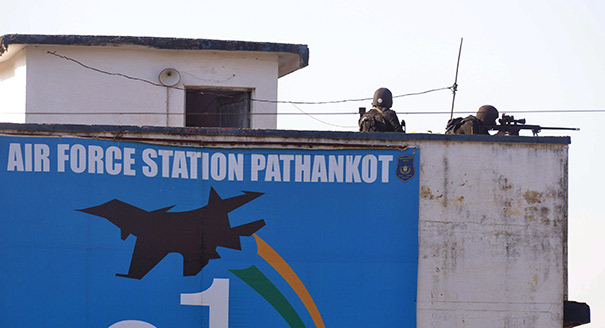
After the Pathankot attack, India has asked Pakistan to investigate the implications of the Jaish-e-Muhammad (JeM), one of the two most active jihadi movements against India along with the Lashkar-e-Taiba (LeT). Its leader, Masood Azhar, is now under “protective custody” according to Punjab Law Minister Rana Sanaullah, but history may well repeat itself.
After the US put pressure on Pakistan in the wake of al-Qaeda-directed 9/11, General Pervez Musharraf banned the JeM, among other groups, in January 2002. But it reappeared under another name and continued to conduct its business openly, even when Azhar was under house arrest.This was a reflection of the close relationship that the JeM had with the Pakistani security establishment; something that Azhar’s career exemplifies. A native of Bahawalpur (south Punjab), the maulana was trained in Binori Town, the renowned madrasa of Karachi, where he became a follower of Maulana Haq Nawaz Jhangvi, founder of the Sipah-e-Sahaba Pakistan (SSP), the Sunni sectarian party, and where a recruiting agent from the Harkat-ul-Ansar sought him out for taking part in the anti-Soviet Afghan jihad.
After winning that war, he went to Indian Kashmir to fight another jihad. He was captured in 1994 and freed at the end of 1999, during an episode that illustrated the intensity of his relations with the ISI, the hijacking of IC 814. The Indian Airlines craft had been diverted by militants demanding the Indian government release jihadists, including Azhar and Ahmed Omar Saeed Sheikh, another Harkat leader. The plane landed in Kandahar, where the hijackers were welcomed by the Taliban. New Delhi gave in to their demands after they slit a passenger’s throat. Mullah Wakil Ahmed Muttawakil, then foreign affairs minister in Kabul, later revealed that “the hijackers were taking instructions from Pakistani officials present at the airport” (Zahid Hussain, Frontline Pakistan, p 63). In fact, as soon as he was freed, Azhar was back in Pakistan, where he founded the JeM.
The ISI has constantly promoted new jihadi groups to counter or balance those going out of hand. The JeM was sponsored by the security establishment after it lost control of the Harkat nebula. Azhar remained close to the establishment while other Harkat operators distanced themselves from Musharraf after he became “too close” to the US.
However, Azhar is not just a creature of the ISI. He is also a product of south Punjab, where Islamism has made progress lately. Next to Bahawalpur, Rahim Yar Khan district (of which the late Lashkar-e-Jhangvi commander Malik Ishaq was a native) is home to the Deobandi madrasa, Makhzan-ul-Uloom, which had became a hotbed of anti-Shiism under the leadership of Maulana Darhwasti in the 1990s. In Bahawalpur, headquarters of the JeM, Azhar has played an important political role because of its connection with two networks that intersect, sectarian and Deobandi. Mariam Abou-Zahab points out that the JeM, SSP and Lashkar-e-Jhangvi are “three wings of the same party” (Pashtun and Punjabi Taliban: The Jihadi-Sectarian Nexus, p 370), as is evident from the JeM’s anti-Shia activities as early as 2000. Second, these groups grew out of the same Deobandi matrix, the Jamiat Ulema-e-Islam (JUI) and its network of Dini Madaris. Binori Town played a particularly significant role. Its chancellor, Shamzai, who then sat on the JUI Shura, supported the JeM immediately after Azhar, an alumnus of the madrasa, created it in 2000.
Not just the JeM benefits from sectarian and Deobandi support networks. They are somewhat embedded in the political fabric of Punjab. In this province, mainstream politicians from the PML(N), PML(Q) and other parties have had to admit that they sometimes need the support of extreme groups, sectarian or jihadi, for winning elections because of their local popularity and/ or muscle power. This is, ironically, even true for Shia politicians. Riaz Pirzada, elected under the PML(Q) label in Bahawalpur in 2008, is a case in point — even though his father had been killed, allegedly, by the SSP. While Azam Tariq, the SSP leader, had been arrested for this murder, “Pirzada woke up to the reality and won the elections [of 2008] by getting support from the extremist Deobandi outfit, the Jaish-e-Muhammad” (Mujahid Hussain, Punjabi Taliban, p 150). Pirzada subsequently joined the PML(N) in 2012, was re-elected in 2013, and became a federal minister.
Recently, the army has intensified its operations against sectarian extremists under the framework of the National Action Plan that was decided after the Peshawar tragedy of December 2014. The encounter last year that resulted in the death of Ishaq, then leader of the Lashkar-e-Jhangvi, is a case in point. But can this kind of operation net jihadi groups like the JeM? It would reflect a paradigmatic shift at the top of the Pakistan army.
As early as 2001, after the attack on the Srinagar legislative assembly, the Indian government urged the Americans to place the LeT and JeM on the State Department’s list of foreign terrorist organisations compiled in the aftermath of 9/11. After the December 13 attack on Parliament, New Delhi demanded the extradition of 20 terrorists, including Azhar. It was in this extremely tense situation that the US formally added the LeT and JeM to the list of terrorist organisations. But in spite of the $10 million bounty offered for Hafiz Saeed by the US, he continues to live in his Lahore house and hold meetings. The same is the case with Azhar.
Does Azhar’s “protective custody” reflect a new policy at the top of the Pakistan army? It is too early to say but this question may easily be answered if one considers that the Pathankot attack was a form of retaliation against the gift of three Indian helicopters to Kabul and an attempt to derail the rapprochement initiated by the two prime ministers. In fact, the whole episode shows how powerless Nawaz Sharif has become and, therefore, even if talks with Pakistan resume, India will still miss a credible interlocutor.
This article was originally published in the Indian Express.
Former Nonresident Scholar, South Asia Program
Jaffrelot’s core research focuses on theories of nationalism and democracy, mobilization of the lower castes and Dalits (ex-untouchables) in India, the Hindu nationalist movement, and ethnic conflicts in Pakistan.
Recent Work

Milan Vaishnav, Rahul Verma, Rukmini S., …
Christophe Jaffrelot
Carnegie does not take institutional positions on public policy issues; the views represented herein are those of the author(s) and do not necessarily reflect the views of Carnegie, its staff, or its trustees.

European states control several Overseas Countries and Territories around the world that carry strategic, economic, and environmental weight. As great powers challenge the rules-based order, defending them is a geopolitical imperative for Europe.

Marc Pierini

Mounting economic strain and battlefield losses will not necessarily make the Kremlin less dangerous. They could instead push Moscow toward a more aggressive hybrid campaign designed to test NATO’s Eastern flank, exploit allied hesitation, and fracture European resolve.

Maksym Beznosiuk

Over the past ten years, NATO has held almost as many summits as it did during the entirety of the Cold War. Are they still useful, or is it time to stop holding annual meetings?

Rym Momtaz, ed.
As Russia's war on Ukraine drags on, NATO is expanding its footprint in the Black Sea. Turkey, Romania, and Bulgaria are upgrading their fleets and deepening trilateral cooperation.

Dimitar Bechev
For ninety years, Turkey has been positioned as the principal gatekeeper of Black Sea security. As a result, European and NATO efforts to support Ukraine will require closer engagement with Ankara.

Thomas de Waal