

Other
- +5
Frances Z. Brown, Zainab Usman, Erin Jones, …
{
  "authors": [
    "Aqil Shah"
  ],
  "type": "legacyinthemedia",
  "centerAffiliationAll": "dc",
  "centers": [
    "Carnegie Endowment for International Peace"
  ],
  "collections": [],
  "englishNewsletterAll": "ctw",
  "nonEnglishNewsletterAll": "",
  "primaryCenter": "Carnegie Endowment for International Peace",
  "programAffiliation": "SAP",
  "programs": [
    "South Asia"
  ],
  "projects": [],
  "regions": [
    "South Asia",
    "Pakistan"
  ],
  "topics": [
    "Security",
    "Military"
  ]
}
Source: Getty
The Pakistani military must end its long history of using jihad as an instrument of national security as part of any successful strategy to tackle terrorism.
Source: Foreign Affairs
On Sunday, March 27, a suicide bomber blew himself up in a crowded public park in Lahore, Pakistan, killing 72 people and injuring over 350 others, most of them women and children. The Jamaat-ul-Ahrar, a vicious splinter group of the Tehrik-e-Taliban Pakistan (TTP), claimed responsibility for the attack, saying it was meant to target Christians celebrating Easter. It also sent the signal that it is capable of striking at will in Lahore, the capital of Pakistan’s largest province, Punjab, and Prime Minister Nawaz Sharif’s hometown. In response, the military reportedly launched a province-wide counterterror operation and authorities detained over 300 suspected militants.
Pakistan has been here many, many times before. Every major terrorist attack reproduces a sickeningly familiar pattern. With robotic consistency, the generals vow to fight terrorism of all forms, while blaming it all on foreign powers (mostly India) and civilian incompetence. In reality, the fundamental cause of mayhem on Pakistani streets is not a malicious foreign power or inept civilians, but blowback from the military’s own long history of using jihad as an instrument of national security.Even as terrorists have exploded bomb after bomb in Pakistan for almost a decade, Pakistan’s military has doggedly stuck to a false, self-serving dichotomy between “good” and “bad” terrorists. As it has fought hostile factions of the TTP, it has continued to use other militant groups as proxies against archrival India. These include the Haqqani network and the Afghan Taliban, which help maintain Pakistan’s influence over Afghanistan, and the Lashkar-e-Taiba (reincarnated as Jamaat-ud-Dawa or JUD), which is mainly focused on India.
The military’s black-and-white view assumes that these groups can be neatly separated, when the actual lines between them are blurred. For instance, the TTP pledged allegiance to the Afghan Taliban supreme leader Mullah Omar until the announcement of his death in 2015. The groups also offer each other operational assistance, and there is a revolving door of “good” terrorists turning into “bad” ones. For example, in December of last year, police in Punjab Province busted an alleged Islamic State (ISIS) cell in Sialkot City, whose members were all former JUD militants. And the TTP itself is a loosely organized conglomerate of jihadi groups that were created or sponsored by the military’s Inter-Services Intelligence (ISI) to fight in Indian Kashmir and Afghanistan but are now, apparently, more interested in killing Pakistanis.
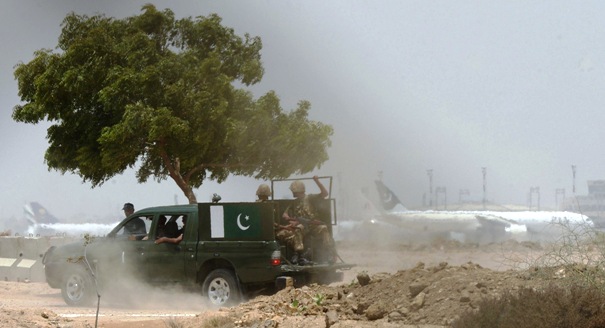
In the past two years, the military has taken the fight to the TTP and its allied militant groups based in North Waziristan. But its much-delayed offensive, named Zarb-e-Azb, which was launched as a reaction to a terrorist attack on Karachi airport in June 2014, has been a partial success at best. The army seems to have deprived the Pakistani Taliban of its local sanctuaries and degraded their operational capacity to carry out terror operations from Waziristan. In 2015, terrorist attacks were down by 48 percent compared to 2014.
But the military’s gains might be illusory. The army has yet to capture or kill a senior TTP commander, and the operation has reportedly driven the Taliban leadership to sanctuaries across the border in Afghanistan, where they continue to plan terrorist attacks inside Pakistan. At any rate, there is not even any way of accurately assessing the operation’s effectiveness since news media are barred from the area and the only source of information is the army, which has an obvious interest in inflating the losses suffered by militants while underreporting its own.
In a perverse way, terrorism has aggrandized Pakistan’s army. For example, in response to the TTP attack on an army school in Peshawar in December 2014 that killed over 130 students, the army, under Chief of Staff General Raheel Sharif, took full charge of the state’s response to that horrific act. The generals pressed the government to create military courts for delivering “speedy justice” to terrorists. Subsequently, parliament amended the country’s constitution in January 2015 to authorize military courts to try civilians accused of terrorism. The proceedings of the courts remain secret, convicts do not have the right of appeal, and the impact on terrorism is less than impressive despite the execution of three dozen “hardened” terrorists.
For its part, the government adopted a National Action Plan (NAP) immediately after the army school attack. The NAP lifted the moratorium on the death penalty, in place since 2008, to execute terrorists on death row. It also committed the government to preventing armed militias from operating in the country, strengthening the civilian-led National Counter Terrorism Authority (NACTA), tackling terrorist financing, regulating madrassas (religious seminaries), cracking down on hate speech and extremist materials, creating a special counterterrorism force, and reforming the criminal justice system. But the plan remains poorly implemented, partially because of the government’s lackluster follow-through but mainly due to resistance from the military, which wants to lead the counterterror effort without civilian interference.
For example, NACTA remains a shell organization in considerable measure because the military’s intelligence agencies refuse to work under its authority. With the exception of the government’s prosecution of several clerics for hate speech and the police’s extrajudicial killings of key Sunni militants in Punjab, there is as yet no concerted strategy or plan for dismantling the country’s vast militant infrastructure, nor have any serious efforts been made to reform the criminal justice system or bring the madrassas that typically spawn terrorists under meaningful scrutiny.
Civilian intelligence and police officials, meanwhile, complain that the ISI routinely blocks or intervenes in their investigations when they involve “good” terrorists. Even the anti-terror campaign against “bad” terrorists is hampered by the military’s desire to steal the limelight and appear resolute to the Pakistani public. Following the Lahore attack, the army and its intelligence services carried out raids against suspected militants in five major cities across the province, which were duly advertised on Twitter by the military’s social media-savvy official spokesman, Asim Bajwa, as an exclusively military operation. The military’s PR offensive forced an embarrassed provincial government to claim that the counterterror operation was actually a joint venture between civilian and military security forces.
Aware that the military’s domination in Pakistan is linked to the longstanding rivalry with India, Sharif has tried to mend fences with New Delhi as part of a broader drive for regional stability. For example, Sharif met Indian Prime Minister Narendra Modi on the sidelines of the Paris climate change meeting in November 2015, which ultimately paved the way for foreign-secretary-level talks to discuss security, confidence-building measures, Kashmir, and counterterrorism. On December 25, Modi made an unexpected visit to Pakistan, apparently to greet Sharif on his 66th birthday, giving further impetus to the dialogue process.
But just as the relationship seemed to be thawing, terrorists belonging to the Pakistan-based militant group Jaish-e-Mohammad attacked an Indian Air Force base close to the border with Pakistan. And while Indian security forces were still battling the terrorists, Afghan Taliban militants struck the Indian consulate in Mazar-e-Sharif, in northern Afghanistan. A day before the Lahore attack, the military revealed that it had captured an alleged Indian operative who later admitted to sponsoring subversive activities in the restive Baluchistan province, where Baloch nationalists have waged an insurgency against the Pakistan Army. Although the Indian government expectedly denied involvement, the timing of the spy’s confession was more than curious, because it shifted the focus of public scrutiny from homegrown terrorists to India and simultaneously scuttled Sharif’s renewed efforts to reduce the enduring tensions between India and Pakistan.
The success of any strategy to tackle terrorism is subject to the fundamental contradiction in the military’s counterterrorism approach: attack the terrorists who attack you, but patronize those who kill your enemies. Short of a radical break with this self-deluding policy, Pakistanis will continue to pay for the generals’ intransigent follies with their blood.

Former Visiting Scholar, South Asia Program
Aqil Shah was a visiting scholar in the South Asia Program at the Carnegie Endowment for International Peace.
Recent Work


Frances Z. Brown, Zainab Usman, Erin Jones, …
Aqil Shah
Carnegie does not take institutional positions on public policy issues; the views represented herein are those of the author(s) and do not necessarily reflect the views of Carnegie, its staff, or its trustees.

European states control several Overseas Countries and Territories around the world that carry strategic, economic, and environmental weight. As great powers challenge the rules-based order, defending them is a geopolitical imperative for Europe.

Marc Pierini

Mounting economic strain and battlefield losses will not necessarily make the Kremlin less dangerous. They could instead push Moscow toward a more aggressive hybrid campaign designed to test NATO’s Eastern flank, exploit allied hesitation, and fracture European resolve.

Maksym Beznosiuk
Over the past ten years, NATO has held almost as many summits as it did during the entirety of the Cold War. Are they still useful, or is it time to stop holding annual meetings?

Rym Momtaz, ed.
As Russia's war on Ukraine drags on, NATO is expanding its footprint in the Black Sea. Turkey, Romania, and Bulgaria are upgrading their fleets and deepening trilateral cooperation.

Dimitar Bechev
For ninety years, Turkey has been positioned as the principal gatekeeper of Black Sea security. As a result, European and NATO efforts to support Ukraine will require closer engagement with Ankara.

Thomas de Waal