

Commentary
Alexander Baunov
{
  "authors": [
    "Alexander Baunov"
  ],
  "type": "commentary",
  "centerAffiliationAll": "",
  "centers": [
    "Carnegie Endowment for International Peace",
    "Carnegie Russia Eurasia Center"
  ],
  "collections": [],
  "englishNewsletterAll": "",
  "nonEnglishNewsletterAll": "",
  "primaryCenter": "Carnegie Endowment for International Peace",
  "programAffiliation": "",
  "programs": [],
  "projects": [],
  "regions": [],
  "topics": [
    "Economy"
  ]
}
Source: Getty
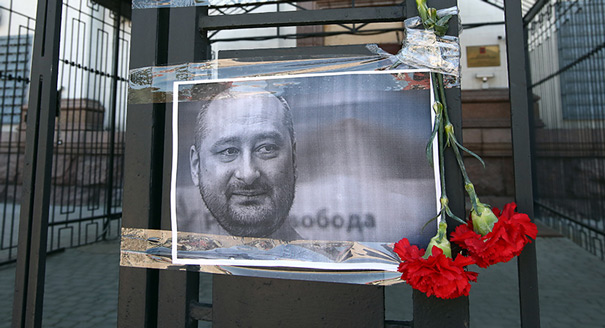
As the world debates the danger of manipulating public opinion through fake news, Ukraine has created a false narrative of global significance. Blurring the borders of truth is unlikely to help Ukraine in the long run. But the country’s desire for a spectacular victory over its enemy outweighed other concerns.
The illusion of death is a literary device with a long history. The character in question “dies” and then hears what people say about him at his own funeral—an old, parable-like, and often comic plotline. But never before has this storyline been brought to life on the stage of a country’s national politics, as happened in Ukraine last week.
In faking Russian opposition journalist Arkady Babchenko’s death, Ukraine’s security service, the SBU, appears to have dragged the man into a dubious plot and taken advantage of his fairly extreme personality and growing resentment of Russia.
But the SBU has also pulled itself and all of Ukraine into a story with an unclear ending.
Unlike Russia—whose highly negative image can hardly be damaged by another political murder—Ukraine’s shaky reputation in global public opinion can easily be harmed by a questionable action.
Western politicians and authors of front-page articles will demonstrate joy (and many will be truly happy) that another “Putin critic” has not been killed. But they also will not forget how Ukraine manipulated their feelings, forcing them to vent anger, express condolences, and call for the guilty parties to be held accountable.
As the entire world discusses the danger posed by fake news that manipulates public opinion (with the West and its allies exclusively presented as the victims), Ukraine has created a phony news story that tricked international news agencies, print and online media, diplomats, and social media.
And Facebook, already under fire for not stopping Russian fictions, officially “verified” the death of a public figure and created a memorial account—in essence, a virtual monument to a living person.
Right as the global community is remembering the importance of truth in politics, Ukraine forced it to accept a certain relativity of lies: there are good and bad fake news, depending on whether they are for us or against us.
Ukraine has long ago decided that the victim of aggression has the right to restrict freedoms and play military tricks. Meanwhile, the dehumanization and vilification of the enemy in public opinion has broadened the boundaries of what is permissible.
But even the sympathetic outside world is likely not ready to follow Ukraine that far. Reporters Without Borders, the OSCE Representative on Freedom of the Media, and the editors of leading Western media outlets have already condemned the SBU operation.
The danger of useful deception is that it breaks down the boundaries of reality, regardless of its intention. Now, truth’s border is mobile, and each person can move it in accordance with his or her own personal beliefs. Babchenko’s murder was staged. But should we believe that his wife didn’t know the truth and was actually mourning her husband? This was implied at the beginning, but after harsh criticism it was acknowledged that she was a part of the operation. What about his friends? What’s to stop those wishing to move the border a few steps further?
And if a death turns out to be staged, then anyone can declare many other things staged: recordings of a conversation, arrests, evidence, interrogations, suspects, communication with the Russian special services, the very fact of an assassination attempt, and future terrorist attacks. If security agents with dodgy reputations decided to fake a death, what’s stopping them from faking a couple of interrogations and a bit of material evidence?
The issue is not whether the Russian special services could actually order Babchenko’s murder. While their activities are often exaggerated, that does not negate what is truly connected to them—both in the recent and the not-so-recent past. To their own detriment, Russia’s security agencies are overly opaque. This means that one can not always claim that they are guided exclusively by political expediency.
But false news about a victim’s death only exposes the Russian special services’ treachery if the intended audience is already convinced of their guilt. Among skeptics, it likely has the opposite effect. Even on CNN, a channel unsympathetic to Russia, the reporters admitted the previously unfathomable: that information spread by the Ukrainian officials was false, while everything the Russians said was correct and they had nothing to do with Babchenko’s murder.
The manipulation of truth creates a strong foundation for conspiracy theories. A phony bloody corpse strengthens these theories because they are based upon the idea that the corpses “they” show us have been falsified.
Even worse, the simulation creates a foundation for retrospective doubt about any of the Ukrainian authorities’ previous claims, just like the Russian media’s propagandistic exaggeration and evasion became the basis for doubting the statements of Russian officials. Future dramatic events—an inevitable part of the Ukrainian situation—will for many years have a theatrical flavor.
The staged “murder” of Arkady Babchenko also unpleasantly divides the Ukrainian political elite and its partners abroad into insiders and outsiders. Who knew the truth and who didn’t? Who was closer and who was further away, both inside and outside the country? Did the American intelligence services know? The Germans? Ukraine’s partners have reason to take offense at the different levels of trust.
An assassination plot, thwarted during the planning stage, would have been enough to support accusations against Russia. It’s not as eye-catching as death and resurrection, but Russia has long been the default murderer in Ukrainian and global public opinion. Russia brought this upon itself, albeit not always on the scale attributed to it.
The news of Babchenko’s death caused a wave of accusations and demands that would never have been vocalized had the murder plot simply been thwarted. Perhaps Ukraine’s calculation was that it would be difficult to take back these words after “resurrection,” inertia would take over, and the wave of anger would remain strong.
However, by and large, this is not the case. On the contrary, there is confusion. One reason is that international media typically prefer to cite Ukrainian sources over Russian ones. Now this will be more difficult.
Until it becomes clear whom Babchenko’s faked death allowed law enforcement to catch and how it helped them do it, one of the explanations for the operation will be the effect it had on Ukrainian society. This time, the odious enemy is not simply accused or even captured red-handed. Rather, the local special services have demonstrated that they can carry out grandiose special operations that the entire world will believe. They tricked everyone. The long speech by Prosecutor General Yuri Lutsenko with the main message “you accused us of being ineffective, now see how effective we are,” delivered at the same press conference where Babchenko turned up alive, supports suspicions.
It appears that the growing desire in Ukrainian society for a clear, unmistakable victory over the enemy prompted the authorities to stage this excessively theatrical operation. However, you can only abuse the world’s trust once. Next time, appealing to that trust will be more difficult.
The outrage over Babchenko’s murder unified virtually everyone. But the enthusiasm for this clever special operation was less widespread: it was almost exclusively confined to Ukraine.

Senior Fellow, Editor-in-Chief, Carnegie Russia Eurasia Center
Baunov is a senior fellow and editor-in-chief at the Carnegie Russia Eurasia Center.
Recent Work
Alexander Baunov
Alexander Baunov
Carnegie does not take institutional positions on public policy issues; the views represented herein are those of the author(s) and do not necessarily reflect the views of Carnegie, its staff, or its trustees.

As geopolitical rivalry weaponizes global supply chains, the EU’s true vulnerability lies in emerging-risk imports. For these goods, suppliers are growing more concentrated, substitution more difficult, and political risk is looming.

Sinan Ülgen

The EU is putting together a new security strategy to meet today’s myriad challenges. But for any proposal to be effective, the union needs to grapple with its identity and ambitions.

Pierre Vimont
Between the United States’ market-driven approach and China's state-led industrial strategy, Europe is reckoning with how it can remain competitive in the global economy. But is Europe in danger of becoming a U.S. or China colony?
Noah Barkin, Anu Bradford
The U.S.-sponsored TRIPP deal is driving the Armenia-Azerbaijan peace process forward. But foreign and domestic hurdles remain before connectivity and economic interdependence can open up the South Caucasus.

Thomas de Waal, Areg Kochinyan, Zaur Shiriyev

Economic growth is at the heart of a dilemma between planetary and international security.

Olivia Lazard