

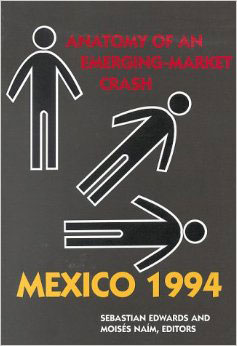
Mexico 1994: Anatomy of an Emerging-Market Crash
This book offers in-depth analysis of long-term political and economic processes that set the stage for Mexico's peso crisis, and of specific actions in Mexico and abroad that prompted the crash and shaped its outcome.
Source: Washington

In late December 1994—after attracting widespread praise as a model of economic reform, becoming a super-magnet for international investors as well, and joining the United States and Canada as a partner in NAFTA—Mexico plunged into political and economic crisis. What went wrong? What role was played by design flaws in the Mexican reforms? By political and economic decision-making; by external market forces; by sheer bad luck?
Mexico 1994 is as much about one country's experience as about our changing world. The book offers in-depth analysis of long-term political and economic processes that set the stage for the crisis, and of specific actions in Mexico and abroad that prompted the crash and shaped its outcome. It also casts much-needed light on important new interrelationships between domestic and global phenomena.
The authors are uniquely positioned to provide valuable insights on both the Mexican crisis and the metamorphosis in the nature of financial debacles. Some of the contributors had first-hand experience with the Mexican crash and with the unfolding East Asian crisis as government officials, international money managers, or senior officials at the World Bank, the International Monetary Fund, and the Inter-American Development Bank; others are leading economists, political scientists, and influential financial commentators.
Contributors are: Robert L. Bartley, Nancy Birdsall, Shahid Javed Burki, Agustin Carstens, Rudiger Dornbusch, Denise Dresser, Jeffry A. Frieden, Michael Gavin, Francisco Gil-Diaz, David D. Hale, Ricardo Hausmann, Claudio M. Loser, Sebastian Edwards, and Moisés Naím.
About the Authors

Distinguished Fellow
Moisés Naím is a distinguished fellow at the Carnegie Endowment for International Peace, a best-selling author, and an internationally syndicated columnist.
Sebastian Edwards
Carnegie does not take institutional positions on public policy issues; the views represented herein are those of the author(s) and do not necessarily reflect the views of Carnegie, its staff, or its trustees.