
• Research
  • Strategic Europe
  • About
  • Experts
Carnegie Europe logoCarnegie lettermark logo
EUUkraine
  • Donate
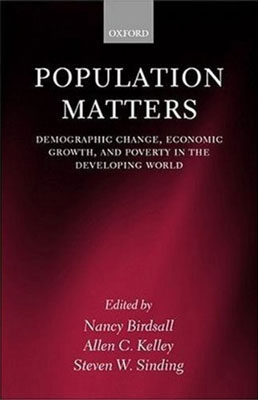
Population Matters: Demographic Change, Economic Growth, and Poverty in the Developing World
Book

Population Matters: Demographic Change, Economic Growth, and Poverty in the Developing World

The effect of demography on economic performance has been the subject of intense debate in economics for nearly two centuries. In recent years opinion has swung between the Malthusian views of Coale and Hoover, and the cornucopian views of Julian Simon.

Link Copied
By Nancy Birdsall, Allen Kelley, Stephen Sinding
Published on Sep 27, 2001

Additional Links

Table of Contents

Source: Carnegie

The effect of demography on economic performance has been the subject of intense debate in economics for nearly two centuries. In recent years opinion has swung between the Malthusian views of Coale and Hoover, and the cornucopian views of Julian Simon. Unfortunately, until recently, data were too weak and analytical models too limited to provide clear insights into the relationship. As a result economists as a group have not been clear or conclusive.

This volume, based on a collection of papers that heavily rely on data from the 1980s and 1990s and on new analytical approaches, sheds important new light on demographic-economic relationships, and it provides clearer policy conclusions than any recent work on the subject. In particular, evidence from developing countries throughout the world shows a pattern in recent decades that was not evident earlier: countries with higher rates of population growth have tended to see less economic growth. An analysis of the role of demography in the 'Asian economic miracle' strongly suggests that changes in age structures resulting from declining fertility create a one-time 'demographic gift' or window of opportunity, when the working age population has relatively few dependents, of either young or old age, to support. Countries which recognize and seize on this opportunity can, as the Asian tigers did, realize healthy bursts in economic output. But such results are by no means assured: only for countries with otherwise sound economic policies will the window of opportunity yield such dramatic results. Finally, several of the studies demonstrate the likelihood of a causal relationship between high fertility and poverty. While the direction of causality is not always clear and very likely is reciprocal (poverty contributes to high fertility and high fertility reinforces poverty), the studies support the view that lower fertility at the country level helps create a path out of poverty for many families.

Population Matters represents an important further step in our understanding of the contribution of population change to economic performance. As such, it will be a useful volume for policymakers both in developing countries and in international development agencies.

To order a copy of this book, please contact Oxford University Press at: book.orders@oup.co.uk 

About the Authors

Nancy Birdsall

Former Senior Associate

Allen Kelley

Stephen Sinding

Authors

Nancy Birdsall
Former Senior Associate
Allen Kelley
Stephen Sinding
EconomyTrade

Carnegie does not take institutional positions on public policy issues; the views represented herein are those of the author(s) and do not necessarily reflect the views of Carnegie, its staff, or its trustees.

More Work from Carnegie Europe

  • Commentary
    Strategic Europe
    Europe and the Arab Gulf Must Come Together

    The war in Iran proves the United States is now a destabilizing actor for Europe and the Arab Gulf. From protect their economies and energy supplies to safeguarding their territorial integrity, both regions have much to gain from forming a new kind of partnership together.

      • Rym Momtaz

      Rym Momtaz

  • Commentary
    Strategic Europe
    Global Instability Makes Europe More Attractive, Not Less

    Europe isn’t as weak in the new geopolitics of power as many would believe. But to leverage its assets and claim a sphere of influence, Brussels must stop undercutting itself.

      Dimitar Bechev

  • Turkey Erdogan Caucasus Central Asia
    Article
    How Turkey Can Help the Economies of the South Caucasus to Diversify

    Over the past two decades, regional collaboration in the South Caucasus has intensified. Turkey and the EU should establish a cooperation framework to accelerate economic development and diversification.

      • Feride Inan
      • Güven Sak
      • Berat Yücel

      Feride İnan, Güven Sak, Berat Yücel

  • Commentary
    Strategic Europe
    How Europe Can Survive the AI Labor Transition

    Integrating AI into the workplace will increase job insecurity, fundamentally reshaping labor markets. To anticipate and manage this transition, the EU must build public trust, provide training infrastructures, and establish social protections.

      Amanda Coakley

  • Commentary
    Strategic Europe
    Can Europe Still Matter in Syria?

    Europe’s interests in Syria extend beyond migration management, yet the EU trails behind other players in the country’s post-Assad reconstruction. To boost its influence in Damascus, the union must upgrade its commitment to ensuring regional stability.

      Bianka Speidl, Hanga Horváth-Sántha

Get more news and analysis from
Carnegie Europe
Carnegie Europe logo, white
Rue du Congrès, 151000 Brussels, Belgium
  • Research
  • Strategic Europe
  • About
  • Experts
  • Projects
  • Events
  • Contact
  • Careers
  • Privacy
  • For Media
  • Gender Equality Plan
Get more news and analysis from
Carnegie Europe
© 2026 Carnegie Endowment for International Peace. All rights reserved.