

Commentary
The new U.S.–Denmark–Greenland agreement will help Washington exert political, economic, and financial dominance under the guise of security. Yet, it acknowledged Copenhagen’s and Nuuk’s sovereignty on the island.
Marc Pierini
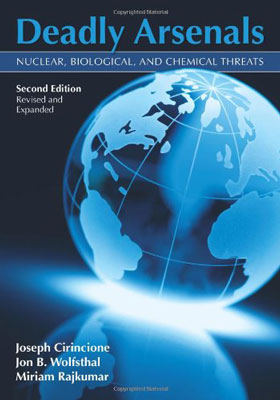
The revised and expanded edition ofDeadly Arsenals provides the most up-to-date and comprehensive assessment available on global proliferation dangers, with a critical assessment of international enforcement efforts.
Source: Washington

The new edition addresses the recent, dramatic developments in Iran, Iraq, Libya, North Korea, and the nuclear black market, analyzing strategic and policy implications.
On July 12, 2005, the authors of this new study presented their findings and then chaired a discussion and debate with experts from the audience. Click here to go to the LIVE AT CARNEGIE site, featuring archived audio and a slideshow presentation with new maps and charts from the book.
About the Authors
Joseph Cirincione previously served as a senior associate and director for Non-Proliferation at the Carnegie Endowment for International Peace, and is coauthor of the major Carnegie report, Universal Compliance: A Strategy for Nuclear Security and editor of Repairing the Regime: Preventing the Spread of Weapons of Mass Destruction (Routledge, 2000).
Jon B. Wolfsthal is former associate and deputy director for non-proliferation at the Carnegie Endowment. He is coauthor of Universal Compliance and coeditor of Nuclear Status Report: Nuclear Weapons, Fissile Material, and Export Controls in the Former Soviet Union (Carnegie/Monterey, 2001).
Miriam Rajkumar is former project associate for nonproliferation at the Carnegie Endowment.
"[A] comprehensive and useful guide to nuclear and CBW proliferation issues, and an essential companion to the SIPRI Yearbook.”
—Pierre-Emmanuel Dupont, Caucasian Review of International Affairs

Former Senior Associate, Director for NonProliferation
Former Nonresident Scholar, Nuclear Policy Program
Jon Wolfsthal was a nonresident scholar with the Nuclear Policy Program.

Former Associate, Non-Proliferation Project
Carnegie does not take institutional positions on public policy issues; the views represented herein are those of the author(s) and do not necessarily reflect the views of Carnegie, its staff, or its trustees.

The new U.S.–Denmark–Greenland agreement will help Washington exert political, economic, and financial dominance under the guise of security. Yet, it acknowledged Copenhagen’s and Nuuk’s sovereignty on the island.

Marc Pierini

European Commission President Ursula von der Leyen is about to give her annual address on the state of the EU. Here’s what she won’t—but should—say.

Rym Momtaz

Radical-right parties are expected to do well in upcoming elections in four of the EU's biggest member states. If successful, they could prevent the union from addressing key challenges ahead.

Stefan Lehne

Canadian Prime Minister Mark Carney has twice inspired praise for standing up to U.S. President Donald Trump: at the 2026 World Economic Forum in Davos and on Canada-U.S. trade negotiations. Is Carney showing a third way better than the EU has in dealing with the Trump administration?
Rym Momtaz, ed.

European states control several Overseas Countries and Territories around the world that carry strategic, economic, and environmental weight. As great powers challenge the rules-based order, defending them is a geopolitical imperative for Europe.
Marc Pierini