• Research
  • Strategic Europe
  • About
  • Experts
Carnegie Europe logoCarnegie lettermark logo
EUUkraine
  • Donate
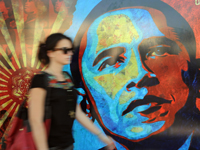
Social Significance of Obama's Election

Source: Getty

Article

Social Significance of Obama's Election

The U.S. election was not merely a local affair as the world awaited its outcome with great intensity. The current U.S. election opened our eyes to the merits of American democracy in particular and those of Western democracy in general.

Link Copied
By Gamal Al-Ghitany
Published on Dec 5, 2008

The U.S. election was not merely a local affair as the world awaited its outcome with great intensity. I had never been interested in the U.S. presidential election until this year and the reason for my interest is Barack Obama. My feelings are not influenced by his African roots or his middle name (Hussein), as I do not form my opinions on the basis of anyone’s religion, whatever it may be. Even in the United States, those who pointed to Obama’s roots or religion met with disapproval. Most notable was the position taken by Colin Powell—a high profile figure in the Republican Party—who correctly asked “so what if Obama were a Muslim?” underlining that the nature of the question ran contrary to the spirit of the United States. He then announced his support for Obama despite his party affiliation.

I admit that I belong to a generation that grew up with a tradition of hostility toward the United States and anything it offers on the political and sometimes the cultural levels. In the 1950s we used to criticize U.S.-funded cultural institutions such as the Franklin Publishing Institute and al-Karnack Publishing House, before realizing their significant contribution to the translation of important works. For example, the Franklin Institute published the only book available in Arabic by the brilliant French architect Le Corbusier, and al-Karnak published some of the best translations of short stories, which still adorn my personal library.
 
Although we criticized publication projects with an American bias, we never took a similar stand against Soviet-sponsored publications. Our position was influenced by the echoes from the Cold War, which reached us through the clash between the capitalist and socialist camps. It took me many years to realize that human civilization from all corners of the world is essential for mankind and its existence. It also took me time to realize that the crucial factors influencing my judgment are my life experiences and the characteristics of the milieu to which I belong and that I should not prematurely reject or embrace preconceived positions.
 
The current U.S. election opened our eyes to the merits of American democracy in particular and those of Western democracy in general. What I have come to realize—thanks to modern information technology—is that the only perfect political form available for humanity is democracy, as known by the West for centuries. All talk about specific oriental or southern democracy or democracy as defined by a religion is nothing but an excuse to bolster the incumbent repressive regimes, whose rulers refuse any change and do not allow any transparency. Our Arab world is the most miserable example in this regard.
 
I observe Obama’s rise to power with amazement. He is a young man of a humble origins and African roots who was given a chance to graduate from Harvard Law School, one of the most selective and distinguished schools, before ascending to the position of the Democratic Party’s presidential candidate, and being elected as commander in chief of the greatest power in the world. There is no doubt that it is this environment that nourishes an individual’s potential that allowed the United States to attain its leading place among nations. If I had had a vote, I would have given it to Obama, with an enthusiasm I share with multitudes across Europe and around the world who understand the significance of such a man’s arrival to the White House. The election of Obama is an important moment in human history because Obama’s ancestors were slaves, most of whom died during the Middle Passage. This human dimension of his triumph is very important to me regardless of the details of his election program. Equally admirable is the uncompromised transparency of an election process that holds candidates accountable for their spending and allows the press to scrutinize the wardrobe of the Republican candidate’s running mate and her expenses.  
 
We notice that although the Republican Party, with its representative in the White House, had been in power for the last eight years, it faced a resounding defeat in the 2008 election. President Bush’s disastrous decisions, especially in foreign policy, have hurt the United States to the point where even the Republican candidate tried to distance himself from the president. On the other hand, former presidents such as Clinton and Carter were supportive of Obama and were assets to his campaign. Looking at the democratic process in the United States intensifies my feeling that here we live on a different planet and drives me to despair and a sense of futility. Obama’s rise to power is an extraordinary achievement in human history.
 
Gamal Al-Ghitany, Chief Editor of the Cairo-based Akhbar al-Adab weekly newspaper, Egypt.

About the Author

Gamal Al-Ghitany

Gamal Al-Ghitany
North AmericaUnited StatesMiddle EastNorth Africa

Carnegie does not take institutional positions on public policy issues; the views represented herein are those of the author(s) and do not necessarily reflect the views of Carnegie, its staff, or its trustees.

More Work from Carnegie Europe

  • Commentary
    Strategic Europe
    Russia’s Imperial Retreat Is Europe’s Strategic Opportunity

    The war in Ukraine is costing Russia its leverage overseas. Across the South Caucasus and Middle East, this presents an opportunity for Europe to pick up the pieces and claim its own sphere of influence.

      William Dixon, Maksym Beznosiuk

  • Commentary
    Is the Radical-Right Threat Existential or Overstated?

    Amid increased polarization and the influence of disinformation, radical-right parties are once again gaining traction across Europe. With landmark elections on the horizon in several countries, are the EU’s geostrategic vision and fundamental values under existential threat?

      Catherine Fieschi, Cas Mudde

  • Commentary
    Strategic Europe
    Europe and the Arab Gulf Must Come Together

    The war in Iran proves the United States is now a destabilizing actor for Europe and the Arab Gulf. From protect their economies and energy supplies to safeguarding their territorial integrity, both regions have much to gain from forming a new kind of partnership together.

      • Rym Momtaz

      Rym Momtaz

  • Commentary
    Strategic Europe
    Taking the Pulse: Is France’s New Nuclear Doctrine Ambitious Enough?

    French President Emmanuel Macron has unveiled his country’s new nuclear doctrine. Are the changes he has made enough to reassure France’s European partners in the current geopolitical context?

      • Rym Momtaz

      Rym Momtaz, ed.

  • Commentary
    The Iran War’s Dangerous Fallout for Europe

    The drone strike on the British air base in Akrotiri brings Europe’s proximity to the conflict in Iran into sharp relief. In the fog of war, old tensions in the Eastern Mediterranean risk being reignited, and regional stakeholders must avoid escalation.

      Marc Pierini

Get more news and analysis from
Carnegie Europe
Carnegie Europe logo, white
Rue du Congrès, 151000 Brussels, Belgium
  • Research
  • Strategic Europe
  • About
  • Experts
  • Projects
  • Events
  • Contact
  • Careers
  • Privacy
  • For Media
  • Gender Equality Plan
Get more news and analysis from
Carnegie Europe
© 2026 Carnegie Endowment for International Peace. All rights reserved.