A team of investigators successfully detected North Korea's April 5 rocket launch using infrasound monitoring. Their experiment demonstrated the efficacy of infrasound in the detection of nuclear tests and in the verification of nonproliferation-related agreements.
Link Copied
By Bharath Gopalaswamy
Published on May 5, 2009
On April 5, 2009, North Korea launched what it claimed was a rocket bearing a satellite. We carried out an investigation to detect the launch using the infrasound component of the International Monitoring System (IMS) set up to verify the Comprehensive Test Ban Treaty (CTBT). This demonstrates that infrasound monitoring is useful not only in the detection of nuclear tests, but also in the verification of other nonproliferation-related agreements.
Infrasound consists of sound waves with a frequency too low to be heard by humans (approximately between the range of 20-0.001 Hz). It is of particular interest for the monitoring of several natural and man-made phenomena. The IMS has 60 infrasound stations in 35 countries. Forty-one stations are currently certified, eleven are being planned, and eight are under construction.
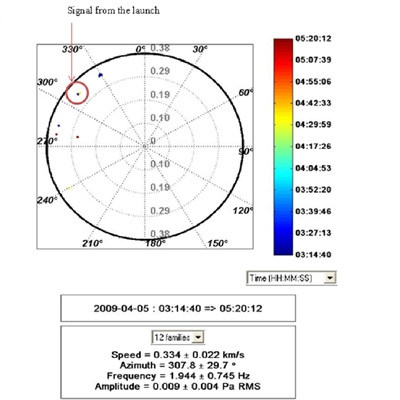
Following the launch on April 5, 2009, we examined infrasound data from nearby infrasound stations. The I30 sensor in Tsukuba, Japan, which is approximately 1,000 km away from the Musudan-Ri launch site in North Korea, detected the launch an hour later. The other stations that were examined, namely the I34 sensor in Mongolia (approximately 2,000 km away) and I31 sensor in Aktuybinsk, Kazakhstan (approximately 5,400 km away), did not show any positive evidence of the launch. Analysis of the data from the Tsukuba sensor indicates that the wave energy seemed to originate from 307-309 degrees, which is roughly the direction of the launch site in North Korea from the detector. Had more than one station detected the signal, then it would have been possible to determine its geographic origin.
Figure 1. Radar plot showing the direction of the arrival of the signal. The points associated with the rocket launch are indicated by the red circle.
The IMS infrasound network has been able to routinely detect rocket launches. Table 1 shows some of the launches that the IS31 sensor in Aktuybinsk, Kazakhstan, has recently detected from the Baikanour Cosmodrome. The detection of rocket launches primarily depends on three factors: 1) the mechanism by which infrasound is produced (about which there is some dispute); 2) local noise conditions at the receiver; and 3) the atmospheric conditions between the source and receiver. In addition, detection depends on the thrust of the rocket. For example, a SCUD-B can be detected only as far as 130 km away. We are currently investigating data from other sources such as space vehicle re-entry, flaring of gas in oil fields, quarry blasts, mine explosions, volcanoes eruptions, and earthquakes.
Figure 2. Google Earth Image showing the sensor and launch site.
Table 1. Some of the Rocket Launches Detected at IS31, Aktuybinsk, Kazakhstan.
Date
Time of Launch, UTC
Launcher
23.8.2005
21:10:00
Dnepr
2.9.2005
09:50:00
Soyuz
1.10.2005
03:54:53
Soyuz
25.12.2005
05:07:10
Proton
29.12.2005
02:28:40
Proton
30.3.2006
02:30:20
Soyuz
24.4.2006
16:03:25
Soyuz
15.6.2006
08:00:00
Soyuz
17.6.2006
22:44:05
Proton
24.6.2006
15:08:18
Soyuz
Infrasound stations are capable of detecting rocket launches hundreds to thousands of kilometers away. They are also relatively inexpensive when compared to satellite monitoring systems. Chaparral Model 2.5 Microbarometers, for example, cost only around US $4,000 each, much less than satellites and radars, which have price tags measured in millions of dollars and to which only a few states have access. Furthermore, satellites employing infrared detection technology and radars are not devoid of false alarms. About a day before the North Korean launch, J/FPS-5 radar belonging to the Japanese Self-Defense Forces wrongly detected a launch from North Korea; fortunately, Japan did not launch a missile interceptor in response. Infrasound sensors are also non-intrusive when compared to aerial monitoring. Of course, infrasound sensors have potential drawbacks: their performance is weather-dependent and requires favorable atmospheric conditions. Yet such shortcomings can be counteracted, to some extent, by using a sensor network with some redundancy to observe activities of interest.
Detection using infrasound sensors is possible only after a launch because of the time needed for the signal to reach the detector. However, confirming events post-launch can often be important. For example, agreements to constrain the testing of ballistic missiles can be a useful confidence-building measure, as in the case of the agreement signed by India and Pakistan in 2005 on pre-notification of missile tests. Infrasound sensors provide a cheap and easy way for states to verify such agreements. With further research, these sensors could even help provide warning of potential natural disasters, such as tsunamis and tornados. Finally, the ability of the IMS to detect missile launches enhances confidence in its ability to detect nuclear tests—something key to US ratification of the CTBT.
Bharath Gopalaswamy is a postdoctoral associate at Cornell University's peace studies program. He can be reached at bg265@cornell.edu.
Carnegie does not take institutional positions on public policy issues; the views represented herein are those of the author(s) and do not necessarily reflect the views of Carnegie, its staff, or its trustees.
When the U.S.-Iran memorandum of understanding was announced, the UK, France, Germany, and Italy declared their readiness to help demine the Strait of Hormuz and lift nuclear sanctions on Tehran. But does Europe need new tools to recover a diplomatic role?
Amid uncertainty caused by the Iran war, the global drive for nonproliferation has stalled. With Europe diplomatically marginalized and countries reassessing their nuclear options, efforts to curb the spread of nuclear weapons risk becoming irrelevant.
French President Emmanuel Macron has unveiled his country’s new nuclear doctrine. Are the changes he has made enough to reassure France’s European partners in the current geopolitical context?
Europe’s reaction to the war in Iran has been disunited and meek, a far cry from its previously leading role in diplomacy with Tehran. To avoid being condemned to the sidelines while escalation continues, Brussels needs to stand up for international law.
France has stopped clinging to notions of being a great power and is embracing the middle power moment. But Emmanuel Macron has his work cut out if he is to secure his country’s global standing before his term in office ends.