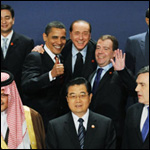
Consulting the G20, rather than the G8, on preventing the spread of nuclear weapons would be a novel and intriguing approach to strengthening the nonproliferation regime.
Link Copied
By Gregory L. Schulte
Published on Nov 24, 2009
The Obama administration has been thinking big about how to transform American diplomacy and international relations. One idea is to replace the G8 with the G20 on a variety of global issues. Doing nonproliferation "at 20" rather than 8 is an intriguing possibility.
The Group of Eight provides one of the world's fora to consult on preventing the spread of nuclear weapons. The eight members—Canada, France, Germany, Italy, Japan, Russia, U.K. and U.S.—generally share a common nonproliferation agenda.
The Eight are committed to strengthening the Nuclear Non-Proliferation Treaty (NPT). They support universal adoption of the Additional Protocol to increase the verification authority of the International Atomic Energy Agency (IAEA). They support restricting transfers of civil technologies that can be misused to build atomic bombs and creating international fuel banks to limit the need for these technologies.
The G8 brings together like-minded countries on nonproliferation. But perhaps the Group and our ambitions for it are now too small.
Replacing the G8 with the G20 would add five members that largely share the nonproliferation policies of the current eight. These are Australia, Mexico, South Korea, Turkey, and the European Union. Like the Eight, these five have an interest in nuclear power. Indeed, South Korea is a helpful example of a country that generates much of its electricity with nuclear reactors but buys its nuclear fuel on the world market rather than investing in dangerous dual-use technologies.
However, eight of the newcomers would bring new challenges. India did not sign the NPT, though it recently signed an IAEA Safeguards Agreement and Additional Protocol for its civil program. Argentina and Brazil signed the Treaty but have refused to sign the Additional Protocol. It would not be a simple matter to convince the G20 to promote universal adherence to these two important international instruments when three of the newcomers have not signed one or the other.
China would be another newcomer. While Beijing likes to be a global player, nonproliferation does not always top its foreign policy agenda, particularly when it competes with China's economic or regional interests. Indonesia and South Africa would be two other newcomers. They take their nonproliferation obligations seriously, but would bring a developing world perspective that too often values abstract "rights" over concrete measures to strengthen the nonproliferation regime.
Tackling Iran at 20 would be another challenge. The G8 is united in strongly condemning Tehran's nuclear violations. China, Turkey, and Indonesia would be more reticent for reasons of commerce and Muslim identity. Saudi Arabia is the only G20 member from the Middle East. The Saudi government is seriously concerned about Iran's nuclear ambitions, but rarely says so in public, preferring instead to criticize Israel.
Negotiating a common agenda, collective decisions, and consensus declarations would be significantly more difficult at 20. Yet the challenge may be worth accepting.
Unlike the G8, the G20 includes all permanent members of the UN Security Council and all participants in the nuclear talks with North Korea and Iran. By including key developing countries, G20 endorsement would carry more diplomatic weight than the G8. It would also be harder for those countries to hide behind archaic constructs like the "Non-Aligned Movement."
The G20 offers an opportunity to engage a broader range of key countries on the specific measures sought by President Obama and President Bush before him. For example, not all of the Twenty participate in the Proliferation Security Initiative launched by the Bush Administration and continued by President Obama. Doing nonproliferation "at 20" could help bring the navies of countries like India, Indonesia, and China into PSI efforts to interdict illicit nuclear trade.
Nonproliferation at 20 rather than 8 would also give the U.S. president an opportunity to engage more leaders personally. Only the U.S. president can encourage President Lula of Brazil to sign the Additional Protocol, Prime Minister Singh of India to back international fuel banks, or President Yudhoyono of Indonesia to take a stronger stand on Iran's illicit nuclear activities. Presidential engagement is necessary to achieve the president's agenda.
President Obama has called for a world without nuclear weapons. The G20 would provide a forum to start laying the groundwork while tackling the more immediate nuclear dangers that confront us today.
Ambassador Gregory L. Schulte was the U.S. Permanent Representative to the International Atomic Energy Agency from July 2005 to June 2009. He is now a Senior Visiting Fellow at the Center for the Study of Weapons of Mass Destruction at the National Defense University. This article reflects his personal views and not those of NDU or the U.S. Government.
Carnegie does not take institutional positions on public policy issues; the views represented herein are those of the author(s) and do not necessarily reflect the views of Carnegie, its staff, or its trustees.
Canadian Prime Minister Mark Carney has twice inspired praise for standing up to U.S. President Donald Trump: at the 2026 World Economic Forum in Davos and on Canada-U.S. trade negotiations. Is Carney showing a third way better than the EU has in dealing with the Trump administration?
European states control several Overseas Countries and Territories around the world that carry strategic, economic, and environmental weight. As great powers challenge the rules-based order, defending them is a geopolitical imperative for Europe.
In supporting Europe’s far-right, MAGA and Russia both want the same thing: a weaker EU. Europe must defend itself without abandoning the openness these forces exploit.
The hybrid warfare landscape is evolving rapidly, leaving policymakers without clear strategies. To better inform their work in addressing emerging challenges, governments must dig deeper into the underlying dynamics at play.