• Research
  • Strategic Europe
  • About
  • Experts
Carnegie Europe logoCarnegie lettermark logo
EUUkraine
  • Donate
Deterrence During Disarmament: Deep Nuclear Reductions and International Security
Book

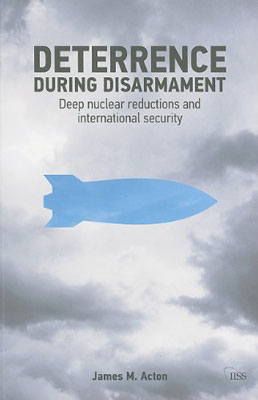
Deterrence During Disarmament: Deep Nuclear Reductions and International Security

Although Russia, the United States, and American allies have been loath to downsize their nuclear arsenals, deep reductions would not undermine a nation’s security since arsenal size has little bearing on effectiveness of deterrence.

Link Copied
By James M. Acton
Published on Mar 14, 2011

Source: International Institute for Strategic Studies

After two decades of stagnation, Russia and the United States have pledged their support for reductions in nuclear warheads. But the vision of mutual disarmament remains plagued by doubts on all sides. Russia, the United States, and American allies struggle as ever with the notion that downsizing would be a step into the unknown, and hold on to the belief that, when it comes to deterrence, size matters. Until now, the reasons behind this anxiety—and whether it is justified—have not been properly explored. Based on a series of interviews with opinion formers in Russia and the United States, this Adelphi paper by Carnegie's James Acton examines long-held concerns about the effectiveness of deterrence (including extended deterrence) at low numbers, the possible incentives to use nuclear weapons first in a crisis, the potential for rearmament, and risks surrounding nuclear multipolarity.

Deep reductions in nuclear arsenals are much less problematic than commonly perceived, as the experience of the USSR and the United States in the early Cold War, and China, France, and the United Kingdom over a longer period demonstrates. Taking into account these examples, together with potential stumbling blocks and crisis scenarios, this book contends that arsenal size has little bearing on many of the security challenges usually associated with low numbers, and accordingly, that making deep cuts would not undermine international security.

Click here for further information on ordering copies of this book.

About the Author

James M. Acton

Jessica T. Mathews Chair, Co-director, Nuclear Policy Program

Acton holds the Jessica T. Mathews Chair and is co-director of the Nuclear Policy Program at the Carnegie Endowment for International Peace.

    Recent Work

  • Other
    Unpacking Trump’s National Security Strategy
      • Cecily Brewer
      • +18

      James M. Acton, Saskia Brechenmacher, Cecily Brewer, …

  • Commentary
    Trump Has an Out on Nuclear Testing. He Should Take It.

      James M. Acton

James M. Acton
Jessica T. Mathews Chair, Co-director, Nuclear Policy Program
James M. Acton
North AmericaUnited StatesCaucasusNuclear Policy

Carnegie does not take institutional positions on public policy issues; the views represented herein are those of the author(s) and do not necessarily reflect the views of Carnegie, its staff, or its trustees.

More Work from Carnegie Europe

  • Commentary
    Strategic Europe
    Taking the Pulse: Is France’s New Nuclear Doctrine Ambitious Enough?

    French President Emmanuel Macron has unveiled his country’s new nuclear doctrine. Are the changes he has made enough to reassure France’s European partners in the current geopolitical context?

      • Rym Momtaz

      Rym Momtaz, ed.

  • Commentary
    The Iran War’s Dangerous Fallout for Europe

    The drone strike on the British air base in Akrotiri brings Europe’s proximity to the conflict in Iran into sharp relief. In the fog of war, old tensions in the Eastern Mediterranean risk being reignited, and regional stakeholders must avoid escalation.

      Marc Pierini

  • Commentary
    Strategic Europe
    The EU Needs a Third Way in Iran

    European reactions to the war in Iran have lost sight of wider political dynamics. The EU must position itself for the next phase of the crisis without giving up on its principles.

      Richard Youngs

  • Trump United Nations multilateralism institutions 2236462680
    Article
    Resetting Cyber Relations with the United States

    For years, the United States anchored global cyber diplomacy. As Washington rethinks its leadership role, the launch of the UN’s Cyber Global Mechanism may test how allies adjust their engagement.

      • Christopher Painter

      Patryk Pawlak, Chris Painter

  • Commentary
    Strategic Europe
    Europe on Iran: Gone with the Wind

    Europe’s reaction to the war in Iran has been disunited and meek, a far cry from its previously leading role in diplomacy with Tehran. To avoid being condemned to the sidelines while escalation continues, Brussels needs to stand up for international law.

      Pierre Vimont

Get more news and analysis from
Carnegie Europe
Carnegie Europe logo, white
Rue du Congrès, 151000 Brussels, Belgium
  • Research
  • Strategic Europe
  • About
  • Experts
  • Projects
  • Events
  • Contact
  • Careers
  • Privacy
  • For Media
  • Gender Equality Plan
Get more news and analysis from
Carnegie Europe
© 2026 Carnegie Endowment for International Peace. All rights reserved.