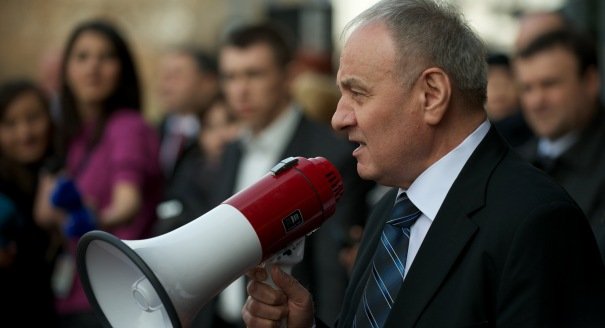
Moldova’s three-year-long political crisis is finally over. Having elected a new president, Nicolae Timofti, on March 16, 2012, Moldovans can now breathe a sigh of relief. Not everyone is happy of course, but the situation is under control and back within constitutional norms. Moldovan authorities can finally start addressing the country’s day-to-day problems instead of counting down the hours before the next extraordinary election.
The possibility for compromise was in fact always there, and it would have been possible to avoid three years without a president had two main conditions been met.
First, the Moldovan authorities had to realize that they had no choice but to reach an agreement.
Second, the scope of the search for a compromise candidate had to be expanded. It was clear from the start that the candidate should not come from within the current political elite—that is, from the parliament and the main political parties. Yet, the Democratic Party of Moldova continued to insist on an earlier agreement that the current parliamentary speaker and Democratic Party leader Marian Lupu should be the ruling Alliance for European Integration’s sole candidate, making it impossible to reach an agreement.
But no sooner did the Democratic Party lay aside its demands than an agreement was found quite easily. When the mediators took the interparty consultations within the ruling alliance beyond the usual claims and suggestions, the required result was quickly and effectively produced: Timofti, a judge and chairman of the Superior Council of Magistrates, was put forward as a candidate.
One wonders why they did not do this sooner. The question will probably remain unanswered. This is simply the political reality in Moldova today, and it reflects the relations between the parties in the ruling alliance and the extent of the public demand for transparent and accountable government.
Despite delays and failed elections, Moldova’s politicians have now reached an agreement within the constitutional framework, and the Constitutional Court has confirmed Timofti’s election. The political crisis was ended in the right fashion, and that in itself is reason for optimism.
The new president is said to be a calm, balanced, and thoughtful person, and his main task now will to be to maintain these positive qualities in his new job, which will be far from calm and will present more problems than can possibly be listed. Timofti will have to conciliate the various members of the Alliance for European Integration that feel left out of the new distribution of posts—above all the Liberal Party. And he will have to find a way to become a bridge between the alliance and the radical communist opposition, which continues to boycott the parliament and, at the same time, has a high popularity rating among the public.
Timofti does not have the experience or the specialized knowledge for this work, which means he runs the risk of making mistakes that in a Moldovan context are best to be avoided. The situation in the country is complicated and unstable, and any inattentive step could have negative consequences.
Let us hope that Timofti will be up to his task and that Moldova’s politicians and citizens will help him in his effort. The main obstacle has been overcome—Moldova has chosen its president.
Vladimir Bruter is a scholar at the International Institute for Humanities and Political Studies.