

Commentary
Nathalie Tocci, Jan Techau
{
  "authors": [
    "Jan Techau"
  ],
  "type": "commentary",
  "blog": "Strategic Europe",
  "centerAffiliationAll": "",
  "centers": [
    "Carnegie Endowment for International Peace",
    "Carnegie Europe"
  ],
  "collections": [],
  "englishNewsletterAll": "",
  "nonEnglishNewsletterAll": "",
  "primaryCenter": "Carnegie Europe",
  "programAffiliation": "",
  "programs": [],
  "projects": [],
  "regions": [],
  "topics": [
    "EU"
  ]
}
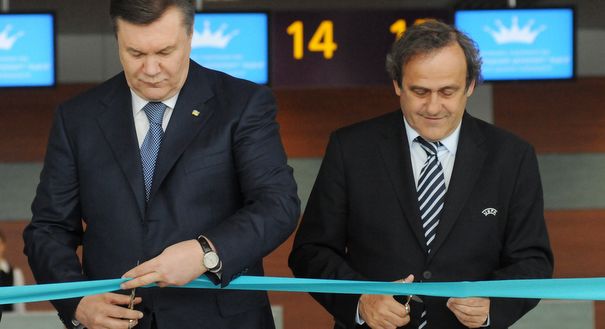
Source: Getty
The international community cannot just stand helplessly on the side lines while a despot reaps the benefits of a huge PR festival designed to cover up the true nature of his regime.
In light of the deteriorating political situation in Ukraine, especially the catastrophic treatment of opposition politician Yulia Tymoshenko, some observers, pundits, and even football fans, have asked for the cancellation or postponement of this year’s European Football Championship tournament in Ukraine.
I am not sure this is the right way to approach the problem. Politically motivated sanctions, economic or other, have rarely had any positive effect on the targeted regime. A boycott would only strengthen the spiteful resolve of the regime in Kiev. It would also mean that for four weeks, thousands of camera teams, journalists, and observers would not be in a country that so urgently needs every form of attention and scrutiny it can get—if only as the by-product of some sports reporting. Tens of thousands of football fans from abroad would not travel to Ukraine as ambassadors of the free world. Ukrainians would not have the chance to tell these visitors about the grim truth of daily life in a dictatorship. Also, a boycott would unjustly punish Poland, the co-host of this year’s tournament, for other people’s misdeeds. In short, a boycott would not help anyone.
But the international community can also not just stand helplessly on the side lines while a despot reaps the benefits of a huge PR festival designed to cover up the true nature of his regime.
However, going ahead as planned with the tournament need not be a moral defeat for organizers and sports fan alike. Quite to the contrary. With a little creativity, the event offers a huge once-in-a-lifetime opportunity to undermine the Yanukovich regime’s communications strategy just as the games are going on. The key lies in branding, or, more to the point, re-branding. If Kiev wants to create the faux image of a modern, democratic political reality in Ukraine, the aim must be to create a more truthful image for viewers around the globe. Here is what can be done:
In all of this it is important to make a very fine distinction between the Ukrainian people and the government in Kiev. Ukrainians must not be victimized by a campaign that attempts to highlight the very opposite: that they are the indeed victims of a corrupt and brutal regime.
Once such an idea gets traction, there is no creative limit to more new and playful ways to get the message across. If done systematically, the tournament’s image-building power would be taken away from the regime in Kiev and turned from a regime-friendly PR instrument into a tool for political change. The regime itself would be forced to swallow the bitter pill, as it could not simply cancel the tournament without a massive loss of face.
This leads to the question whether a football tournament should be willfully politicized in such a way. Well, they already are, just take a look the papers. International sports events have become rare occasions on which a multifariously fragmented global community comes together as one. This gives sports organizations such as the UEFA, the IOC, and FIFA, to name but a few, enormous political weight. They can no longer claim to be unaffected by political developments in the very nations they rely on to stage their world events. They are political organizations by default, even though they’ve been trying hard to be in denial about that fact. If they want to live up to that reality, if they want to retain their good reputations, and if they want to make sure they can cash in on the big events like they have in the past, they need to start thinking politically. They need to realize the enormous potential they have as forces for good. And they need to turn into shrewd political operators. Ukraine offers a great chance to do so.
Director, Europe Team, Eurasia Group
Techau is director with Eurasia Group's Europe team, covering Germany and European security from Berlin. Previously, he was director of Carnegie Europe.
Recent Work
Nathalie Tocci, Jan Techau
Jan Techau
Carnegie does not take institutional positions on public policy issues; the views represented herein are those of the author(s) and do not necessarily reflect the views of Carnegie, its staff, or its trustees.

While the EU and European governments are embracing the much-lauded middle-power moment, this entails three difficult conundrums.

Richard Youngs

Much has been said of the changes Brussels is trying to make to the EU enlargement process. Here’s why gradual integration might—or might not—be the answer.

Dimitar Bechev

The European Commissioner for Trade is headed to China. But after President Xi’s bridge-building visit to Washington, can a more isolated EU overcome Beijing’s stranglehold on critical raw materials? Who will blink first?

Rym Momtaz, ed.

The domestic impacts of how long it is taking to end the war in Ukraine have pushed the French electorate to the political extremes and compromised the country’s diplomatic capacity.
Rym Momtaz

Before the next wave of EU enlargement takes place, the union needs to grapple with thorny questions of how power is distributed among its members.


Emil Sondaj Hansen, Ditte Brasso Sørensen