

Commentary
Are Germany’s economic, industrial, and political struggles becoming a liability for the EU’s ability to rise to the geopolitical moment?
Rym Momtaz, ed.
{
  "authors": [
    "Meltem Müftüler-Baç",
    "Ezgi Uzun-Teker"
  ],
  "type": "commentary",
  "blog": "Strategic Europe",
  "centerAffiliationAll": "",
  "centers": [
    "Carnegie Endowment for International Peace",
    "Carnegie Europe"
  ],
  "englishNewsletterAll": "",
  "nonEnglishNewsletterAll": "",
  "primaryCenter": "Carnegie Europe",
  "programAffiliation": "",
  "programs": [],
  "projects": [],
  "regions": [
    "Eastern Europe",
    "Middle East"
  ],
  "topics": [
    "Climate Change",
    "Security"
  ]
}
Source: Getty
Geopolitical shifts have put into question the effectiveness of the EU’s strategic partnerships. Crises in its vicinity present the union with an opportunity to reassess this foreign policy framework.
This blog is part of ENGAGE, a project that examines challenges to global governance and EU external action. A consortium of thirteen academic institutions and think tanks seeks to assess the EU’s ability to harness all its foreign policy tools and identify ways to strengthen the EU as a global actor.
***
Amid the complex and rapidly evolving challenges in global security, the EU is faced with the need to find innovative solutions through collaboration with key global players within a multilateral framework.
Strategic partnerships—defined here as relatively loose cooperation frameworks with important regional or global players—are critical. These actors’ comprehensive engagement with the EU in a multilateral context can generate positive outcomes for tackling multifaceted global challenges.
Since 1998, the EU has formally established strategic partnerships with ten global players and six intergovernmental organizations, with many more informal and potential partners on the horizon, reflecting its commitment to effective multilateralism.
Debates abound about the effectiveness of strategic partnerships as a tool of the EU’s Common Foreign and Security Policy and its Common Security and Defense Policy.
One area of contention is the lack of precision in the EU’s understanding and implementation of strategic partnerships. The distinction between formal and informal partnerships in EU strategic documents as well as the differentiation between well established and ad hoc formulations often blurs lines and creates inconsistencies.
Another issue is that the EU and its member states engage with various global partners through multiple diplomatic instruments in pursuit of different foreign policy objectives. This further hinders the coherence and effectiveness of the strategic partnership framework.
Moreover, the evolving geopolitical landscape has raised questions about the viability of existing strategic partnerships. The identification of Russia and China, the EU’s first two strategic partners, as “strategic rivals” following the Russian annexation of Crimea and destabilization of eastern Ukraine in 2014 and China’s rise underscores the need for reassessing the EU’s strategic partnership framework. These shortcomings have led some to question the relevance and efficacy of the EU’s strategic partnerships.
Paradoxically, the very crises that disrupted the European strategic partnerships have served as catalysts for the EU to rethink and institutionalize its strategic partnership framework. This evolution is evident in strategy documents that outline the EU’s strategic partnerships from the 2003 European Security Strategy to the 2022 Strategic Compass.
Over the years, the European Commission has taken on a more proactive role in identifying key global players—both states and regional organizations. It has presented them with cooperation opportunities on a wide range of issues. And it has increasingly formalized the procedures for sealing partnerships in the form of standardized strategic partnership agreements.
Effective cooperation with strategic partners in times of crisis opens new communication and cooperation channels, creating a cycle of engagement and building more effective long-term relations. The geopolitical crisis precipitated by Russia’s invasion of Ukraine in 2022 has solidified the union’s partnerships with “like-minded” partners in this respect, most notably with the United States and NATO. This reflects how the EU’s strategic partnerships as a foreign policy framework is maturing.
The crisis in the Middle East provides another litmus test for rethinking the effectiveness of the EU’s strategic partnerships. Like the war in Ukraine, the Israel-Hamas conflict is taking place in the EU’s immediate neighborhood and has critical implications on the union as a global actor. It has wider regional and international repercussions beyond the core Israeli-Palestinian conflict as it impacts Iran’s regional aspirations, global trade flowing through the Red Sea, and the normalization process between Israel and the Arab states.
EU High Representative Josep Borrell has said that “a significant part of the EU’s future global role, and in particular [the EU’s] relations with many countries of the so-called Global South, will depend on [the EU’s] commitment to help solve this conflict.”
In contrast to other regions, the union has proactively sought strategic partnerships with two regional organizations in the Middle East—one with the League of the Arab States (LAS) in 2014 and another one with the Gulf Cooperation Council (GCC) in 2022. This aligns with the EU’s past efforts to foster regional integration globally and its objective of bolstering its influence in broader political contexts.
Yet neither LAS nor the GCC falls into the category of the EU’s “like-minded” partners. This makes them interesting test cases for seeing how far the EU can find common ground for cooperation based on shared interests with “non-like-minded” partners when it comes to complex global security issues. The question here is whether the EU can become an effective global foreign-policy actor by using its regional strategic partnerships.
The EU-LAS and EU-GCC partnerships have seen concrete diplomatic efforts before and after the outbreak of the Israel-Hamas conflict. Initiatives with LAS included the Peace Day Effort for Middle East Peace launched in September 2023 to reinvigorate the idea of the two-state solution and high-level meetings involving EU member states, the foreign ministers of both Israel and Palestine, and LAS.
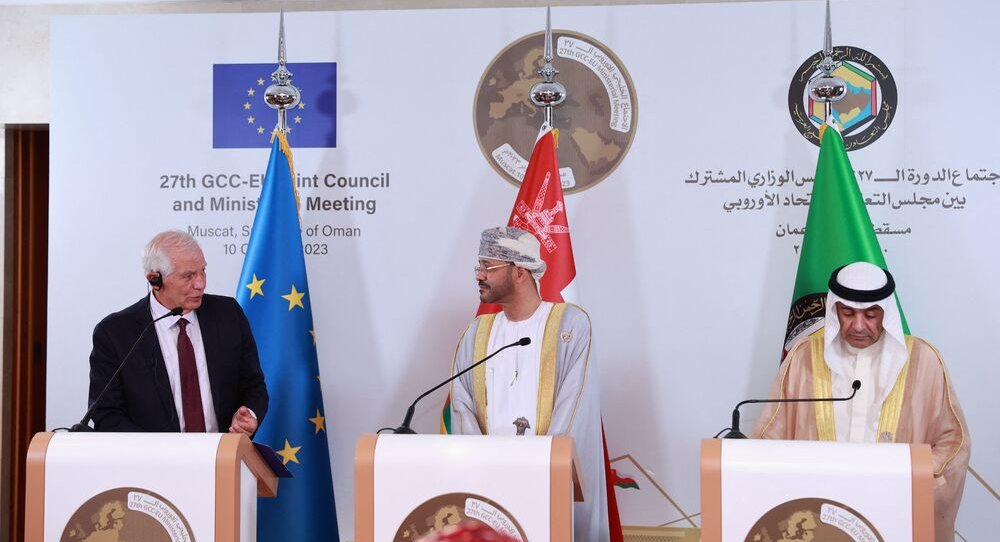
Similarly, Borrell convened with the GCC during their twenty-seventh Joint Ministerial Meeting in October 2023, leading to the issuance of a joint “Co-Chairs’ Statement,” which underscored the importance of upholding international humanitarian law, halting violence, supporting the peace process, and promoting de-escalation in the region.
Efforts were also made to institutionalize communication channels and to coordinate their efforts on the flow of humanitarian aid. This culminated in the EU-GCC Structured Security Dialogue and the High-Level Forum on Regional Security and Cooperation in 2024. All of these diplomatic efforts show that the EU, LAS, and the GCC converged on a clear set of shared strategic objectives. Those included respecting international law, alleviating the humanitarian situation in Gaza, preventing the conflict’s spillover, ensuring maritime, commercial, and oil security, and promoting a two-state solution.
But whether these positive steps will generate tangible outcomes remains to be seen. A central handicap of the EU’s strategic partnerships—and this relates to the Middle Eastern partners as well—is the practical implementation. There is a lack of common understanding between the EU and its Middle Eastern counterparts on how to achieve a ceasefire between Israel and Hamas—and how to address the humanitarian crisis in Gaza.
Additionally, internal discord between the EU institutions and its member states complicates the bloc’s foreign policy stance on the crisis, as made evident in the UN General Assembly votes for a ceasefire and aid allocations to organizations like the UN Relief and Works Agency for Palestine.
Overall, while the EU’s strategic partnerships have fostered structured dialogue channels, their effectiveness in generating tangible policy results remains uncertain. Progress with non-like-minded partners could serve as a litmus test in this respect. As the EU continues to navigate complex global challenges, the evolution and refinement of its strategic partnership framework will be critical in shaping its role as a global actor in the years to come.

Meltem Müftüler-Baç
Meltem Müftüler-Baç is dean of the Faculty of Arts and Social Sciences at Sabancı University in Istanbul. She teaches international relations with a focus on EU-Turkey relations, European integration, Turkish foreign policy, and international relations theory.
Ezgi Uzun-Teker
Ezgi Uzun-Teker is an assistant professor of political science at Yeditepe University in Istanbul. She specializes in the Middle East and Iranian politics, with a focus on religion and international relations, Shia geopolitics, and security and strategic culture studies.
Carnegie does not take institutional positions on public policy issues; the views represented herein are those of the author(s) and do not necessarily reflect the views of Carnegie, its staff, or its trustees.

Are Germany’s economic, industrial, and political struggles becoming a liability for the EU’s ability to rise to the geopolitical moment?

Rym Momtaz, ed.

Mounting economic strain and battlefield losses will not necessarily make the Kremlin less dangerous. They could instead push Moscow toward a more aggressive hybrid campaign designed to test NATO’s Eastern flank, exploit allied hesitation, and fracture European resolve.

Maksym Beznosiuk
Over the past ten years, NATO has held almost as many summits as it did during the entirety of the Cold War. Are they still useful, or is it time to stop holding annual meetings?
Rym Momtaz, ed.

Western Europe’s dual-use infrastructure melted down during its latest heat wave. If a predicted hot weather event can take the continent by surprise, what chance does it have to withstand unexpected geopolitical crises?
Rym Momtaz
There is an elephant in the room when it comes to the EU’s upcoming security strategy: Donald Trump. Unless European leaders acknowledge the depth of the transatlantic crisis, true autonomy will remain out of reach.

Stefan Lehne