

Report
- +2
George Perkovich, Jessica Tuchman Mathews, Joseph Cirincione, …
{
  "authors": [
    "Joseph Cirincione"
  ],
  "type": "legacyinthemedia",
  "centerAffiliationAll": "dc",
  "centers": [
    "Carnegie Endowment for International Peace"
  ],
  "collections": [],
  "englishNewsletterAll": "ctw",
  "nonEnglishNewsletterAll": "",
  "primaryCenter": "Carnegie Endowment for International Peace",
  "programAffiliation": "NPP",
  "programs": [
    "Nuclear Policy"
  ],
  "projects": [],
  "regions": [
    "Iraq"
  ],
  "topics": [
    "Foreign Policy",
    "Nuclear Policy"
  ]
}
REQUIRED IMAGE
Source: Carnegie
Reprinted from Le Monde, December 9, 2002
The U.S. administration has convinced most journalists and world leaders that it will soon attack Iraq. The rhetoric is escalating and so are military movements. There are now 60,000 U.S. troops on the border of Iraq and 45,000 more could fly in with short notice to marry up with pre-positioned equipment. Leaked plans detail a ferocious, short war to isolate, then topple Saddam Hussein. Arab leaders publicly oppose a war, but news reports indicate their quiet support. President George Bush seems ready to let loose the dogs of war at any moment.
Which is precisely why he will not have to.
The unanimous Security Council resolution ordering Iraqi compliance with United Nations inspections--and the credible threat of war should Iraq not comply--make it very likely that Saddam will cooperate with UN inspections. The early inspections have gone well enough and Iraq will likely provide volumes of information on December 8, as required by the UN resolution. The declaration will not be full or complete, but it may reveal information Saddam believes the US already knows, such as secret imports or caches of old chemical weapons. It will not be obvious any time soon that Saddam is not cooperating. It will be very difficult, even for the most bellicose in the U.S., to initiate a war if Saddam does not blatantly obstruct inspections.
This is the very trap that hard-liners in the administration feared and why they did not want the president to go to the United Nations at all. But after the president’s powerful September 12 speech to the General Assembly, after months of work to unite the Security Council, President Bush cannot simply walk away from diplomacy. As he has said, war is neither inevitable nor unavoidable as long as Saddam agrees to disarm.
But it is more than diplomatic considerations that argue against war. There are many serving and retired military who believe that war is neither necessary nor easy. In the best-case, the war could be over in days. But there are several very plausible scenarios that could turn the war into a catastrophe. These include the use of chemical or biological weapons against US troops; an attack on Israel that prompts an Israeli counter-attack, possibly with a nuclear weapon; the siege of Baghdad resulting in thousands of Arab and US casualties. Even if all goes well, US troops will have to occupy Iraq for years. "Are we prepared to occupy Iraq for the next 30 to 50 years?" warns former Reagan Secretary of the Navy James Webb, with our troops as "50,000 terrorist targets."
The push to invade Iraq does not come from the military. Retired General Anthony Zinni, former head of the US Central Command and President Bush’s special envoy for the Middle East, speaks for many when he argues, as he did this October at a Washington conference, "If we see this as a beginning of a chain of events, meaning that we intend to solve this through violent action, we're on the wrong course. First of all, I don't see that that's necessary. Second of all, I think that war and violence are a very last resort, and we have to be careful how we apply it, especially now in our position in the world." Zinni argues that our first priorities ought to be to restart the Israel-Palestinian peace process; encourage Iran’s turn towards moderation and rebuild Afghanistan. Iraq is way down his list of urgent issues.
There are also powerful economic arguments against war. A November study from the Center for Strategic and International Studies in Washington concludes that a sustained conflict would collapse stock prices, send unemployment to 7.5 percent, plunge the US into a recession, and drag down European economies. Estimates of the direct cost of the war range from $60 billion to over $200 billion. In 1991, the Arab nation paid for most of the Gulf War. This time, it is very unlikely that any other nation will pay the bill. Even in a best case, the war will add to the growing federal deficit that George Bush has generated in just two years.
This is why many senior Republicans have counseled the president not to go to war. They remember what happened to the former President Bush after his military victory. With the US economy still fragile, a war could ruin both it and Republican political prospects. Former Secretary of State James Baker and former general Brent Scowcroft urged Bush last August to turn to the United Nations instead. Now Scowcroft again urges patience. In a November 21 op-ed in the Washington Post, Scowcroft praises Bush’s UN victory and urges him now not to war, but to devote "the same kind of skill, audacity and laser-like attention to the Israeli-Palestinian issue."
While many of the American media are promoting "countdowns" and "showdowns" with Iraq, the American people are not pushing the president to war. Polls show that while over 60 percent favor the use of force in Iraq if sanctioned by the United Nations, only 30 percent want the U.S. to go to war alone. The public would undoubtedly rally around the president at the start of a war, but if it goes badly, the weak public support could turn into a backlash that would drive the president and his party from power. Politically, economically and military, war with Iraq is a high-risk operation.
For these reasons, it is not likely that the United States will go to war anytime soon. Two miscalculations could change the equation: Saddam could do something stupid that provides the excuse for war, or Bush could be persuaded by the siren songs of his hard-line advisors that war is both necessary and easy. History shows that illusions of grandeur can overcome even the most persuasive factual analysis.
Joseph Cirincione is the author of Deadly Arsenals: Tracking Weapons of Mass Destruction and a senior associate at the Carnegie Endowment for International Peace in Washington, D.C.

Former Senior Associate, Director for NonProliferation
Recent Work


George Perkovich, Jessica Tuchman Mathews, Joseph Cirincione, …
Joseph Cirincione
Carnegie India does not take institutional positions on public policy issues; the views represented herein are those of the author(s) and do not necessarily reflect the views of Carnegie, its staff, or its trustees.

After the chill in ties between 2020 and 2024 that brought India–China relations to their lowest point in several decades, the two countries have engaged each other afresh. This paper argues that there are predominantly four imperatives guiding India’s approach to China, and they exist in an order of priority.

Saheb Singh Chadha

This piece argues that India’s central challenge is not managing a single flashpoint but resolving the underlying tension between expansion and institutional coherency of the BRICS grouping.

Vrinda Sahai

A partnership between India, a country of subcontinental size, and Africa, a continent of fifty-four countries, may seem asymmetric until one notes that both are home to nearly the same number of people—1.4 billion. This essay spells out the existing challenges to the partnership, its optimal potential, and the possible pathways to realize it over the next quarter-century.

Rajiv Bhatia

The India–EU Free Trade Agreement (FTA) is shaping up to be one of the most consequential trade negotiations, both economically and strategically. But, what’s in the agreement, what’s missing, and what will determine its success in the years ahead
Vrinda Sahai, Nicolas Köhler-Suzuki
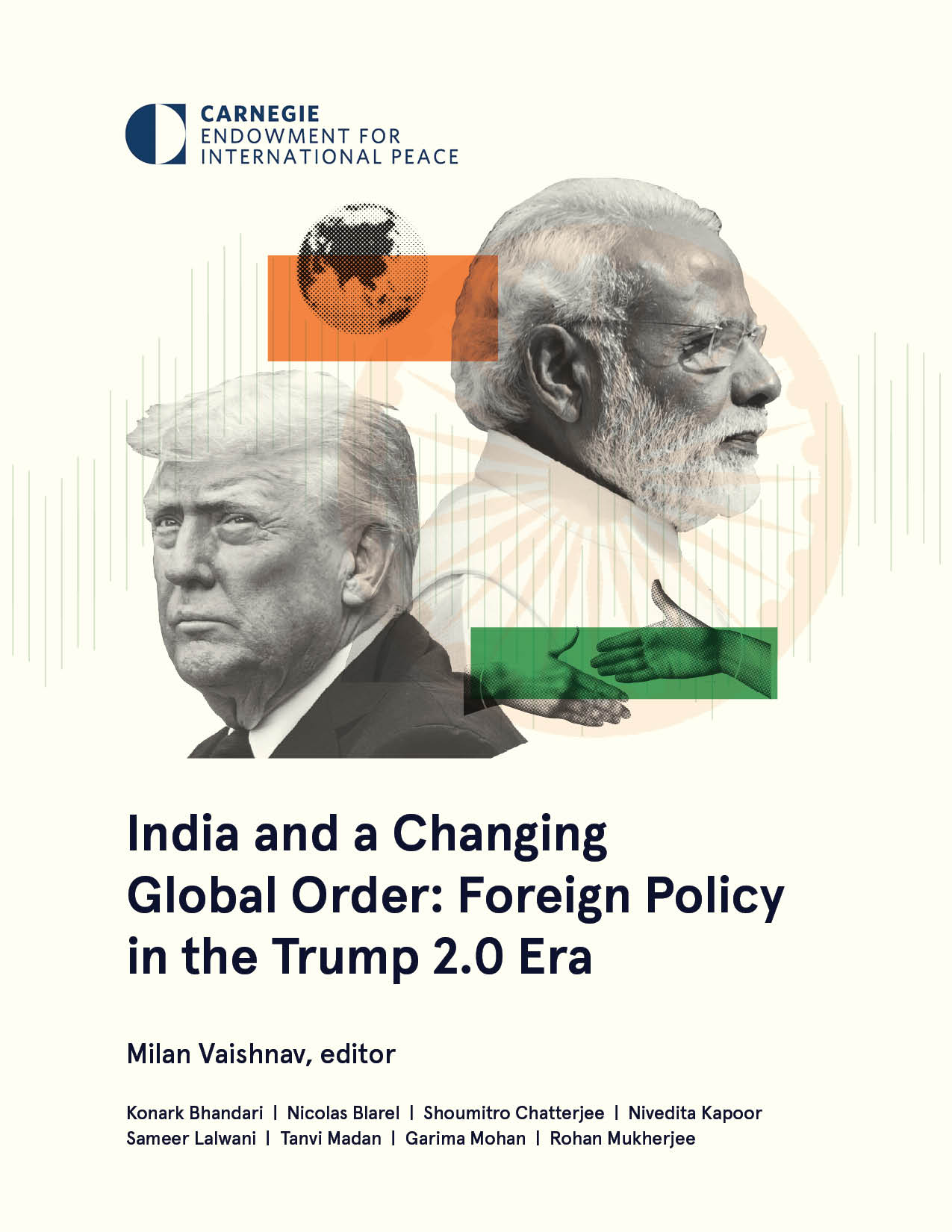
Trump 2.0 has unsettled India’s external environment—but has not overturned its foreign policy strategy, which continues to rely on diversification, hedging, and calibrated partnerships across a fractured order.



Milan Vaishnav, ed., Sameer Lalwani, Tanvi Madan, …