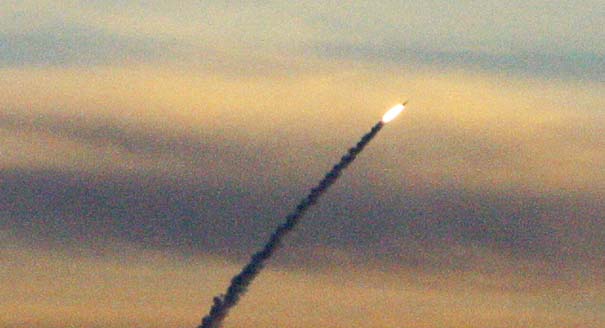
The Missile Defense Silver BulletU.S. President Barack Obama's arrival in Moscow next week may either mark the end of the beginning of a long-term improvement in U.S.-Russian relations or the beginning of the end of their short, vaguely promising stage.
The outcome of the summit, however, will not be decided by whether the U.S. president falls into the idealistic or the realistic camp in his approach to Russia. In addition, the geopolitical swap involving "Ukraine and Georgia for Iran" that some people fear will not be placed on the table, nor is a repeat of Obama's Cairo speech adapted for Russia very likely. Regarding Iran and Afghanistan -- the two issues that at the moment drive Washington's interest in cooperating with Moscow -- Russia's ability to influence these countries is only marginal.
One possible breakthrough in the U.S.-Russian summit could be an agreement on the parameters of a new treaty on strategic nuclear weapons, but there is a nasty snag that may hold up an agreement -- missile defense. Speaking recently in the Netherlands, President Dmitry Medvedev said Russia's consent to further cuts in nuclear weapons depended on U.S. curbs in missile defense. Moscow is definitely taking a gamble, and if it doesn't play its cards right it will end up with a double defeat -- no treaty and missile defense sites in Central Europe.
For those wondering why missile defense matters so much to the Russian leadership, take a look at the recent version of the country's national security strategy. The document approved by Medvedev in May states that the existential threat to Russia's national security comes from the United States gaining a first-strike capability through the development of a global missile shield. When Russian officials refer to the planned sites in Poland and the Czech Republic, they usually refer to them as the "third position" (after Alaska and California), thus suggesting the global nature of the network. The U.S. withdrawal from the Anti-Ballistic Missile Treaty in 2002 sparked concerns among Russian leaders and military top brass about the ultimate strategic goals of the United States. Many senior officials continue to believe that the United States has a hidden agenda: to destroy Russia.
Many people would regard such fears as paranoid, but no one should dismiss them lightly. The lack of trust is staggering. The world crisis has not tempered Moscow's policies or ambitions, whether domestic or foreign, as some originally hoped. After a brief rally at the beginning of the year, Russia's relations with both the United States and the European Union have grown tenser. Isolationist motifs in Moscow's policies toward the West are palpable. Russia's about-face on the issue of Word Trade Organization accession is a vivid example. If, as some predict, this will be followed by Moscow's withdrawal from the Council of Europe, it would set a dangerous trend.
It was said at the beginning of Vladimir Putin's and George W. Bush's second presidential terms that if U.S.-Russian relations did not improve, they would deteriorate. They certainly did deteriorate, and this led to the Russia-Georgia war in August. Russia had reason to believe that they were fighting a U.S. proxy, a disturbing flashback to the numerous proxy wars of the Cold War era.
What can be done to arrest the potentially dangerous trend? Ironically, the key to saving the U.S.-Russian relationship may be found in missile defense. Since the early 2000s, Moscow has been coming out in favor of developing a joint missile defense system. In 2007, Putin made an offer to Bush at Kennebunkport, which has been updated since. The problem, however, is that the United States views Russia's missile defense proposals as add-ons to its own plans in Central Europe and beyond, not as a replacement for them, which is a nonstarter for Moscow. And, of course, there are serious doubts in Washington about the wisdom of cooperating on such a strategically sensitive project with a country that U.S. leaders consider unreliable.
But to see any improvement in bilateral relations, Washington needs to take a bolder stance toward improving relations with Moscow. Its security advantages over Russia are tremendous, and the risk in offering reasonable compromises is relatively low. Amid U.S. and NATO expansion, Russia feels boxed in, and that should be a matter of concern to the Obama administration. An agreement to explore the possibility of a joint or combined U.S.-Russian missile defense system in which the Europeans could also play an important role would be a first step in moving away from the posture of mutual assured destruction -- an old relic of the Cold War that needs to be removed from U.S.-Russian relations.
The United States has little to lose by deciding to go for a joint missile defense system instead of a purely national one. The joint project may fail, of course, but the United States needs to show more interest in trying to make it work. This is something Obama needs to think seriously about in the days leading up to the summit next week.
Carnegie India does not take institutional positions on public policy issues; the views represented herein are those of the author(s) and do not necessarily reflect the views of Carnegie, its staff, or its trustees.
After the chill in ties between 2020 and 2024 that brought India–China relations to their lowest point in several decades, the two countries have engaged each other afresh. This paper argues that there are predominantly four imperatives guiding India’s approach to China, and they exist in an order of priority.
This piece argues that India’s central challenge is not managing a single flashpoint but resolving the underlying tension between expansion and institutional coherency of the BRICS grouping.
A partnership between India, a country of subcontinental size, and Africa, a continent of fifty-four countries, may seem asymmetric until one notes that both are home to nearly the same number of people—1.4 billion. This essay spells out the existing challenges to the partnership, its optimal potential, and the possible pathways to realize it over the next quarter-century.
The U.S.–India semiconductor cooperation story is well-stocked with top-level strategic intent. What remains unresolved, however, are some underlying challenges that will determine whether the cooperation actually functions. Three such friction points stand out.