

Commentary
Maria Lipman
{
  "authors": [
    "Maria Lipman"
  ],
  "type": "legacyinthemedia",
  "centerAffiliationAll": "",
  "centers": [
    "Carnegie Endowment for International Peace",
    "Carnegie Russia Eurasia Center"
  ],
  "collections": [],
  "englishNewsletterAll": "",
  "nonEnglishNewsletterAll": "",
  "primaryCenter": "Carnegie Russia Eurasia Center",
  "programAffiliation": "",
  "programs": [],
  "projects": [],
  "regions": [
    "Caucasus",
    "Russia"
  ],
  "topics": [
    "Political Reform",
    "Domestic Politics"
  ]
}
Source: Getty
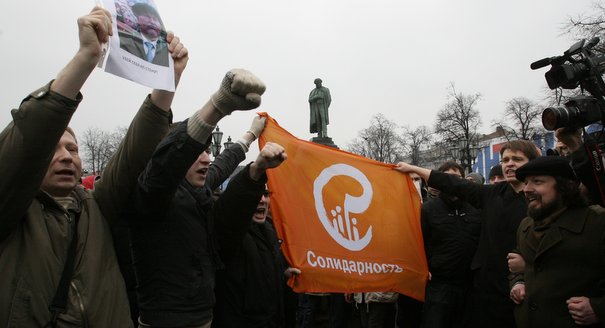
Recent rallies staged by a group called Strategy 31, demanding that the Kremlin respect the constitutional right of freedom of assembly, have demonstrated the Russian government’s discomfort with unsponsored political activism.
Source: The Washington Post

A high-ranking Kremlin aide has acknowledged that even small signs of opposition make the Kremlin jittery. "We have a heightened perception of [political] turbulence," Vladislav Surkov said in a meeting in early July. "We give a jump up each time anything begins to move." This insecurity is deepening as the Russian people's mood has soured in recent months.
The government does not want to be seen opposing the freedom of assembly, so rather than impose a direct ban, it uses tactics such as informing Strategy 31 activists that another group reserved the same space earlier, leaving their rally "unsanctioned." But such tricks aren't fooling anyone, and the 31ers have continued to stage rallies in that square. Just as tenaciously, the police have disrupted them.
For months the police actions were not overly harsh: Some people were pushed from the square, a few detained. But on May 31 about 2,000 people turned out -- far more than usual -- and the police reaction shifted. About 170 people were detained. Some were roughed up; others outright beaten. One journalist had his arm broken by the police.
On the last day of July the government sought to refrain from violence. Instead it securely barred the square from unwelcome activists.
Before the 31ers arrived, Triumphal'naya had been cordoned off by double fences guarded by hordes of police and interior troopers. The cordons that afternoon were so tight that no one could get in. Photographers captured small groups of young people trying to push through, but the police and soldiers standing shoulder to shoulder pushed them back.
Inside the square, another "rival" event was staged, this time a car race. Triumphal'naya may be a good size for a public rally, but it is ridiculously small for a motor race. The few cars drifting inside the cordon made a terrible noise; the air was filled with dust and smoke, and the acrid smell was compounded by the 92-degree heat. The scene looked especially grotesque in light of recent comments by Prime Minister Vladimir Putin: In a somewhat tense exchange with popular rock singer Yuri Shevchuk in late May, Putin said that protesters should respect the rights of others who may be disturbed by their gathering.
The rally was effectively quashed. About 80 people were detained, all were released the same day, and no serious injuries were reported.
Apparently eager to demonstrate that the 31ers lack public support, the police reported that only 200 people showed up. But this falsehood -- the rally attracted about 400 -- emphasized the government's overreaction. The absurdity of a rattling motor race in downtown Moscow strengthened the protesters' point: It is hard to imagine freedom of assembly being so physically and graphically denied.
Government policy is to snuff out unwanted political activism before it can evolve as a broader movement. Most protest groups in Russia are small and isolated, and these preemptive efforts have been successful so far. In the past year, the Strategy 31 campaign, whose leaders include veteran Soviet dissident Lyudmila Alekseeva and writer Eduard Limonov, has not gained outsize public support.
The government's measures, though, go beyond tricks and manipulation to quash rallies. Among them are repeated attempts to control the Internet and passing legislation broadening the authority of the state security service, the FSB -- even though this agency enjoys full unaccountability to the public and hardly needs new legal instruments to act at will. The FSB is now authorized to take measures against people whose actions are merely "creating conditions for committing crimes," vague wording that enables the government to practice selective and arbitrary enforcement.
For the time being, this police-state arsenal is more commonly used to intimidate potential troublemakers than to prosecute them.
The 31ers appear undeterred: The group has pledged to rally on Aug. 31. The 31ers, however, are not the government's main problem.
Public frustration has grown in the past year. Increases in tariffs and some taxes sparked protests in winter and early spring. Online reports of lawlessness and injustice, police violence, corruption, and impunity of the bureaucracy have provoked outbursts of anger among citizens, whose Web use is rising fast. Low quality of governance exposed during crises, such as the fires caused by the unprecedented heat wave in central Russia, add to the disgruntlement.
Most such outbursts have subsided, hardly generating any social organization, but dissatisfaction is growing. To appease socioeconomic fears as the 2011-12 election cycle approaches, Moscow has increased social spending. But the dramatic slowdown of the Russian economy in the past two years means that this generosity cannot last much longer. Sooner or later the government will have to seriously cut social spending, and the public's sour mood may translate into action that can't be quashed by tricks. Then the temptation to resort to oppressive ways may be hard to resist.
Former Scholar in Residence, Society and Regions Program, Editor in Chief, Pro et Contra, Moscow Center
Lipman was the editor in chief of the Pro et Contra journal, published by the Carnegie Moscow Center. She was also the expert of the Carnegie Moscow Center’s Society and Regions Program.
Recent Work
Maria Lipman
Maria Lipman
Carnegie India does not take institutional positions on public policy issues; the views represented herein are those of the author(s) and do not necessarily reflect the views of Carnegie, its staff, or its trustees.

This piece argues that India’s central challenge is not managing a single flashpoint but resolving the underlying tension between expansion and institutional coherency of the BRICS grouping.

Vrinda Sahai
Unless the government can up its communications game, anti-vax movements could prolong India’s pandemic effects.

Shruti Sharma
The proposal aims to produce high and sustained growth to get the country back on track after slowdowns that preceded the coronavirus pandemic.
Suyash Rai
India’s proposed data protection law would create an enormous task for the new agency formed to regulate it. Given stretched resources, the new Data Protection Authority should take a strategic approach.
Shivangi Tyagi
The COVID-19 crisis in India is devastating. The Biden administration must consider exceptions to the Defense Production Act and ease the global vaccine supply chain.

Arvind Gupta, Rudra Chaudhuri, Harsh Pant, …