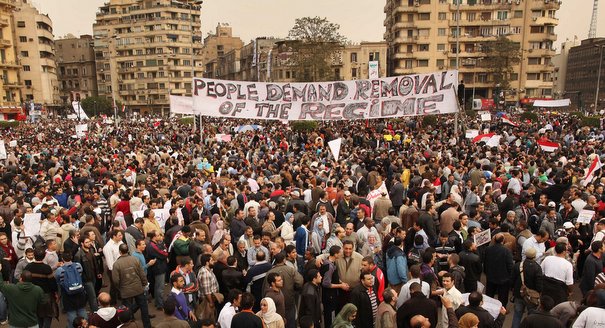
The Egyptian public must recognize that freedom from authority and corruption requires citizens who follow through with the measures needed for reconstruction and institutional reform, not merely the removal of individual personalities from power.
What Egypt Must Do During TransitionTo attribute Egypt’s current political and social crises to personalities alone is to oversimplify them. One ought to be similarly skeptical when certain individuals are then marketed as the solution to the problem.
Many in Egypt are attempting to link its decades-long crises of authoritarianism and corruption merely to the actions of former President Hosni Mubarak and individuals in his family and those close to him. Simply expelling these individuals from political and social life will not build a democratic and transparent Egypt that combats corruption.
Those making this argument ignore the fact that the institutions of authoritarianism—from security agencies to state media to judicial committees accustomed to doing the rulers’ bidding—are the very mechanisms that enabled Mubarak and his family to remain in power since 1981. They forget too that the integrated system of corruption that Mubarak’s regime produced entangled a considerable number of citizens in various ways.
Merely expelling Mubarak’s family and cohorts cannot rid Egypt of authoritarianism and corruption. Egyptians are incapable of achieving much progress if they shortcut the work on democratic reform in constitutional and legal contexts and placate themselves with the legal pursuit of prominent corrupt figures.
Democracy, transparency, and a crackdown on corruption can take root in a sociopolitical life only via a long-term process of development. The key to this process is institutional reform so that the rule of law is established and a balanced and mutual oversight among the legislative, executive, and judicial authorities is guaranteed. Such reform must consistently apply the legal and political principles of oversight and accountability to officials and must protect citizens’ rights and liberties. It is therefore incumbent upon Egyptians, as patriotic forces, civil society, activists, and intellectuals, to understand that authoritarianism will not end with the expulsion of Mubarak’s family. Nor will the imprisonment or removal of some of the individuals who symbolize repression and corruption from their public posts solve the problem. In spite of the importance of both these measures, they alone will change nothing. The public must know that freedom from authoritarianism and corruption requires that citizens follow through with mechanisms and measures of reconstruction and institutional reform. Egyptians must also temper the excessive intoxication of victory after Mubarak’s departure.
In addition, attempts have been made by some to reduce the critical and complicated conversation about the transitional stage to a discussion of potential candidates for the presidency—lending Egyptians the impression that one particular person is capable of delivering democracy to the country. The problem is that such talk about names distracts public attention from the process of the transitional stage and the challenges of democratic construction in Egypt.
Over the past few days I have attempted to intensify discussion on a range of issues: whether a presidential or a parliamentary regime is more preferable for a democratic Egypt; amending the current constitution versus drafting a new one; the role of the military in the transitional stage and afterward; how to institutionally manage an expanded national dialogue about the transitional and democratic stage; the role of civil society; the challenges of reforming governmental and public institutions; and others.
All these issues are more central and important to Egypt’s democratic transformation than the discussion of the identities of possible candidates. Seriously addressing them requires ordered and detailed thought about mechanisms, measures, and timing—not public discussion of a particular post and the abilities of this or that candidate.
My bias here, as we strive to manage a successful transformation toward democracy, is in favor of a parliamentary republic that guarantees developed political life and limits the encroachment of the presidency and executive authority. I prefer this to a presidential republic that gives the president absolute power with no accountability. I believe strongly in the necessity of a new Egyptian constitution that establishes parliamentarianism and saves us from the flawed 1971 constitution (perhaps after the next six months). However, I also think it preferable that, after the Supreme Council of the Armed Forces hands over rule to an elected parliament and president, the role of the military in political life be retained—perhaps in a form close to that of the Turkish National Security Council—to guarantee that there will be no coup against democracy and pluralism.
I have also called for the formation of an institution for national dialogue, representing within itself all national forces, labor and professional syndicates, youth movements, and civil society. This body would manage, alongside the Supreme Council of the Armed Forces, the tasks of the transitional stage. It would precisely define mechanisms, measures, and timings for the democratic transformation.
Such issues warrant the public’s continual concern. Their discussion must be intensified to prevent the Supreme Council from making all the decisions of the transitional stage itself, and in order to guarantee citizens’ participation in defining the face of the new political regime. As for the talk about potential candidates—whether by them directly or through their intermediaries—I am convinced that it is premature and pointless at this moment.
Here, one must take note of the respected stance of Mohammad ElBaradei, who refused to talk personally about his potential candidacy and continually stressed the importance of achieving constitutional, political, and institutional reform before thinking about the identity of presidential candidates. He then announced that he would not run for the presidency, affirming that what concerned him was Egypt’s democratic transformation. ElBaradei’s stance was in total harmony with the legitimate demands of the Egyptian revolution. His stance served these goals much more effectively than the open declarations by some of those who wish to run for the presidency, or by early televised electoral campaigns.
Amr Hamzawy is a senior fellow and the director of the Carnegie Middle East Program. His research and writings focus on Egypt’s and other middle powers’ involvement in regional security in the Middle East, particularly through collective diplomacy and multilateral conflict resolution
Carnegie India does not take institutional positions on public policy issues; the views represented herein are those of the author(s) and do not necessarily reflect the views of Carnegie, its staff, or its trustees.
After the chill in ties between 2020 and 2024 that brought India–China relations to their lowest point in several decades, the two countries have engaged each other afresh. This paper argues that there are predominantly four imperatives guiding India’s approach to China, and they exist in an order of priority.
This piece argues that India’s central challenge is not managing a single flashpoint but resolving the underlying tension between expansion and institutional coherency of the BRICS grouping.
A partnership between India, a country of subcontinental size, and Africa, a continent of fifty-four countries, may seem asymmetric until one notes that both are home to nearly the same number of people—1.4 billion. This essay spells out the existing challenges to the partnership, its optimal potential, and the possible pathways to realize it over the next quarter-century.
The U.S.–India semiconductor cooperation story is well-stocked with top-level strategic intent. What remains unresolved, however, are some underlying challenges that will determine whether the cooperation actually functions. Three such friction points stand out.