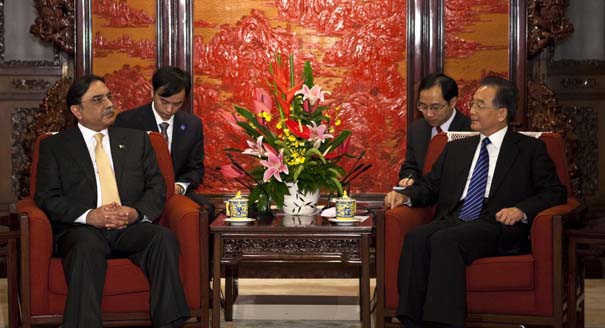
Although Beijing agreed not to export nuclear reactors to Pakistan when it joined the Nuclear Suppliers Group in 2004, it is currently planning the construction of two reactors at the Chasma site in Pakistan.
Moving Forward on China, Pakistan, and the NSGJust a couple of weeks after I joined the Carnegie Endowment at the beginning of March last year, I found myself in a musty agricultural exhibition hall in east Beijing, across Dongsanhuan Beilu from the Sanlitun diplo quarter. In the corner of one wing of that Mao-flavoured building, an engineering subsidiary of China’s leading nuclear state-owned enterprise, China National Nuclear Corp, displayed on a panel all the nuclear facility construction projects it had on its plate through 2015.
One of these listed projects was construction of two new PWRs at the Chashma site in Pakistan. That was interesting because until then there had been only rumors and unconfirmed assertions by officials in Islamabad that this deal was in the bag. Here in a drafty corner of a Chinese nuclear industry exhibition, where bussed-in Chinese reactor engineers took their furtive cigarette breaks, we had something in black and white which looked like an official Chinese confirmation that CNNC was in fact about to build more power reactors in Pakistan.
During the rest of 2010 I raised this issue in a modest spate of articles and media interventions, before, during, and after the Nuclear Suppliers Group held its annual meeting, in Christchurch last June. Carnegie flagged this because, of course, in 2008, the U.S. persuaded the NSG to award India an exemption to its nuclear trade sanctions, which were in fact triggered by India’s post-1968 nuclear explosive test and subsequent absence of full-scope safeguards on all its nuclear activities. By 2010, China, which had acquiesced at the NSG to the US request for the India exemption—while making known to the group it favored this to happen on the principle of “non-discrimination”—had joined the US, Russia, and France in preparing to export nuclear reactors to non-NPT states on behalf of its ally Pakistan.
The problem at hand was, however, that under NSG guidelines which China pledged to adhere to when it joined the group in 2004, China agreed not to export nuclear reactors to Pakistan. Before China joined the NSG, it signed contracts to set up two PWRs at Pakistan’s Chashma site, as provided by a pre-NSG Sino-Pak cooperation agreement. According to people who were on hand when China joined the NSG in 2004, Beijing then even spelled out to NSG participating governments that it had no intention to sell any more power reactors to Pakistan beyond Chashma-1 and -2, and that China enumerated what was on its list of goods that it had committed itself to export to Pakistan under that old trade agreement.
The NSG’s other 45 members last year did not have a common response to China’s resolve in exporting two more reactors to Pakistan. During the 2010 NSG plenary meeting, a number of states—including the U.S.—requested clarification from China about its intentions. Chinese officials provided only vague assurances that all current and future Chinese exports would follow NSG guidelines—suggesting to many at the meeting that China tacitly implied that the new exports to Pakistan were “grandfathered” under the old trade deal. Last spring, the US Department of State spelled out it would certainly take issue with that version of events.
It’s now a year later. The NSG this week is meeting again, in Noordwijk, and that meeting is set to conclude on Friday, June 24.
In the meantime, Pakistan has continued beating the drum that it should be accorded nuclear trade rights on par with India’s, China and Pakistan have been going forward in preparing to build the reactors (Pakistan officials told me in Islamabad a couple of months ago that they were beginning civil construction for the foundation of Chashma-3) and the NSG braced for another testy tete-a-tete with China during its forthcoming annual closed-door conclave.
At Carnegie, we were working on this.
Yesterday, Toby Dalton, I, and George Perkovich published this Policy Outlook on our website in an effort to focus international attention on the Sino-Pak-NSG conundrum.
We have been watching what is happening in China and elsewhere in response to Fukushima. We think there is an opportunity for China, Pakistan, and the NSG to rethink this issue.
The politically correct status quo course of inaction—which appears to be veering toward a don’t-ask-don’t-tell policy of tacitly accepting Chinese grandfathering of its trade with Pakistan—won’t work. It will further erode the NSG’s credibility in the shadow of the US-India deal. It will permit China and Pakistan to brush off NSG rules. Pakistan would get old reactors from China which won’t seriously address its real-time energy deficit, and won’t comply with safety standards which after Fukushima the world will demand for new nuclear projects.
Instead, moving forward on the basis of what we propose for NSG to think about would give the NSG, Pakistan, and China an opportunity. The NSG can establish criteria and a roadmap for other countries without full-scope safeguards to qualify for civilian nuclear cooperation; it can put the group in the position of raising the nonproliferation bar for future NSG membership; and it can incentivize China and Pakistan to make their nuclear trade legitimate in an NSG process acceptable to all NSG members.
We’re not naïve. We know there will be fierce opposition to this from those who will argue that the NPT—and its 1968 nuclear test cut-off date—is set in stone. But the alternative to what we propose is that China and Pakistan will proceed without conditions. To them, the US-India deal was a game changer.
More broadly, India, Israel, and Pakistan are nuclear-armed states. These are facts on the ground. The next step for India would be full membership. The Obama administration is advocating this. Many NSG states—more than the number which resisted the US-India deal from 2005-2008—are not prepared to roll over. They can now set the crossbar for future membership. While the approach we recommend for China and Pakistan is about nuclear cooperation, not NSG membership, there could be a carryover. In either case, NPT states outside the NSG should also be brought into this process to understand that a criteria-based approach can result in a modern and robust benchmark which will provide the world greater security against the threat of nuclear weapons proliferation.
Hibbs is a Germany-based nonresident senior fellow in Carnegie’s Nuclear Policy Program. His areas of expertise are nuclear verification and safeguards, multilateral nuclear trade policy, international nuclear cooperation, and nonproliferation arrangements.
Carnegie India does not take institutional positions on public policy issues; the views represented herein are those of the author(s) and do not necessarily reflect the views of Carnegie, its staff, or its trustees.
In any defense establishment, change is an ongoing process. However, despite the best of intentions, existing bureaucracies, bound by habit and years of socialization, have their limits in implementing transformative change.
After the chill in ties between 2020 and 2024 that brought India–China relations to their lowest point in several decades, the two countries have engaged each other afresh. This paper argues that there are predominantly four imperatives guiding India’s approach to China, and they exist in an order of priority.
This piece argues that India’s central challenge is not managing a single flashpoint but resolving the underlying tension between expansion and institutional coherency of the BRICS grouping.
This piece argues that the present Indian strategy, based on opportunistic diversification and utilization of limited strategic reserves, remains inadequate when confronting supply disruptions. It evaluates India’s options in the short, medium, and long terms.
Trump 2.0 has unsettled India’sexternal environment—buthas notoverturned its foreign policystrategy,which continuesto relyon diversification, hedging,and calibrated partnerships across a fractured order.
+6
Milan Vaishnav, ed., Sameer Lalwani, Tanvi Madan, …