

In The Media
David Rothkopf
{
  "authors": [
    "David Rothkopf"
  ],
  "type": "legacyinthemedia",
  "centerAffiliationAll": "",
  "centers": [
    "Carnegie Endowment for International Peace"
  ],
  "collections": [],
  "englishNewsletterAll": "",
  "nonEnglishNewsletterAll": "",
  "primaryCenter": "Carnegie Endowment for International Peace",
  "programAffiliation": "",
  "programs": [],
  "projects": [],
  "regions": [
    "North America",
    "United States",
    "South Asia",
    "East Asia",
    "China",
    "Southeast Asia",
    "Oceania",
    "Australia"
  ],
  "topics": [
    "Security",
    "Military",
    "Foreign Policy"
  ]
}
Source: Getty
With Washington making China the centerpiece of its efforts in Asia, Australia is likely to only grow in significance and potential value as an ally.
Source: Foreign Policy

That said, Brits can take comfort. This newly ascendant relationship remains within the extended family of their former colonies.
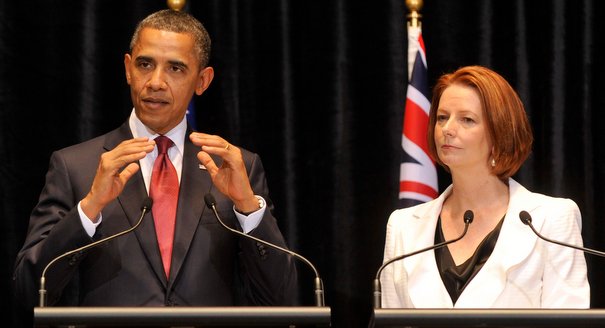
Currently, President Obama is on his first official visit to Australia. So far, during his stay, he has sent several clear messages that America's almost always warm relationship with our cousins down under is getting warmer and is being seen by this White House as strategically more important than ever. His interactions with Australian Prime Minister Julia Gillard have been characterized as especially warm. He has described America's shifting focus to the Asia-Pacific region that is increasingly be presented as the centerpiece of this administration's foreign policy. And, backing up his assertion that the region is "of huge strategic importance to us", the President and Gillard have announced a new defense deal that will establish a U.S. military presence in Darwin and will deepen and enhance cooperation between the two nations' air forces.
There is no coyness about why a United States that is pulling back from other deployments around the world is establishing this new relationship. While Obama has said that the presence is not intended to contain China, there is no question that it is intended to both counterbalance what is seen as China's growing military clout and in particular to assure the ability to control key regional sea lanes. One of Obama's security deputies asserted that the deal was struck in direct "response to demand" from China's neighbors.
Britain's importance to the United States through most of the last century was due in large part to her strategic location off the coast of Europe, the area of America's principal economic and political interests. That Britain, though a fading empire, was still one of the world's most powerful nations and one that was deeply tied to America in almost every conceivable way, added to the "specialness" of the relationship.
While Australia is not as closely integrated with the U.S. economy as Britain nor is it as militarily powerful -- spending less than half of what Britain does on defense -- it does have a few things going for it. Much as Britain was the most natural ally in the European region, so too is Australia the most natural in the Asia-Pacific region. Its location -- near to Asia but separated by the sea -- offers a similar set of strategic advantages. It has cultivated close regional relationships and can be an effective interlocutor -- in some ways more effective than outlier Britain can be in the context of modern Europe (whatever that is). Moreover, with China and the rest of Asia on the rise, Australia is only likely to grow in significance and potential value as an ally.
What Obama and his Secretary of State Hillary Clinton are doing in Asia is as clear as it is deft. They are making China the centerpiece of their efforts, engaging deeply across a wide range of issues. They challenge where they feel they should. They cooperate wherever they can. And thus they are managing to deepen what is clearly the most important bilateral relationship on the planet. Meanwhile, through efforts like that in Australia, they are strengthening the U.S. position throughout Asia -- from the Koreas to Japan, across ASEAN, and on to India and the sub-continent. In all this, the old ties of empire give special place and ease of dealing to relations with the Australians, the Indians, and the Singaporeans. It is hard to see how these relationships will not continue to grow in significance during the decades ahead -- perhaps to a time when the relationship between two or more of England's stroppier colonies end up being more important than those any of them share with the "mother country."
(By the way, as a closing footnote, it should be noted that Secretary Clinton, who has played a central and effective role in these efforts working closely with the NSC team and a Department of Defense for whom this shift in focus has long been a top priority, is currently enjoying yet another affirmation of her special role in the cabinet having just won the top ranking among all senior members of the Obama team in the Partnership for Public Service's rating of leadership performance.)

Former Visiting Scholar
David Rothkopf was a visiting scholar at the Carnegie Endowment as well as the former CEO and editor in chief of the FP Group.
Recent Work
David Rothkopf
David Rothkopf
Carnegie India does not take institutional positions on public policy issues; the views represented herein are those of the author(s) and do not necessarily reflect the views of Carnegie, its staff, or its trustees.

In any defense establishment, change is an ongoing process. However, despite the best of intentions, existing bureaucracies, bound by habit and years of socialization, have their limits in implementing transformative change.

Anit Mukherjee

How is AI reshaping space security, creating governance challenges, and where does international diplomacy stand today?


Tejas Bharadwaj, Almudena Azcárate Ortega

After the chill in ties between 2020 and 2024 that brought India–China relations to their lowest point in several decades, the two countries have engaged each other afresh. This paper argues that there are predominantly four imperatives guiding India’s approach to China, and they exist in an order of priority.

Saheb Singh Chadha

This piece argues that India’s central challenge is not managing a single flashpoint but resolving the underlying tension between expansion and institutional coherency of the BRICS grouping.

Vrinda Sahai

A partnership between India, a country of subcontinental size, and Africa, a continent of fifty-four countries, may seem asymmetric until one notes that both are home to nearly the same number of people—1.4 billion. This essay spells out the existing challenges to the partnership, its optimal potential, and the possible pathways to realize it over the next quarter-century.

Rajiv Bhatia