

Paper
Paul Salem
{
  "authors": [
    "Paul Salem"
  ],
  "type": "legacyinthemedia",
  "centerAffiliationAll": "dc",
  "centers": [
    "Carnegie Endowment for International Peace",
    "Malcolm H. Kerr Carnegie Middle East Center",
    "Carnegie Russia Eurasia Center"
  ],
  "collections": [
    "Arab Awakening"
  ],
  "englishNewsletterAll": "ctw",
  "nonEnglishNewsletterAll": "",
  "primaryCenter": "Malcolm H. Kerr Carnegie Middle East Center",
  "programAffiliation": "russia",
  "programs": [
    "Russia and Eurasia"
  ],
  "projects": [
    "Eurasia in Transition"
  ],
  "regions": [
    "Levant",
    "Syria",
    "Middle East",
    "Caucasus",
    "Russia"
  ],
  "topics": [
    "Political Reform",
    "Security",
    "Foreign Policy"
  ]
}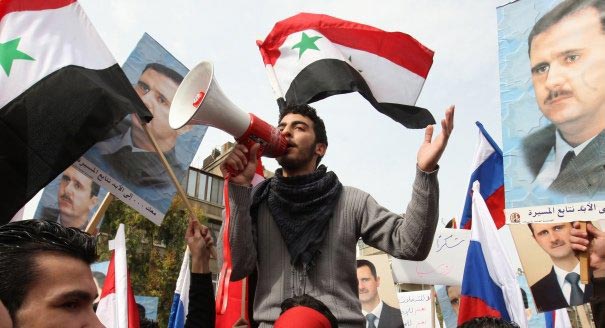
Source: Getty
Russia has the opportunity to move beyond saving the doomed Syrian regime to save the country itself from civil war and devastation and to bring about a political transition that leads to a stable and democratic Syria.
Source: Vedomosti

The Syrian regime is losing the confrontation with its people. It cannot win. Its authoritarian structure is from a bygone era and is falling as other authoritarian regimes have in the region. And its minoritarian backbone is succumbing to the inevitable demographic logic of empowered communities and populations.
With its massive security apparatus and firepower in addition to continued support from Iran and other outside players, the regime can stagger on for a while in the face of a stubborn uprising in which thousands have perished. But Assad and his clique can only prolong the conflict and drive Syria deeper into civil war; meanwhile, the regime is losing ground every week. There is an urgent need for diplomacy that might save Syria from collapsing into chaos.The Syrian people and opposition are not hostile to Russia or other outside players. They are simply demanding basic human and political rights. The regime has been unable or unwilling to accept the democratic transformation that has erupted in the Arab world in general and in Syria in particular. By turning a blind eye to reality, and falsely assuming that all political problems can be dealt with by force, it has put itself, the Alawi community, and Syria as a whole on a road to ruin.
The recent announcement to hold a referendum in the midst of ongoing massacres and without any prior negotiation with the opposition or consultation with the population only adds insult to injury. Moscow can save the regime from its own miscalculations, and save Syria—and the region—from the terrible devastation of state failure and civil war. And Russia can emerge as a leader of positive change in the Arab world with continued influence in the new Syria and an important position in tomorrow’s Middle East.
The Assad family and the regime’s cronies have painted themselves into a corner: they face victory or death. Victory is proving more impossible every day; the regime clique will soon need an exit strategy. The Alawi community has effectively been taken hostage by the Assad regime in a communal confrontation with the Sunni majority that outnumbers them 7 to 1 and that they cannot beat; the Alawis too need an exit strategy from civil war if they are not to become its victims.
The Syrian opposition, as well as the majority of the Syrian population, seek long-overdue and fundamental political reforms, but they do not want civil war and the ruin of Syria. The all-important middle and merchant classes, which have so far not joined the revolution, have no wish to see their homeland destroyed or broken up into mutually hostile sectarian cantons. They would heartily support a power transition that led to greater democracy.
Russia is the only actor today that can offer a win-win solution to these various players and be the architect of a political transition in Syria that will avoid state failure and civil war while ensuring a transition that is positive and stable.
A “Russian Plan” could have elements of other recent transitions in the Arab world. As the West did in Tunisia and Egypt, Russia could use its influence in Syria to encourage a transition without a collapse of state institutions and national order; and as Saudi Arabia and others did in Yemen, it could encourage this transition while offering an exit strategy for the ruling family and clique.
While the Arab League and the West have failed to find a way forward for Syria, and are proposing political and interventionist initiatives that will probably only deepen the crisis, Moscow has a chance to demonstrate its influence, indispensability, and diplomatic acumen by engineering a safe transition for Syria.
In doing so, it will earn the goodwill of the Syrian people as well as the gratitude of many in the Alawi community and even some in the regime itself who realize that they are on a dead-end road. It will also earn the goodwill of countries in the region that fear that the slow and inevitable collapse of the Syrian regime will create instability for the entire Middle East. It will prove Russia’s responsible and positive role in the world community and the Middle East, making Moscow a key player in the new Arab world.
Senior Fellow at the Middle East Institute
Paul Salem is a senior fellow at the Middle East Institute.
Recent Work
Paul Salem
Paul Salem
Carnegie India does not take institutional positions on public policy issues; the views represented herein are those of the author(s) and do not necessarily reflect the views of Carnegie, its staff, or its trustees.

In any defense establishment, change is an ongoing process. However, despite the best of intentions, existing bureaucracies, bound by habit and years of socialization, have their limits in implementing transformative change.

Anit Mukherjee

After the chill in ties between 2020 and 2024 that brought India–China relations to their lowest point in several decades, the two countries have engaged each other afresh. This paper argues that there are predominantly four imperatives guiding India’s approach to China, and they exist in an order of priority.

Saheb Singh Chadha

This piece argues that India’s central challenge is not managing a single flashpoint but resolving the underlying tension between expansion and institutional coherency of the BRICS grouping.

Vrinda Sahai

A partnership between India, a country of subcontinental size, and Africa, a continent of fifty-four countries, may seem asymmetric until one notes that both are home to nearly the same number of people—1.4 billion. This essay spells out the existing challenges to the partnership, its optimal potential, and the possible pathways to realize it over the next quarter-century.

Rajiv Bhatia

The India–EU Free Trade Agreement (FTA) is shaping up to be one of the most consequential trade negotiations, both economically and strategically. But, what’s in the agreement, what’s missing, and what will determine its success in the years ahead
Vrinda Sahai, Nicolas Köhler-Suzuki