

Paper
Lora Saalman
{
  "authors": [
    "Lora Saalman"
  ],
  "type": "legacyinthemedia",
  "centerAffiliationAll": "",
  "centers": [
    "Carnegie Endowment for International Peace",
    "Carnegie China"
  ],
  "collections": [],
  "englishNewsletterAll": "",
  "nonEnglishNewsletterAll": "",
  "primaryCenter": "Carnegie Endowment for International Peace",
  "programAffiliation": "",
  "programs": [],
  "projects": [],
  "regions": [
    "North America",
    "United States",
    "East Asia",
    "China"
  ],
  "topics": [
    "Nuclear Policy",
    "Security",
    "Arms Control"
  ]
}
Source: Getty
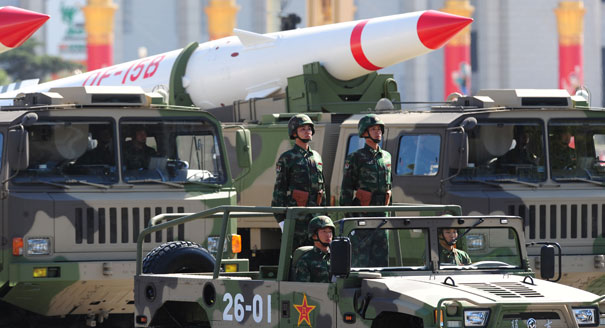
While interdependence might bring China to the negotiation table, its presence does not guarantee meaningful engagement, much less nuclear reductions.
Source: Strategic Stability: Contending Interpretations
In China, everything from its “peaceful rise” to “harmonious development” has been predicated on economic incentives to maintain a stable environment. While China’s rapid economic growth would enable it to greatly expand its nuclear arsenal, this priority has conversely compelled it to emphasize economic growth and stability over arms racing. As part of this logic, interdependence is a driver of stability. While the concept is not new, its linkage to strategic stability is.Interdependence fits China’s construct for relations with the rest of the world, based on intertwined interests and economic incentives. Yet, there exists a parallel discourse on comprehensive national power (CNP) in China. The latter predates the former and posits that China’s lack of comparative political, economic, and military power constrains its participation in strategic stability talks or nuclear reduction negotiations. When these two discourses intersect, however, Chinese claims of inadequate CNP are increasingly difficult to justify.
This trend has far-reaching implications for Sino-U.S. strategic relations. While interdependence might bring China to the negotiation table, its presence does not guarantee meaningful engagement, much less nuclear reductions. So while much ink has been spilled on whether or not China will sprint to parity, not enough has been devoted to whether it has adequate incentives to walk towards zero. This essay shows that Chinese experts are likely to find the opportunity costs of disarmament to be greater than the benefits.
This article was originally published in Strategic Stability: Contending Interpretations

Former Nonresident Associate, Nuclear Policy Program
Saalman was a nonresident associate in the Nuclear Policy Program at the Carnegie Endowment for International Peace. Her research focuses on China’s nuclear and strategic policies toward India, Russia, and arms control.
Recent Work
Lora Saalman
Lora Saalman
Carnegie India does not take institutional positions on public policy issues; the views represented herein are those of the author(s) and do not necessarily reflect the views of Carnegie, its staff, or its trustees.

How is AI reshaping space security, creating governance challenges, and where does international diplomacy stand today?


Tejas Bharadwaj, Almudena Azcárate Ortega

After the chill in ties between 2020 and 2024 that brought India–China relations to their lowest point in several decades, the two countries have engaged each other afresh. This paper argues that there are predominantly four imperatives guiding India’s approach to China, and they exist in an order of priority.

Saheb Singh Chadha

This piece argues that India’s central challenge is not managing a single flashpoint but resolving the underlying tension between expansion and institutional coherency of the BRICS grouping.

Vrinda Sahai

The U.S.–India semiconductor cooperation story is well-stocked with top-level strategic intent. What remains unresolved, however, are some underlying challenges that will determine whether the cooperation actually functions. Three such friction points stand out.

Shruti Mittal

This piece argues that the present Indian strategy, based on opportunistic diversification and utilization of limited strategic reserves, remains inadequate when confronting supply disruptions. It evaluates India’s options in the short, medium, and long terms.
Vrinda Sahai