Source: National Interest
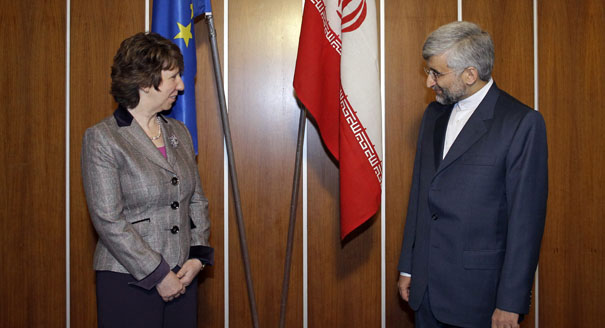
With yet another round of talks with Iran only producing an agreement for more talks, critics are again branding President Obama as naïve for facilitating Iran’s delaying tactics. Of course, had the talks in Almaty produced substantive results, the same chorus would have chanted the same refrain, only this time citing Obama’s willingness to cut a deal with the Islamic Republic as evidence of his supposed naiveté. What is noticeably absent from all this criticism, however, is almost any articulation of an alternative to negotiations.
To be sure, critics of negotiations—in both Israel and the United States—are already declaiming loudly that sanctions must be tightened. Yet, sanctions and negotiations are not alternatives. Believing that sanctions might precipitate a complete and unilateral climb down by Ayatollah Khamenei really would be extreme naiveté. If sanctions are to achieve their political objective of preventing Iran from proliferating, the leverage they generate must be used in talks to find a mutually acceptable outcome.
Rejecting negotiations is, therefore, tantamount to arguing for military strikes on Iran. In private, some critics of negotiations acknowledge this (others, who don’t have a plausible alternative, are simply criticizing Obama for the sake of it). Yet, few advocates of military action have the guts to say so publicly. This is understandable. Neither the American nor the Israeli public has much of an appetite for yet another war in the Middle East. As a result, it is easier for supporters of military action to muster domestic opposition to any conceivable deal with Iran—thus damaging the prospects for a peaceful outcome—than it is to argue openly for air strikes.
Yet, when examined closely, the premises on which the logic of the military option rest are much more naïve than those underlying the dual approach of sanctions and negotiations.
The almost unanimous consensus of regional experts is that an attack on Iran would strengthen both the regime and its determination to acquire nuclear weapons. Moreover, the regime could use such an attack, which would not be approved by the UN Security Council and thus run counter to international law, to justify Iran’s withdrawal from the Nuclear Non-Proliferation Treaty and its pursuit of nuclear weapons.
In any case, one attack on Iran would not suffice to deny it a nuclear-weapon capability forever. Repeated attacks, on a yearly basis, if not more frequently, would be needed.
This prospect raises a string of questions. Would accurate and timely intelligence indicating the location of key sites always be available? Could these sites be destroyed without unacceptable civilian casualties? And, most importantly, would American and Israeli public opinion support ongoing military action with no apparent end in sight? To claim that the answers to all these questions would be “yes”—and would remain so until the current Iranian regime collapses—really is wishful thinking of the highest order.
In fact, from the standpoint of a cold-blooded, hard-nosed realist, the most plausible option by which the international community can have confidence that Iran will abide by its nonproliferation promises is a temporary but appropriately intrusive inspection regime.
Even the fiercest critics of international institutions give grudging praise to the International Atomic Energy Agency for its work in uncovering the extent of Iran’s nuclear program and its willingness—under its current director general, Yukio Amano—to present the evidence of Iran’s deception. The current inspection regime is not perfect and needs improvement, not least because any negotiated settlement will have to permit Iran to continue with limited enrichment. However, tightening safeguards will require Iranian consent and hence negotiations.
The lesson of Iraq is instructive. Following the 1991 Gulf War, Iraq was forced to accept an exceptionally intrusive UN verification regime. Its compliance was far from perfect. Nonetheless, we now know that inspectors successfully oversaw the effective destruction of Iraq’s extensive nuclear, chemical and biological programs.
In December 1998, however, in response to deteriorating Iraqi compliance with inspectors, the United States and United Kingdom conducted air strikes without UN authorization. Iraq retaliated by permanently expelling UN inspectors. Without inspectors on the ground enjoying even partial Iraqi cooperation, international knowledge of Iraq’s WMD programs decayed rapidly. The resulting intelligence failure was a major contributor to the debacle that was the 2003 Iraq War and subsequent occupation.
The most realistic approach to preventing a similar catastrophe with Iran is to craft a negotiated settlement that facilitates a credible and robust IAEA inspection regime. Unlike in Iraq, its purpose would be to safeguard—not eliminate—Iran’s nuclear program by providing clear and timely warning of any attempt at weaponization. Even with the pressure of sanctions, there is no guarantee that Iran will agree and, even if it eventually does, there may be many more fruitless sessions of talks. But negotiations, including the offer of incentives and the threat of further sanctions, are still the least-naive option available today.
This article was originally published in National Interest.