

Research
- +4
Milan Vaishnav, Rahul Verma, Rukmini S., …
{
  "authors": [
    "Christophe Jaffrelot"
  ],
  "type": "legacyinthemedia",
  "centerAffiliationAll": "dc",
  "centers": [
    "Carnegie Endowment for International Peace"
  ],
  "collections": [],
  "englishNewsletterAll": "ctw",
  "nonEnglishNewsletterAll": "",
  "primaryCenter": "Carnegie Endowment for International Peace",
  "programAffiliation": "SAP",
  "programs": [
    "South Asia"
  ],
  "projects": [
    "India Decides 2014"
  ],
  "regions": [
    "South Asia",
    "India"
  ],
  "topics": [
    "Political Reform",
    "Democracy",
    "Civil Society"
  ]
}
Source: Getty
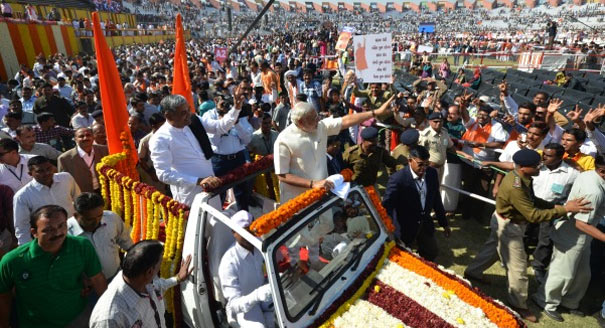
Narendra Modi may have trouble hanging on to the support of the middle class if the Bharatiya Janata Party does not crack down on corruption in its ranks.
Source: Indian Express
In December, Narendra Modi won the Gujarat election with the support, not only of the middle class, but also of what the state BJP called the "neo-middle class'' in its manifesto. According to the CSDS pre-electoral survey, not only did 57.4 percent of the richest voters go the BJP way, but 54.2 percent of the middle income bracket voters also did the same (against 28 and 34.4 percent for the Congress respectively — which got the vote of the poor). This neo-middle class is made of aspiring groups that tend to change their political color after migrating to an urban milieu. The shift is particularly striking in the case of the OBCs: while the Kolis vote more for the Congress when they are in a rural context (53 percent), they move to the BJP the moment they join a semi urban constituency (that is, one with 25 to 75 percent of urban voters) — 65 percent of them do so. This shift is even more dramatic when the upwardly mobile OBCs end up in a city.
Rural constituencies of Gujarat are the only places where more voters support the Congress, while semi-urban and urban constituencies are almost fully behind the BJP. But the urban/rural divide is a proxy for class. What the above data shows is simply that caste identities — and caste-related political cultures — are submerged by class considerations when formerly rural groups come to the city, hoping to join the lower middle class. Their new ethos — or at least their aspirations — make them turn to Modi's BJP and its promise of jobs in the name of "development."
The propensity of the neo-middle class to support Modi's BJP in Gujarat can be easily explained without even factoring in the communal element (although it is arguably more developed in the urban context, notably because of recurring riots). The BJP of Gujarat simply paid more attention to the material interests of the urban middle class than to any other group, as is evident from its election manifesto. Among the relevant items of this carefully drafted document, one can cite the promise to construct 50 lakh houses, the increase of the age limit for entry into government jobs from 25 to 28, English medium schools, Rs 2,000 crore for flyovers and underpasses in cities, the building of mono rail in places other than Ahmedabad (where the project has already been planned) and insurance schemes. These are, typically, promises aiming at wooing the urban middle class.But there's no need to further scrutinize pre-electoral promises. The actual polarization of Gujarat's society speaks for itself. Modi's policy, over the last 10 years, has benefited the urban middle class more than anybody else. If Gujarat ranks only 11th out of 23 states in terms of the human development index, it's because groups in rural Gujarat continue to lag behind. Indeed, Gujarat is a case of social polarization with the new rich in the cities and most of the groups that are at the receiving end concentrated in the villages. There, the number of families below the poverty line has jumped from 23.39 lakh in 2000 to 30.49 lakh in July 2012, according to the rural development commissioner. Unsurprisingly, 9 lakh of the 11 lakh houses without electricity, according to the Gujarat 2011 census, are in rural areas. In terms of education, the excellent report of the NGO, Pratham, shows that rural Gujarat was lagging behind states like Haryana.
Dalits and Adivasis (11.3 and 16.5 percent of the state population, respectively) are particularly affected. For instance, the percentage of tribal underweight children (0-5 years old) is much higher in Gujarat than the tribal average at the national level (64.5 percent compared to 54.5 percent). The under-five mortality rate of tribal children is also much higher. Similarly, the percentage of Dalit participation in the NREGA program is three times less in Gujarat (7.83 percent) than in India at large (22.67 percent). In fact, development has meant socioeconomic polarization, because Gujarat is a typical case of growth without development for all. The Gujarat chapter of the India Human Development Report of 2011 concluded that "the high growth rate achieved by the state over the years has not percolated to the marginalized sections of society, particularly STs and SCs, to help improve their human development outcomes."
That the middle class cares only for its interests is fair enough. But over the last two years, it has seemed that it was more and more concerned by corruption and the criminalizaton of politics — evident from the Anna Hazare movement which, arguably, was driven by the middle class.
Here, the record of Gujarat suggests a paradox. In this state, the middle class supports the BJP government in spite of uneven indicators in terms of the rule of law and a number of tainted former members of the government on the radar screen of the judiciary. Today, five Gujarat-based police officials — including senior IPS officers — are behind bars, waiting for their trial in Mumbai. They've been accused of being responsible for at least one of the many alleged fake encounters that have taken place in the years 2003-2006 in Gujarat. The most famous of these cases are those regarding Sohrabuddin, his wife Kauser bi and their friend Tulsiram Prajapati.
The CBI, in its chargesheet, named Amit Shah, the then minister of state for home, as the kingpin of the conspiracy. He was arrested in 2010, spent over three months in jail and, while on bail, was not allowed to return to Gujarat, lest he interfere with the investigators. He came back two months before the last state elections, was re-elected and, by all accounts, has again become a close aide of the chief minister. Maya Kodnani, also a former member of the state government, has been convicted for involvement in the 2002 violence in Ahmedabad. The Supreme Court has ordered the transfer of several cases to Maharashtra "to preserve the integrity of the trial."
BJP president Rajnath Singh has not only inducted Narendra Modi into the party's apex decision-making bodies, the parliamentary board and central election committee, but he has also appointed Amit Shah as one of the general secretaries of the party. And among the new national council members from Gujarat, figures also Babubhai Katara, a former BJP MP from Dahod who had been arrested in 2007 for human trafficking and was suspended from the party.
In this context, L.K. Advani has lectured his colleagues to ensure that the BJP remained "a party with a difference." But was it because the middle class cares for political cleanliness?
Former Nonresident Scholar, South Asia Program
Jaffrelot’s core research focuses on theories of nationalism and democracy, mobilization of the lower castes and Dalits (ex-untouchables) in India, the Hindu nationalist movement, and ethnic conflicts in Pakistan.
Recent Work

Milan Vaishnav, Rahul Verma, Rukmini S., …
Christophe Jaffrelot
Carnegie India does not take institutional positions on public policy issues; the views represented herein are those of the author(s) and do not necessarily reflect the views of Carnegie, its staff, or its trustees.

This piece argues that the present Indian strategy, based on opportunistic diversification and utilization of limited strategic reserves, remains inadequate when confronting supply disruptions. It evaluates India’s options in the short, medium, and long terms.

Vrinda Sahai

India and the United States are close to concluding a Reciprocal Defense Procurement Agreement (RDPA) that will allow firms from the two countries to sell to each other’s defense establishments more easily. While this may not remedy the specific grievances both sides may have regarding larger bilateral issues, an RDPA could restore some momentum, following the trade deal announcement.

Konark Bhandari

On the last day of the India AI Impact Summit, India signed Pax Silica, a U.S.-led declaration seemingly focused on semiconductors. While India’s accession to the same was not entirely unforeseen, becoming a signatory nation this quickly was not on the cards either.
Konark Bhandari

On January 12, 2026, India's "workhorse," the Polar Satellite Launch Vehicle, experienced a consecutive mission failure for the first time in its history. This commentary explores the implications of this incident on India’s space sector and how India can effectively address issues stemming from the incident.

Tejas Bharadwaj
Connecting real-world AI use cases across sectors such as health, education, agriculture, and livelihoods can help policymakers, innovators, and institutions align around a shared goal. This article looks at a framework ensuring that AI works for everyone.
Shalini Kapoor, Tanvi Lall