

In The Media
John Judis
{
  "authors": [
    "John Judis"
  ],
  "type": "legacyinthemedia",
  "centerAffiliationAll": "",
  "centers": [
    "Carnegie Endowment for International Peace",
    "Malcolm H. Kerr Carnegie Middle East Center"
  ],
  "collections": [
    "Arab Awakening"
  ],
  "englishNewsletterAll": "",
  "nonEnglishNewsletterAll": "",
  "primaryCenter": "Carnegie Endowment for International Peace",
  "programAffiliation": "",
  "programs": [],
  "projects": [],
  "regions": [
    "North Africa",
    "Egypt"
  ],
  "topics": [
    "Political Reform",
    "Democracy",
    "Security"
  ]
}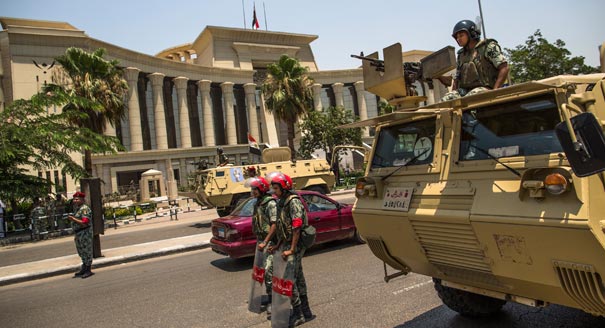
Source: Getty
Egypt today is struggling with two opposing narratives, which are driving the country toward a civil war or a military takeover.
Source: New Republic
Nathan Brown, a professor of political science at George Washington University, and an associate at the Carnegie Endowment for International Peace, is an expert on Egyptian politics. After spending a week last month in Egypt, he wrote up his impressions in Foreign Policy. Brown’s report, which appeared last week, anticipates the current crisis. Brown shows how Egypt today is taken up two opposing narratives, which are driving the country toward a civil war or a military takeover. Here is how Brown characterizes the two narratives:
Egyptian politics now seems to operate in two parallel universes. On the one side is a simple story of a president and ruling political party that suffered years of oppression but were finally rewarded by the Egyptian people for their endurance, dedication, and honesty. Endowed with clear democratic and constitutional legitimacy—and brought to power on the heels of a popular uprising that his movement helped lead—President Morsi suddenly faces an array of forces who wish to rewrite the rules of the political game in a blatant attempt to overthrow the express will of the people. Stopping at nothing (the opposition uses false charges, accepts foreign assistance, uses shrill and incendiary rhetoric, refuses dialogue, and does not even stop at violating common decency by demonstrating in underwear), a collection of rude youth, power-hungry secular politicians, old regime elements, and scheming security services have conspired to declare, in effect, that Egyptians must be called to the ballot box only on condition that they reject Islamists (and if they make a mistake, they must be summoned back again).On the other side is an equally simple story of a president who narrowly won office promising competence, inclusiveness, and conciliation but who delivered instead inflation, unemployment, power outages, fuel shortages, autocracy, sectarianism, and divisive rhetoric. Offering meaningless dialogues without the hint of concessions, his erstwhile allies have all abandoned him. And as the ranks of his critics have grown to the extent that they clearly have come to speak for the vast majority of Egyptians, the society has quite simply withdrawn confidence in him as president. Rather than following the text of a constitution that the president's party rammed through for its own purposes—a constitution that would force the country through three more years of deterioration and despair—Morsi should leave office now and allow the people to pick new leadership.
The entire essay is worth reading.

Former Visiting Scholar
As a visiting scholar at Carnegie, Judis wrote The Folly of Empire: What George W. Bush Could Learn from Theodore Roosevelt and Woodrow Wilson.
Recent Work
John Judis
John Judis
Carnegie India does not take institutional positions on public policy issues; the views represented herein are those of the author(s) and do not necessarily reflect the views of Carnegie, its staff, or its trustees.

In any defense establishment, change is an ongoing process. However, despite the best of intentions, existing bureaucracies, bound by habit and years of socialization, have their limits in implementing transformative change.

Anit Mukherjee

After the chill in ties between 2020 and 2024 that brought India–China relations to their lowest point in several decades, the two countries have engaged each other afresh. This paper argues that there are predominantly four imperatives guiding India’s approach to China, and they exist in an order of priority.

Saheb Singh Chadha

A partnership between India, a country of subcontinental size, and Africa, a continent of fifty-four countries, may seem asymmetric until one notes that both are home to nearly the same number of people—1.4 billion. This essay spells out the existing challenges to the partnership, its optimal potential, and the possible pathways to realize it over the next quarter-century.

Rajiv Bhatia

This piece argues that the present Indian strategy, based on opportunistic diversification and utilization of limited strategic reserves, remains inadequate when confronting supply disruptions. It evaluates India’s options in the short, medium, and long terms.

Vrinda Sahai

This piece examines India’s response to U.S. sanctions and tariffs, specifically assessing the immediate market consequences, such as alterations in import costs, and the broader strategic implications for India’s energy security and foreign policy orientation.
Vrinda Sahai