Source: India Abroad
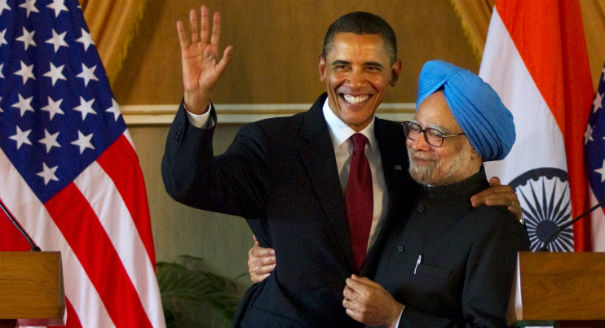
Dr. Manmohan Singh will come to Washington this month on what could be his last visit to the United States as India’s prime minister. When Singh came to Washington previously, he was feted as the first State guest welcomed by President Barack Obama. This time around, the pomp and circumstance will give way to the toils of a “working” visit. It cannot be otherwise—and it could not have come too soon.
Singh’s last visit to the United States in 2009 was undoubtedly a triumph. The Indian growth story then was a coruscating one, and U.S.-Indian commercial ties offered endless promise. The U.S.-Indian civil nuclear cooperation agreement had been successfully concluded and new access to nuclear technology worldwide lay on the horizon for the first time in close to forty years.
The bilateral relationship between the United States and India appeared destined for new heights, with the promise of deeper cooperation in defense, in international institutions, and on a range of global issues.
Today, the situation is markedly different on all counts. The Indian economy has tanked—ironically, at a time when it is led by an economist with the reputation of a reformer. India’s hard-won liberation into the world of nuclear commerce has been hamstrung by a new enslavement, thanks to its nuclear liability legislation.
And India’s relationship with the United States has faltered because of enervating political scandals in New Delhi; neglect and inattention at the highest levels; and, sometimes, deliberate Indian decisions to keep Washington at bay. In the United States, many policymakers have soured on India simply because it appears to be a difficult partner, unable to either appreciate or reciprocate the extra mile that Washington has often walked on its behalf during the last-odd decade.
In New Delhi, Indian leaders often appear chagrined by the United States as well, either because its regional policies towards China, Pakistan, and Afghanistan sometimes have a deleterious impact on India, or because of their perception that the Obama administration is fixated on demanding Indian recompense for past American favors.
These misaligned expectations have created a stasis in US-Indian relations, a reality that has provoked much commentary during the last few months. Manmohan Singh ought to do whatever he can to repair the damage not as a favor to Washington, but because it bears on his own personal legacy.
Ever since he took over as India’s 14th prime minister, Singh nurtured three challenging ambitions: To deepen the economic reforms he inaugurated at P.V. Narasimha Rao’s behest some thirteen years earlier and finally put India on the path of self-sustaining high growth; to effect a historic reconciliation with Pakistan that would unify the subcontinent once again as an economic entity; and to cement the extraordinary rapprochement with the United States that was begun by his predecessor Atal Bihari Vajpayee, whose bold initiatives laid the foundation for the civilian nuclear cooperation agreement that was finally clinched when Singh came into office.
It is indeed unfortunate that because of populist policies pursued by Singh’s own party — a disaster exacerbated by his own acquiescent temperament — his dream of liberating the Indian economy lies in tatters at just the moment when his government is running out of both time and options to repair the damage before it faces the electorate again.
His struggle to forge a new future with Pakistan too is flailing, but this time not for want of either vision or willingness on his part. Rather, the core problem lies in Islamabad—or, properly speaking, in Rawalpindi—where a still paranoid Pakistan army circumvents its civilian masters in setting national security policy, limiting the government’s ability to meaningfully improve ties with India.
Singh’s counterpart in Islamabad, Nawaz Sharif, shares his desire for a genuine rapprochement, but it is unlikely that he will be able to secure the army’s consent to any lasting peace with India before Singh ends his current term.
That leaves relations with the United States as the sole component of the original triumvirate that Singh can still repair in the hopes of salvaging an enduring legacy.
He will no doubt attempt to do so. If all goes well, he will announce the conclusion of an early works agreement between the Westinghouse Electric Company and the Nuclear Power Corporation of India, thus inaugurating the first fruits of the civilian nuclear agreement for American suppliers.
He could also disclose new Indian defense purchases from the United States, since several significant tenders are now wending their way to completion. The promise of defense co-development and co-production shepherded by Deputy Secretary of Defense Ashton Carter and Indian National Security Advisor Shivshankar Menon might also be consummated during this visit.
New commitments to bilateral cooperation in regard to multilateral trade, climate change, and energy could materialize as well. Other sundry initiatives will perhaps also come in tow.
While all such actions would indeed be welcome — and could breathe new life into what by rights should already be a vibrant relationship — one crucial fact risks going unnoticed. Singh’s 2014 visit to Washington is likely to mark the end of an era when personalities drove politics to forge the historical transformation in US-Indian relations.
From Vajpayee’s bold vision of India as a ‘natural ally’ of the United States; to its creative implementation by Jaswant Singh, L.K. Advani, and Brajesh Mishra in the National Democratic Alliance’s term in office; to Manmohan Singh’s singular effort at closing the civilian nuclear agreement, the sinews of partnership were forged by determined individuals who forced policy change well before their countrymen were truly ready.
They were matched at the American end by George W Bush’s fascination with Indian democracy, the demonic zeal of Robert D. Blackwill, the quiet radicalism of Condoleezza Rice and Philip Zelikow, and the constant tending first by Nicholas Burns and now by William J. Burns, who despite all the distractions of larger economic crises and other geopolitical firefights has implemented President Obama’s commitment to India at a time when New Delhi summons few allies in Washington.
The singular leadership that made a difference to advancing bilateral relations has been conspicuously absent in New Delhi during the last four years. In Washington, it hangs by a slender thread.
By itself, this eclipse of personality as a driving force for transformative change would not be fatal if it was adequately substituted by good policies that deepened the strategic partnership. The importance of such policies cannot be underestimated: They alone can enable structural change and provide the lasting effects that go beyond the actions of leaders, however important those may be.
The future of US-Indian ties now lies in the hands of the citizenry of both countries, who can cement the relationship only if they are enabled to engage in what Robert Nozick described as “capitalist acts between consenting adults.” There is no substitute for sensible policies that foster such an upsurge in private cooperation.
While the failures of the last few years on this count in New Delhi are lamentable, the good news is that Singh does not need to do anything special for the United States in order to rejuvenate the bilateral relationship. Doing right by India alone is sufficient for that purpose.
If he can prove wrong the legions of skeptics and show once more that he is capable of making difficult decisions, he could correct the present dystopia and restore U.S.-Indian ties to their previously upward trajectory to the benefit of both nations. This, however, will be hard.
Revitalizing bilateral relations requires, more than ever before, smart policies that return India to the path of high growth—precisely what Singh has been unable to implement during his second term. The electoral pressures coming in the next few months will make this task even more difficult. But if he makes a good faith effort even at this juncture, he will have gone some distance towards retrieving his legacy to show (with due credit to Bollywood) that Singh can still be King.