

Article
C. Raja Mohan, Darshana M. Baruah
{
  "authors": [
    "C. Raja Mohan"
  ],
  "type": "legacyinthemedia",
  "centerAffiliationAll": "dc",
  "centers": [
    "Carnegie Endowment for International Peace",
    "Carnegie India",
    "Malcolm H. Kerr Carnegie Middle East Center"
  ],
  "collections": [],
  "englishNewsletterAll": "ctw",
  "nonEnglishNewsletterAll": "",
  "primaryCenter": "Carnegie India",
  "programAffiliation": "SAP",
  "programs": [
    "South Asia"
  ],
  "projects": [],
  "regions": [
    "Egypt",
    "Gulf",
    "Levant",
    "Middle East",
    "North Africa",
    "Syria",
    "Saudi Arabia"
  ],
  "topics": [
    "Political Reform",
    "Security",
    "Military",
    "Foreign Policy",
    "Global Governance"
  ]
}
Source: Getty
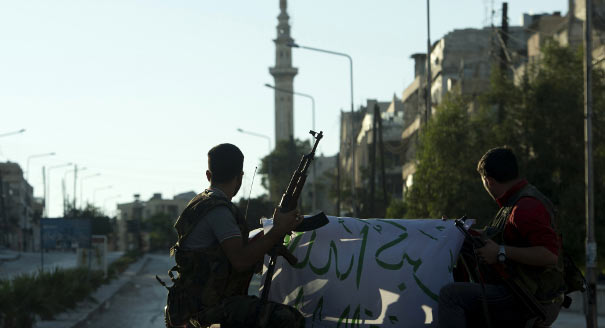
As Obama seeks support for a bombing campaign against Syria, the Arab League has held the Assad regime responsible for the use of chemical weapons and called for international action.
Source: Indian Express
As the U.S. President Barack Obama seeks domestic and international support for the planned bombing campaign against Syria, the Arab League has held the Bashar al Assad regime responsible for the use of chemical weapons and called for international action against Damascus.
At an urgently convened meeting of its foreign ministers in Cairo on Sunday, the 22- member Arab League urged "the UN and international community to take the deterrent and necessary measures against the culprits of this crime that the Syrian regime bears responsibility for." The League also demanded "the punishment and prosecution of all those involved in such a crime at international tribunals, to be tried similarly to those convicted of war crimes."Could the Arab League's apparent endorsement of the U.S. military action, currently on hold, provide the much needed international legitimacy for Obama's Syrian intervention? Recall that the Arab League's support was critical in 2011 when the U.S. and its allies intervened in Libya going way beyond what the United Nations Security Council had authorized.
But the Libyan case is vastly different from that of Syria. The maverick Libyan leader Muammar Gaddafi had few friends in the Arab League. Unlike Libya, Syria is a critical element of the regional balance of power in the Middle East.
On Syria, the League is deeply divided on both sectarian and geopolitical fault lines. Nor is the League neutral in Syria. The Arab League has already suspended the Assad regime and has seated the main opposition group, Syrian National Council in its place.
The Saudi foreign minister, Saud-al-Faisal made a strong pitch for international action against Damascus at a press conference before the Arab foreign ministers met in Cairo. He demanded that the international community act to prevent the "extermination of the Syrian people" by the Assad regime.
Since the civil war gripped Syria in 2011, the nation has become a major theatre for geopolitical contestation between Saudi Arabia and Iran. If Riyadh is angered by the Assad regime's crackdown against the Sunni majority in Syria, Tehran has become the main external supporters for Assad's ruling Alawite sect that is considered a branch of Shia Islam.
Iraq, where the Shia majority has been empowered by the U.S. invasion of 2003, has developed close ties to Iran and is reluctant to back international action against Damascus.
Cairo never had much political affection for Damascus or Tehran, but is unwilling to endorse Western intervention in Syria. As Egypt copes with its own current internal crisis, it has no desire to legitimize Western interference in the internal affairs of Middle Eastern states. At the same time Cairo does not want to oppose the Saudi Arabia which has become Cairo's major international backer after the army's ouster of President Mohamed Mursi last July.
Egypt is looking for a middle path. It is calling for an international effort to end the Syrian civil war through negotiations between the warring parties and its diplomats ensured that the Arab League resolution avoids any reference to direct military action against Syria.
This article was originally published in the Indian Express.
Former Nonresident Senior Fellow, Carnegie India
A leading analyst of India’s foreign policy, Mohan is also an expert on South Asian security, great-power relations in Asia, and arms control.
Recent Work

C. Raja Mohan, Darshana M. Baruah


Alexander Gabuev, Paul Haenle, C. Raja Mohan, …
Carnegie India does not take institutional positions on public policy issues; the views represented herein are those of the author(s) and do not necessarily reflect the views of Carnegie, its staff, or its trustees.

In any defense establishment, change is an ongoing process. However, despite the best of intentions, existing bureaucracies, bound by habit and years of socialization, have their limits in implementing transformative change.

Anit Mukherjee

After the chill in ties between 2020 and 2024 that brought India–China relations to their lowest point in several decades, the two countries have engaged each other afresh. This paper argues that there are predominantly four imperatives guiding India’s approach to China, and they exist in an order of priority.

Saheb Singh Chadha

This piece argues that India’s central challenge is not managing a single flashpoint but resolving the underlying tension between expansion and institutional coherency of the BRICS grouping.

Vrinda Sahai

A partnership between India, a country of subcontinental size, and Africa, a continent of fifty-four countries, may seem asymmetric until one notes that both are home to nearly the same number of people—1.4 billion. This essay spells out the existing challenges to the partnership, its optimal potential, and the possible pathways to realize it over the next quarter-century.

Rajiv Bhatia

The India–EU Free Trade Agreement (FTA) is shaping up to be one of the most consequential trade negotiations, both economically and strategically. But, what’s in the agreement, what’s missing, and what will determine its success in the years ahead
Vrinda Sahai, Nicolas Köhler-Suzuki