

Report
- +3
James M. Acton, Alexey Arbatov, Vladimir Dvorkin, …
{
  "authors": [
    "Petr Topychkanov"
  ],
  "type": "commentary",
  "centerAffiliationAll": "",
  "centers": [
    "Carnegie Endowment for International Peace",
    "Carnegie Russia Eurasia Center"
  ],
  "collections": [],
  "englishNewsletterAll": "",
  "nonEnglishNewsletterAll": "",
  "primaryCenter": "Carnegie Russia Eurasia Center",
  "programAffiliation": "",
  "programs": [],
  "projects": [
    "Eurasia in Transition"
  ],
  "regions": [
    "South Asia",
    "India",
    "Pakistan"
  ],
  "topics": [
    "Nuclear Policy",
    "Arms Control"
  ]
}
Source: Getty
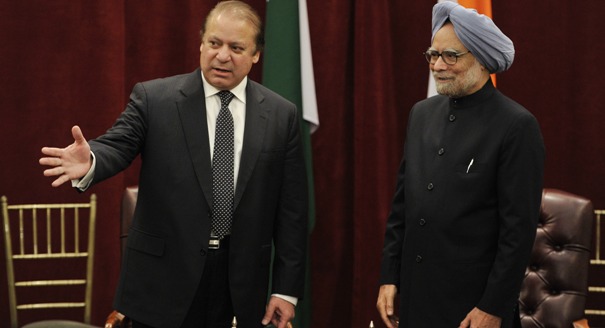
After 1998 nuclear tests, India and Pakistan experienced several crises, including the 1999, 2002, and 2008 events. They have already agreed on some confidence-building measures, though unverified. Do India and Pakistan need a more dangerous crisis to start arms control talks and negotiations on verification mechanisms?
From September 30 till October 1, there was a Conference in Brussels of the EU Non-Proliferation Consortium, which can be described as the main venue in this field in Western Europe. South Asia was one of the regions discussed very often at the conference. Besides a special session dedicated to this region, there India and Pakistan were mentioned at its every other session as well.
It was not the first time that I attended an international nonproliferation conference which paid serious attention to South Asia. At every single of these events, experts from India and Pakistan argued that their countries' case is very special. They are not the Soviet Union or the United States of the Cold War time. They differ from the cases of North Korea and Iran. Their main controversies are legal (non-NPT states), political (disputed territory of Kashmir), and security-related (trans-border terrorism).
It is difficult to disagree with the unwillingness of experts from India and Pakistan to compare their countries with other cases (generally speaking, comparative studies are not very often both well-based and fruitful).
Yet in the nuclear field India and Pakistan can hardly be regarded as pioneers. They were not the first to invent nuclear deterrence and strategic stability. It was not these countries that first exercised ambiguity and cheating in relations with their rivals. Before India and Pakistan other countries had felt a destabilizing effect of tactical and cruise missiles armed with nuclear warheads. India and Pakistan are not the first to resist verified confidence-building measures (CBMs) and arms control, explaining their positions by inappropriate political conditions and the existing risks of compromising national security.
USSR/Russia, United States, and other nuclear states have already experienced all these policies, many elements of which were present even before nuclear weapons were created. Their experience demonstrated that without verified CBMs and arms control these policies can lead to a catastrophe. That is why several crises made these countries start negotiations on verified CBMs and arms control between USSR/Russia and the United States, and in Europe.
After 1998 nuclear tests, India and Pakistan experienced several crises, including the 1999, 2002, and 2008 events. They have already agreed on some CBMs, though unverified. Do India and Pakistan need a more dangerous crisis to start arms control talks and negotiations on verification mechanisms?
It would not be wise to advise India and Pakistan to learn Cold War lessons. They know these lessons very well, which is evident from a number of serious studies on nuclear issues published in India and Pakistan. It would also be a mistake to deny the particularities of these two countries. Yet India and Pakistan are special rather as states than as nuclear-weapons states. In the nuclear weapons field, they do not really differ a lot from other nuclear-weapons state, despite their non-NPT status.
Former Fellow, Nonproliferation Program, Moscow Center
Topychkanov was a fellow in the Carnegie Moscow Center’s Nonproliferation Program.
Recent Work


James M. Acton, Alexey Arbatov, Vladimir Dvorkin, …
Petr Topychkanov
Carnegie India does not take institutional positions on public policy issues; the views represented herein are those of the author(s) and do not necessarily reflect the views of Carnegie, its staff, or its trustees.

In any defense establishment, change is an ongoing process. However, despite the best of intentions, existing bureaucracies, bound by habit and years of socialization, have their limits in implementing transformative change.

Anit Mukherjee
As AI grows more sophisticated, as the supply chains that power it become more contested, and as access to frontier models becomes geopolitically charged, India must begin to ask a different set of questions. Not what applications it can build on someone else’s infrastructure but what the world needs.

Konark Bhandari

The Indian Ocean Region hosts one of the densest concentrations of subsea cables in the world. Yet, despite accounting for a significant share of global internet traffic, India’s participation remains limited.

Charukeshi Bhatt

How is AI reshaping space security, creating governance challenges, and where does international diplomacy stand today?


Tejas Bharadwaj, Almudena Azcárate Ortega

After the chill in ties between 2020 and 2024 that brought India–China relations to their lowest point in several decades, the two countries have engaged each other afresh. This paper argues that there are predominantly four imperatives guiding India’s approach to China, and they exist in an order of priority.

Saheb Singh Chadha